Posted on — Leave a comment

Is prompt engineering real AI development, or just good documentation?

I’ve heard both answers from people I respect. One senior engineer told me prompt engineering is “writing a very long comment and hoping.” A teammate who ships LLM features for a living told me it’s the highest-leverage skill in AI development right now. After building a fair number of LLM-powered features, I think they’re both partly right, and the useful question is when each one is true.

The case for “it’s just documentation”

A good prompt looks a lot like good documentation. It states the goal, defines terms, gives examples, lists edge cases, and says what the output should look like. If you’ve ever written a clear README or onboarding doc, you already know most of the craft.

There’s also no compiler. You can’t unit test a sentence the way you test a function. The same prompt can give different results on different days, and “it works on my five examples” tells you almost nothing. If your prompt engineering is rewording until the demo looks good, then yes, that’s editing, not engineering.

The case for “it’s real AI development”

The moment you add evaluation, the picture changes. Real prompt engineering looks like this:

  • A test set of real inputs, including the ugly ones
  • A scoring method, whether human review, rules, or a model-as-judge
  • Versioned prompts, so you can see which change helped and which broke something
  • Regression checks every time the prompt or the underlying model changes
  • Decisions about where a prompt should stop and code, retrieval, or fine-tuning should start

That isn’t documentation. It’s an engineering loop that happens to use natural language as the interface. The prompt is a component with inputs, outputs, failure modes, and a maintenance cost.

Where I land

Here’s my rough test: If you can’t tell me whether your last prompt change made things better or worse, you’re doing documentation. If you can, with numbers, you’re doing development.

The word “prompt” isn’t what separates the two. Measurement is. A prompt without evals is a guess with good grammar. A prompt with evals, versioning, and clear ownership is a real part of your system.

Also Read: To become better at prompt engineering, learn how to think like a manager

What I’d tell a team starting out

  • Write the prompt like a spec first. Clarity is half the work.
  • Build 20-50 real test cases before you tune anything. Otherwise you’re optimising for your own taste.
  • Track every prompt change like a code change. If it’s not in version control, it doesn’t exist.
  • Know when to stop prompting. Some problems need retrieval, tools, or plain old code, not another paragraph of instructions.
  • Re-run your tests when the model updates. Prompts are tied to the model they were written for.

The uncomfortable part

If prompt engineering is “real” development, then a lot of AI projects have been shipping without anyone doing development. They have impressive demos and no tests.

If it’s “just documentation,” then the people getting reliable results are doing something else on top of it that we haven’t named yet. I suspect that’s the answer: the prompt is the visible tip, and the engineering is the eval and iteration process underneath.

Your turn

Where do you draw the line? Have you shipped a prompt-heavy feature to production, and what was the thing that actually made it reliable? I’d especially like to hear from people who think I’m wrong.

—

Editor’s note: e27 aims to foster thought leadership by publishing views from the community. You can also share your perspective by submitting an article, video, podcast, or infographic.

The views expressed in this article are those of the author and do not necessarily reflect the official policy or position of e27.

Join us on WhatsApp, Instagram, Facebook, X, and LinkedIn to stay connected.

The post Is prompt engineering real AI development, or just good documentation? appeared first on e27.

Posted on — Leave a comment

The hidden economics of returns in Southeast Asian e-commerce

A customer orders a product online, receives it and requests a refund. From the buyer’s perspective, the process may involve a few taps and a parcel handed to a courier. For the merchant, it can initiate a second supply chain involving transportation, inspection, reimbursement, inventory recovery and additional administrative work.

This matters in Southeast Asia, where e-commerce gross merchandise value is projected to reach US$226 billion in 2026, according to the latest Google, Temasek and Bain e-Conomy SEA report. While marketplaces compete to make purchasing easier, retailers must also manage the economics of transactions that do not become completed sales.

Returns are therefore more than a customer-service expense. They represent a commercial commitment whose actual cost depends on product margins, logistics infrastructure, payment arrangements and the ability to recover inventory value.

The refund is only the visible part of the financial loss

A conventional order-level profitability calculation subtracts product costs, marketplace commissions, payment fees, fulfilment expenses and customer acquisition costs from retained revenue. Once an order is returned, however, several additional expenses enter the calculation.

The original shipment may already have consumed transportation and packaging resources. The merchant may then incur collection charges, inspection costs, repackaging expenses and customer-service work. Depending on marketplace rules and contractual arrangements, some commissions and payment fees may be reversed while others remain payable. The financial burden can also be distributed differently between the merchant, platform and logistics provider.

Consider a hypothetical retailer earning US$5 in contribution margin on a successfully completed order but losing US$9 when an order is returned, after accounting for recoverable inventory value and processing costs. At a 10 per cent return rate, expected contribution is US$3.60 per order. At 25 per cent, it falls to US$1.50. These figures are illustrative rather than regional estimates, but they demonstrate how return frequency affects profitability.

The important measurement is expected contribution across retained and returned transactions. Refunds should not be counted twice by treating reversed sales revenue and the refund itself as separate losses. Equally, recovered inventory should not automatically be valued as though it were ready for immediate resale.

Also Read: The invisible shopper rewriting Asia’s e-commerce playbook 

Southeast Asia does not operate through one logistics model

The economic consequences of a return vary substantially across regional markets. Recovering a parcel within Singapore’s dense urban environment is different from collecting one across Indonesia’s islands or from a remote Philippine location. Transportation distances, carrier networks, consolidation capacity and warehouse accessibility influence the cost of moving goods backward.

Payment arrangements introduce another distinction. Cash-on-delivery transactions can generate failed deliveries when customers refuse parcels before payment, leaving the operator with transportation costs but no completed sale. These incidents differ from returns initiated after receiving and paying for merchandise. Although cash on delivery is declining across Southeast Asia, its continued relevance differs between countries, making a single regional assumption inappropriate.

Cross-border commerce creates additional complexity. An inexpensive product may be profitable to ship internationally through consolidated outbound deliveries but uneconomical to return individually. Depending on product value, contractual conditions and applicable consumer protections, a merchant might choose local resale, liquidation, replacement or a refund without physical recovery.

The cheapest logistical option is not necessarily the most profitable. A retailer must compare transportation costs with recoverable product value, inventory availability and the operational consequences of each alternative. Reverse logistics should consequently be designed around product characteristics and destination markets rather than treated as a simple reversal of outbound delivery.

Recovering the product does not mean recovering its value

Returned merchandise must be inspected before its economic value can be determined. An unopened product may qualify for immediate resale, while another requires repackaging, refurbishment or a substantial discount. Some products cannot be sold again under their original commercial conditions.

These differences become particularly important across categories. Apparel may require condition checks and repackaging. Consumer electronics can involve functionality testing, warranty assessment and potential depreciation. Damaged or hygiene-sensitive products may retain little recoverable value despite the cost of transporting them back.

Time also affects profitability. Merchandise undergoing collection and inspection remains unavailable for sale, potentially creating inventory shortages even when returned stock physically exists elsewhere in the network. Seasonal products and rapidly depreciating items may lose value while operators decide how to process them. Refunds can additionally create a working-capital gap before any resale proceeds are received.

An effective recovery decision therefore compares the net proceeds available through different channels. Returning an inexpensive item to a central warehouse may cost more than selling it through a local liquidation partner. Refund-without-return arrangements can sometimes reduce expenses, but poorly controlled policies also introduce fraud risks, inventory discrepancies and avoidable waste.

The objective is not to recover every parcel. It is to determine which recovery process preserves the greatest economic value after all associated costs.

Also Read: Profitable e-commerce: Making real money in the new year

Return policies influence conversion as well as profitability

Restricting returns may appear attractive when reverse-logistics expenses rise. However, a return policy also influences purchasing behaviour. Customers buying unfamiliar products cannot physically examine them before payment, making the possibility of a refund part of the perceived security of the transaction.

Research published in the American Economic Journal: Microeconomics in 2024 examines this tension between the costs generated by returns and the efficiency gained when consumers can evaluate products after purchase. From a retailer’s perspective, a generous policy can therefore produce benefits through greater willingness to buy, even while increasing operational expenses.

The commercial calculation must account for both effects. Reducing return eligibility could lower processing costs while discouraging customers whose purchases depend on reassurance. Conversely, making every return exceptionally convenient may increase conversion without generating sufficient additional contribution to cover the resulting expenses.

Preventing avoidable returns can be more effective than introducing blanket restrictions. Accurate sizing information, realistic product images, technical compatibility details and stronger seller-quality controls address causes of dissatisfaction before an order is placed. Policies should distinguish legitimate product defects from preference-based returns while respecting consumer rights and marketplace obligations.

The question is not simply whether returns should be free. It is whether the purchasing confidence generated by a particular policy creates enough additional economic value to justify its complete cost.

Profitability must be measured after the reverse journey

Managing these economics requires connecting information that frequently sits in separate operational systems. Order records identify the original sale, payment systems record settlements, logistics providers track movements, and warehouse systems establish whether returned merchandise can be resold.

Retailers need a consistent view of these events. Return rates should distinguish items returned after delivery from failed deliveries and cancellations, with clearly defined denominators. Recovery value, time to refund, processing expenses and contribution margin should be analysed by product category, sales channel, carrier and destination.

This creates a more useful basis for evaluating marketplace relationships. The organisation deciding how attractive a return policy should appear is not necessarily the organisation financing its execution. Shipping subsidies, seller-liability rules and reimbursement arrangements can create different economic incentives across the same transaction.

For sellers, understanding this allocation is essential when deciding whether a channel remains profitable. For marketplaces, it helps identify situations where additional purchasing convenience generates costs elsewhere in the network.

The underlying challenge is not to make returns difficult for customers or to eliminate them indiscriminately. It is to build a system capable of providing reliable remedies while recovering inventory value efficiently and maintaining sustainable margins.

Southeast Asian e-commerce has developed increasingly sophisticated capabilities for attracting customers and delivering products. Its next profitability challenge also lies in understanding what happens when those products travel in the opposite direction. Growth measured through merchandise value tells only part of the story. The economic result emerges after the entire transaction, including the possibility of its reversal, has been accounted for.

—

Editor’s note: e27 aims to foster thought leadership by publishing views from the community. You can also share your perspective by submitting an article, video, podcast, or infographic.

The views expressed in this article are those of the author and do not necessarily reflect the official policy or position of e27.

Join us on WhatsApp, Instagram, Facebook, X, and LinkedIn to stay connected.

The post The hidden economics of returns in Southeast Asian e-commerce appeared first on e27.

Posted on — Leave a comment

Meta wants to teach Singapore’s small businesses AI. It also wants them on WhatsApp

SpeakEasy Lab is a two-person communication training business in Singapore, which means that when both founders are teaching, nobody is answering customers. Nobody human, at least. Routine enquiries that once waited an hour or more now get near-instant replies from Meta Business Agent, an AI agent running on WhatsApp and Messenger. The founders reckon it saves them 10 to 15 working hours a week.

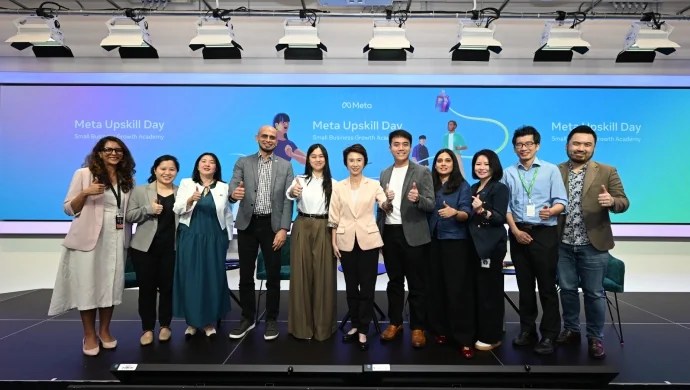
That anecdote took centre stage at Meta Upskill Day 2026, where the social media giant gathered more than 180 small businesses, heartland merchants and creator-entrepreneurs in Singapore for hands-on training on its AI tools. Senior Minister of State Low Yen Ling attended as Guest of Honour. The event forms part of Meta’s Small Business Growth Academy.

Also Read: Malaysian SMEs grapple with a growing “confidence gap” in AI adoption

Meta’s pitch is that Singapore’s small firms want to use AI but do not know how. The more interesting question is whose AI they end up learning.

A Meta survey finds small businesses need Meta’s help

The case rests on new YouGov research commissioned by Meta. It found that 94 per cent of Singapore small business owners surveyed agree small businesses need more guidance to get the full benefit of AI. Among those whose businesses have used AI, 82 per cent report a positive productivity impact over the past 12 months, and 62 per cent of that group say they spend the time saved improving existing work.

The numbers deserve a pinch of salt. YouGov polled 3,983 owners across nine markets, from Australia to Japan, between 6 August and 2 September 2026, without disclosing how many were in Singapore. Its own methodology note says the findings are not nationally representative, and that differences between markets may partly reflect translation and local response habits. A platform commissioning research that concludes small businesses need guidance, then supplying the guidance, is less a conflict of interest than a business model.

Still, the direction matches what e27 has heard elsewhere. Singapore SMEs are buying back time with AI, but messy data keeps many pilots stuck, and across the region, SMEs adopt AI four times slower than big business.

The chatbot is the easy part

Customer engagement is where Meta sees its clearest opening. Some 52 per cent of Singapore owners surveyed have used, or would be interested in using, AI-powered customer responses. The Business Agent masterclass walked participants through setting up agents to handle enquiries on WhatsApp and Messenger, with Meta’s business messaging specialists on hand.

For a micro-business that lives on chat messages, that is genuinely useful. But answering the question is rarely where the work ends. Bookings, invoices, refunds and stock checks still have to happen, and what an SME really needs is the work after the chat done. An agent that cannot reach a merchant’s calendar or inventory simply moves the bottleneck down the line.

Also Read: Meta, Singapore Police disrupt 3.7M scam-linked assets across Facebook and Instagram

There is a governance question too. Staff are already bringing their own AI to work, and an agent speaking for a business on WhatsApp becomes a liability the moment it quotes the wrong price or invents a refund policy. Meta’s announcement says little about how merchants should check what their agents tell customers.

Dream Render walks into a crowded edit suite

Meta also used the event to introduce Dream Render, a browser-based tool that turns a short product description or photo into a draft product video in minutes. Users can adjust shots, framing, pacing, voiceover and on-screen text before approving the final cut, which they download and publish themselves with a label showing it was made with AI. Sign-in runs through an existing Facebook page or Instagram professional account.

The demand is there: 46 per cent of owners surveyed said AI training for marketing and content creation would be useful. Haldy, a Singaporean maker of sugar-free turmeric mints, credits the tool with quickly building its social media presence.

Meta is hardly first to this, though. ByteDance’s CapCut and Canva already put AI video generation in front of the same merchants, and Google, Microsoft and TikTok run their own skilling drives for Singapore’s small businesses. Meta’s edge is distribution: the video gets made next to where the ad will run. The recent appointment of Dhruv Vohra to lead its Southeast Asia business, framed around AI and chat commerce, and the arrival of Meta’s Muse in Singaporesuggest a wider AI stack is being built around exactly these users.

Training, or onboarding?

Since launching in Singapore in 2021, Upskill with Meta says it has trained more than 500 small businesses and upskilled over 4,500 entrepreneurs, working with Digital Industry Singapore, AI Singapore, Enterprise Singapore and the Economic Development Board. This year’s edition also plugs into EnterpriseSG’s partnership with the Heartland Enterprise Centre Singapore, whose business advisers are being equipped to pass AI tools on to neighbourhood merchants.

The fit with the National AI Strategy and the National AI Impact Programme is real, and practical training beats another glossy keynote. But 500 businesses in five years is a rounding error against Singapore’s roughly 300,000 SMEs, and the curriculum is built entirely on Meta’s own products.

Also Read: AI-powered business automation: How SMEs are transforming operations in Southeast Asia

For a heartland merchant, free training that saves 10 hours a week is a good deal. The catch is that skills learnt inside one platform’s tools tend to keep a business on that platform, which is worth weighing alongside subsidies such as the EDGE Grant that let SMEs shop around for software. Meta is not wrong that small businesses need guidance on AI. It just happens to be the one selling the map.

The post Meta wants to teach Singapore’s small businesses AI. It also wants them on WhatsApp appeared first on e27.

Posted on — Leave a comment

AI is changing how we learn, work and invest. Venture capital must change too

I recently started one of my lectures at Nanyang Technological University (NTU) in Singapore by asking students to think about how education has changed over the past 30 years.

When I was studying engineering at university, there was no internet. Information was difficult to access. We spent hours in libraries, reading textbooks, taking notes and memorising facts. Having knowledge was valuable because finding information required considerable effort.

Years later, when I did my MBA, the internet had changed everything. Information was suddenly available to almost everyone. We no longer needed to spend so much time looking for facts. The real challenge was understanding that information, interpreting it and applying it to business problems.

Today, we are entering a third stage. With AI, students can access information and analysis, explanations and proposed solutions. They can ask AI to develop a business plan, analyse a company, build a financial model or explain a complex technology. Tasks that previously took days can now be completed in minutes.

I believe education must focus much more on understanding principles, learning methods and developing judgement. Students still need to understand how businesses operate, how scientific discoveries become commercial products, how financial models work and why some companies succeed while others fail. Memorising large amounts of information is becoming less important.

The challenge is learning how to ask the right questions, challenge the answers and apply knowledge to real situations. This is why experience becomes particularly valuable. In my VC lectures, I use real investment cases, including successful investments and companies that ultimately failed. Students can ask AI to analyse these companies, but understanding why investors made certain decisions, what information was available at the time and what went wrong is a different matter. Learning from people who have actually made these decisions, including mistakes, is becoming an increasingly important part of education.

AI is turning venture capital upside down

I see a similar transformation happening in venture capital, where I have spent over 10 years. Traditionally, when a VC firm received a pitch deck, a junior analyst would review the startup, research the market, examine competitors, check financial assumptions and prepare an initial investment assessment.

Today, one of the first things many investors do is to upload a pitch deck to an AI tool and ask it to identify strengths, weaknesses, inconsistencies and potential red flags. AI can review a company’s business model, challenge its market assumptions, compare competitors and identify gaps in its financial projections within minutes. I use AI for this type of initial analysis. It is particularly useful for identifying questions that deserve further investigation.

Also Read: Singapore is paying startups to secure the AI agents it is racing to deploy

There are some limitations. AI can identify that a company’s revenue assumptions look aggressive. It cannot reliably tell whether the founder has the ability to deliver them. It can compare technologies, but cannot assess the quality of a management team or the strength of relationships with customers. It could also be wrong, especially when information is incomplete or when analysing technologies that are still being developed, which is exactly the case for most of the tech startups.

This is why I see AI as a good assistant and not as a decision maker. The implications for VC firms are important. Traditionally, investment teams have operated like pyramids, with many junior analysts doing research and a smaller number of senior professionals making investment decisions.

AI is turning this pyramid upside down. Firms may need far fewer junior analysts performing routine research, while relying more heavily on experienced investors who can interpret findings, challenge assumptions, build relationships and make decisions. In other words, AI reduces the cost of analysis but increases the relative value of judgement.

Making money from AI is harder than using it

AI is creating enormous investment opportunities, and also creating challenges for VC investors. Almost every startup today claims to use AI. Many are building applications around existing LLMs, adding industry-specific features or improving workflows. Some of these businesses will become successful, but many face a fundamental problem: their technology is relatively easy to replace.

If a company builds a product around an existing AI model, nothing prevents another company from building something similar or the model provider from introducing the same functionality directly. This makes it difficult to identify which companies can build lasting competitive advantages. I believe some of the most attractive opportunities are in solving the bottlenecks that limit AI development and adoption.

Also Read: Open code, unowned risk: The governance gap in business-critical email

One example is Positron AI, a company developing specialised hardware for AI inference. As AI applications expand, the cost of running models becomes increasingly important. The industry needs more computing capacity, better energy efficiency and lower costs. Positron is addressing these challenges through hardware designed specifically for AI inference workloads.

Its rapid increase in valuation illustrates investor demand for technologies addressing fundamental AI infrastructure problems. Positron raised capital at a valuation of approximately US$1 billion in February 2026, followed by a September financing round at a valuation of US$5 billion, a fivefold increase in seven months.

It is not alone. In July, fellow inference chipmaker Etched raised US$300 million at a US$10.3 billion valuation, while SambaNova raised US$1 billion at a US$11 billion valuation. Of course, a rising valuation does not guarantee investment returns. The company still needs to execute, compete and deliver commercial results.

These examples highlight an important distinction between building another AI application and developing technology that addresses a major constraint on the industry’s growth. For venture capital investors, understanding this distinction is critical. The biggest opportunities may not come from companies that simply use AI, but from those making AI faster, cheaper, more efficient and more widely available.

The next generation of venture capital

I believe that AI is here to stay, and its impact will be much greater than simply improving productivity. It is changing what students need to learn, how professionals work and where investors should look for opportunities. For universities, the priority should increasingly be teaching principles, practical methods and critical thinking supported by real-world experience. For VC firms, AI will make research and initial analysis faster and cheaper.

Successful investing will depend on understanding technology, recognising exceptional founders and making difficult decisions under uncertainty. As for investors looking to benefit from the AI revolution, the challenge is separating companies with sustainable competitive advantages from those simply adding AI to existing products.

AI will not make everyone a successful investor, just as the internet did not make everyone a successful entrepreneur. Those who learn to use AI efficiently, while developing the experience and judgement to challenge its conclusions, will have a significant advantage. Venture capital spent years investing in companies that disrupt traditional industries.

Now it is time for VC firms to rethink their own business models.

—

Editor’s note: e27 aims to foster thought leadership by publishing views from the community. You can also share your perspective by submitting an article, video, podcast, or infographic.

The views expressed in this article are those of the author and do not necessarily reflect the official policy or position of e27.

Join us on WhatsApp, Instagram, Facebook, X, and LinkedIn to stay connected.

The post AI is changing how we learn, work and invest. Venture capital must change too appeared first on e27.

Posted on — Leave a comment

Beyond the chatbot: How AI is reshaping customer service in Southeast Asia

A football fan in Bangkok wants to know which streaming package carries tonight’s match. Kick-off is approaching, and the answer is buried somewhere on the provider’s website.

For the customer, a delayed response is frustrating. For the streaming company, it could mean a missed subscription.

Multiply that interaction by thousands of customers, several languages and a growing number of communication channels, and the appeal of AI-powered customer service becomes clear.

Across Southeast Asia, businesses are introducing AI into their support operations. The technology is beginning to handle work previously reserved for employees, from retrieving account information to guiding customers through transactions.

The problem with fragmented communication

Customer service in Southeast Asia has its own complications. LINE is widely used in Thailand, WhatsApp in Indonesia and Malaysia, and Zalo in Vietnam. Businesses must also contend with email, telephone calls and social media messages.

For companies operating across several markets, managing these channels can be cumbersome. Customer information is scattered across systems, conversations lose context and employees spend time piecing together what happened during previous interactions.

Customers frequently end up repeating themselves.

According to Ipsos’ 2026 customer experience research in Thailand, only 35 per cent of customer issues were fully resolved. The study also found that 70 per cent of consumers felt they shared roughly equal responsibility with brands for the effort involved in resolving problems.

These findings suggest that digitalisation has yet to deliver the simplicity customers expect.

Also Read: Is prompt engineering real AI development, or just good documentation?

What AI can do differently

Traditional chatbots were built around predefined responses. They could answer common questions, direct customers to relevant information and escalate more complicated requests.

Recent advances in AI have expanded what can be automated.

When connected to a company’s internal systems, AI agents can retrieve account details, arrange appointments, initiate requests and assist with transactions. Their usefulness increasingly depends on what they can accomplish rather than how convincingly they can hold a conversation.

Customer expectations appear to be changing accordingly.

A July 2026 Gartner survey of 3,566 customers found that 58 per cent of those using generative AI had used it to complete a task. Among business customers, the figure reached 74 per cent.

The potential extends beyond answering enquiries. A customer asking about a delayed delivery may want the problem resolved. Someone checking the availability of a streaming package may be ready to purchase it.

In both cases, the quality of service depends on what happens after the initial response.

One example from Thailand

Thailand’s streaming service TrueVisions NOW provides an example of how this technology is being put to work.

The company has deployed an AI customer service agent built on klink.cloud, a platform that brings telephone, email, WhatsApp, LINE and other communication channels into a shared environment.

In an August 2026 case study, Klink describes how TrueVisions NOW introduced the agent to answer questions about sporting events, programme availability and subscription packages in Thai and English.

According to Klink, the proportion of enquiries resolved by AI rose from 50 per cent in the first week to 67 per cent by the fourth. Median reply times fell to approximately five seconds, while abandoned conversations decreased by more than half. These are the vendor’s own figures, and they measure speed rather than whether problems stayed solved.

Beyond those efficiency gains, the deployment highlights an interesting commercial opportunity.

A subscriber asking whether a particular football match is available might simply need information. Another may be comparing subscription packages before purchasing. A third could be having trouble accessing content already paid for.

Recognising these different intentions allows the system to respond accordingly. The agent can also recommend subscription packages based on the content customers are looking for, bringing product discovery and sales into the customer service conversation.

For subscription-based businesses, particularly those experiencing sudden peaks in demand around live events, this combination of immediate assistance and relevant recommendations offers practical advantages.

It also suggests that the traditional boundaries between customer support, sales and operations are becoming less distinct.

Also Read: What’s actually changing for Asia Pacific businesses in the age of AI

Automation has its limits

The commercial case for AI customer service is still developing.

Reducing response times and increasing the number of automated conversations can improve operating efficiency. Yet businesses must also consider whether customers are receiving better service.

Financial returns across the industry remain uneven. Gartner reported in July 2026 that only 24 per cent of surveyed service and support leaders had demonstrated positive financial returns across their AI use cases.

Customer confidence presents another challenge. In a separate August 2026 Gartner survey, 87 per cent of respondents said access to a human agent was essential when businesses used generative AI for customer service.

There are practical reasons for that preference. AI systems can misunderstand requests, provide inaccurate information or struggle with unusual circumstances. Giving them access to customer records and transaction systems also introduces privacy and security considerations.

Businesses must decide which requests can be handled automatically, which require human approval and how customers can reach an employee when something goes wrong.

The numbers that matter

For startups operating in Southeast Asia, AI offers a way to provide multilingual support across several channels without hiring employees in direct proportion to customer growth.

The economics are attractive, particularly for businesses serving customers outside conventional office hours or dealing with unpredictable peaks in demand.

But the percentage of enquiries handled by AI tells only part of the story.

Companies also need to examine how often problems are resolved on the first attempt, whether customers return with the same issue, how much effort a transaction requires and whether service improvements affect retention or revenue.

For businesses considering similar deployments, the sensible starting point is to identify where customers encounter the most friction and determine whether AI can remove it reliably.

A five-second answer is impressive. A problem that stays solved is worth considerably more.

—

Editor’s note: e27 aims to foster thought leadership by publishing views from the community. You can also share your perspective by submitting an article, video, podcast, or infographic.

The views expressed in this article are those of the author and do not necessarily reflect the official policy or position of e27.

Join us on WhatsApp, Instagram, Facebook, X, and LinkedIn to stay connected.

The post Beyond the chatbot: How AI is reshaping customer service in Southeast Asia appeared first on e27.