
SpeakEasy Lab is a two-person communication training business in Singapore, which means that when both founders are teaching, nobody is answering customers. Nobody human, at least. Routine enquiries that once waited an hour or more now get near-instant replies from Meta Business Agent, an AI agent running on WhatsApp and Messenger. The founders reckon it saves them 10 to 15 working hours a week.
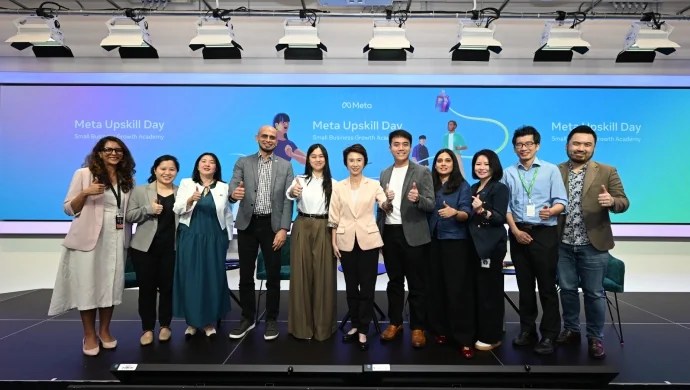
That anecdote took centre stage at Meta Upskill Day 2026, where the social media giant gathered more than 180 small businesses, heartland merchants and creator-entrepreneurs in Singapore for hands-on training on its AI tools. Senior Minister of State Low Yen Ling attended as Guest of Honour. The event forms part of Meta’s Small Business Growth Academy.
Also Read: Malaysian SMEs grapple with a growing “confidence gap” in AI adoption
Meta’s pitch is that Singapore’s small firms want to use AI but do not know how. The more interesting question is whose AI they end up learning.
A Meta survey finds small businesses need Meta’s help
The case rests on new YouGov research commissioned by Meta. It found that 94 per cent of Singapore small business owners surveyed agree small businesses need more guidance to get the full benefit of AI. Among those whose businesses have used AI, 82 per cent report a positive productivity impact over the past 12 months, and 62 per cent of that group say they spend the time saved improving existing work.
The numbers deserve a pinch of salt. YouGov polled 3,983 owners across nine markets, from Australia to Japan, between 6 August and 2 September 2026, without disclosing how many were in Singapore. Its own methodology note says the findings are not nationally representative, and that differences between markets may partly reflect translation and local response habits. A platform commissioning research that concludes small businesses need guidance, then supplying the guidance, is less a conflict of interest than a business model.
Still, the direction matches what e27 has heard elsewhere. Singapore SMEs are buying back time with AI, but messy data keeps many pilots stuck, and across the region, SMEs adopt AI four times slower than big business.
The chatbot is the easy part
Customer engagement is where Meta sees its clearest opening. Some 52 per cent of Singapore owners surveyed have used, or would be interested in using, AI-powered customer responses. The Business Agent masterclass walked participants through setting up agents to handle enquiries on WhatsApp and Messenger, with Meta’s business messaging specialists on hand.
For a micro-business that lives on chat messages, that is genuinely useful. But answering the question is rarely where the work ends. Bookings, invoices, refunds and stock checks still have to happen, and what an SME really needs is the work after the chat done. An agent that cannot reach a merchant’s calendar or inventory simply moves the bottleneck down the line.
Also Read: Meta, Singapore Police disrupt 3.7M scam-linked assets across Facebook and Instagram
There is a governance question too. Staff are already bringing their own AI to work, and an agent speaking for a business on WhatsApp becomes a liability the moment it quotes the wrong price or invents a refund policy. Meta’s announcement says little about how merchants should check what their agents tell customers.
Dream Render walks into a crowded edit suite
Meta also used the event to introduce Dream Render, a browser-based tool that turns a short product description or photo into a draft product video in minutes. Users can adjust shots, framing, pacing, voiceover and on-screen text before approving the final cut, which they download and publish themselves with a label showing it was made with AI. Sign-in runs through an existing Facebook page or Instagram professional account.
The demand is there: 46 per cent of owners surveyed said AI training for marketing and content creation would be useful. Haldy, a Singaporean maker of sugar-free turmeric mints, credits the tool with quickly building its social media presence.
Meta is hardly first to this, though. ByteDance’s CapCut and Canva already put AI video generation in front of the same merchants, and Google, Microsoft and TikTok run their own skilling drives for Singapore’s small businesses. Meta’s edge is distribution: the video gets made next to where the ad will run. The recent appointment of Dhruv Vohra to lead its Southeast Asia business, framed around AI and chat commerce, and the arrival of Meta’s Muse in Singaporesuggest a wider AI stack is being built around exactly these users.
Training, or onboarding?
Since launching in Singapore in 2021, Upskill with Meta says it has trained more than 500 small businesses and upskilled over 4,500 entrepreneurs, working with Digital Industry Singapore, AI Singapore, Enterprise Singapore and the Economic Development Board. This year’s edition also plugs into EnterpriseSG’s partnership with the Heartland Enterprise Centre Singapore, whose business advisers are being equipped to pass AI tools on to neighbourhood merchants.
The fit with the National AI Strategy and the National AI Impact Programme is real, and practical training beats another glossy keynote. But 500 businesses in five years is a rounding error against Singapore’s roughly 300,000 SMEs, and the curriculum is built entirely on Meta’s own products.
Also Read: AI-powered business automation: How SMEs are transforming operations in Southeast Asia
For a heartland merchant, free training that saves 10 hours a week is a good deal. The catch is that skills learnt inside one platform’s tools tend to keep a business on that platform, which is worth weighing alongside subsidies such as the EDGE Grant that let SMEs shop around for software. Meta is not wrong that small businesses need guidance on AI. It just happens to be the one selling the map.
The post Meta wants to teach Singapore’s small businesses AI. It also wants them on WhatsApp appeared first on e27.