Posted on

Former Lazada technology VP joins Carousell as CTO

Carousell continues the string of high profile hires with a new CTOworking in office e27

Fast-growing classifieds Carousell appointed Igor Volynskiy as CTO.

Taking over from Lucas Ngoo, Carousell’s co-founder who had been serving as CTO to date, Volynskiy will be responsible for developing Carousell’s technology capabilities, including engineering, data science, and analytics, product and design. Volynskiy will oversee all technology-related functions in Carousell and will report to co-founder and CEO, Siu Rui Quek.

Formerly, Volynskiy was Technology VP at Lazada and VP of Operations and Marketplace Technology at RedMart. He has over 20 years of experience in leading cross-functional organisations of software engineers, product managers, data scientists and industrial engineers to drive business results.

Also Read: Carousell raises US$56 million at valuation of US$550 million

Ngoo said, “With Igor joining us as CTO, we’re looking forward to leveraging his leadership experience within the rapidly evolving e-commerce space and extensive understanding of technology infrastructure, to build a world-class product and engineering team to accelerate our growth and monetisation efforts.”

Volynskiy’s appointment follows a string of high profile hires  Carousell made in 2019, including VP of Operations Su Lin Tan, Chief Commercial Officer Lewis Ng and Managing Director of Ads JJ Eastwood.

A part of the company’s ongoing investment in deep technology capabilities and AI, Carousell has rolled out several product updates that aim to create personalised and intuitive experiences to help users buy and sell with ease. They rolled out an object identification feature, where an image taken for a listing is automatically provided with recommendations for the object’s name, product categories, and optimal selling price.

Image credit: Photo by Room on Unsplash

The post Former Lazada technology VP joins Carousell as CTO appeared first on e27.

Posted on

Surabaya-based PinjamWinWin secures funding from SOSV MOX, aimed to help finance unbanked Indonesian

Peer-to-peer (P2P) lending fintech company PinjamWinWin is based in the second-largest city in Indonesia

PinjamWinWin, a P2P lending fintech company based in Surabaya, Indonesia, announces that it has raised funding from SOSV, a top 20 US venture capital fund, according to PitchBook. The number of investment made is undisclosed.

With the funding, PinjamWinWin said it will continue providing around 185 million unbanked Indonesians with insurance-backed loans. The investment from SOSV will enable the company to scale its operations and work towards financial inclusion in Indonesia.

“The investment from SOSV will accelerate our growth and help us focus on gathering more lender funds with a special interest in institutional funds. These funds would be the ammunition used to further dominate the US$60 billion P2P lending market opportunity in Indonesia,” shares James Susanto, founder and CEO of PinjamWinWin.

PinjamWinWin is a fintech P2P lending company founded in 2015 by James Susanto, banking, mining, and trading veteran and an alumnus of the University of New South Wales, Australia.

Its mobile app connects lenders and borrowers through its mobile app, offers a less than a day processing time with no collateral and great interest rates. The company claimed that the platform has been able to deliver short-term loans for small and medium-sized businesses.

Also Read: Meet the 10 Indonesian fintech startups you may have never rooted for before

PinjamWinWin recently graduated from SOSV’s Mobile Only Accelerator (MOX), an accelerator program that focusses on emerging markets such as Southeast Asia and South Asia.

MOX—which is operated by SOSV, a top 20 US VC fund (PitchBook)—has long been active in Indonesia’s startup ecosystem. The accelerator’s portfolio includes Achiko, a fintech provider for the unbanked, and ELSA, which raised funding from Google’s Gradient Ventures and recently announced its expansion into Indonesia.

PinjamWinWin finances personal loans of US$35-350 and invoice financing of US$3500-150.000. Through the platform, users also have the option of placing their funds and becoming lenders to enjoy a fixed annual interest of 12-48 per cent.

Recently, PinjamWinWin signed an insurance deal with an insurance company in Indonesia, making any funds placed guaranteed and secure.

Also Read: Meet 10 new startups graduated from SOSV’s MOX programme in Taiwan

“Indonesia is still lacing a credit rating infrastructure. Farmers couldn’t get enough financing and middlemen would buy for low and sell for high. I witnessed all this firsthand and wanted to find a solution,” Susanto added.

PinjamWinWin claims that it has successfully disbursed over US$9 million in loans.

Image Credit: PinjamWinWin

The post Surabaya-based PinjamWinWin secures funding from SOSV MOX, aimed to help finance unbanked Indonesian appeared first on e27.

Posted on

Today’s top tech news, Sept 16: Indonesian e-wallet LinkAja to release sharia-based service

In addition to LinkAja, we also have updates from Lee Fixel, AttainU, and Roots Venture

Indonesian e-wallet platform LinkAja to release sharia-based service – DailySocial

Indonesian e-wallet platform LinkAja (formerly known as TCASH) announced that it is ready to launch a sharia-based service in November, DailySocial wrote.

The announcement was made following the awarding of sharia-compliance certificate by the national sharia council of the country’s ulema council (DSN MUI).

With the certificate, LinkAja plans to start processing e-money license application to the central bank. This process may take 40 working days.

The company also announced that it has formed a sharia monitoring council as part of the requirement to run a sharia-based business.

Tiger Global’s Lee Fixel to launch US$1B new fund – Deal Street Asia

Former Tiger Global executive Lee Fixel is set to launch a new US$1 billion fund called Addition, Deal Street Asia reported.

Citing three anonymous sources, the report stated that the fund will be launched “as early as next month” and will be launched “as soon as a non-compete agreement with his former employer expires.”

The investor plans to actively look at startups in India and Southeast Asia.

As the head of Tiger Global’s private equity business, Fixel led the firm’s investment in Flipkart, which was later acquired by Walmart.

Also Read: Indonesia’s state-owned lender BNI to set up a US$50M VC arm, to invest in LinkAja

Indian edutech startup AttainU raises angel funding round – Press Release

Bangalore-based edutech startup AttainU today announced a funding round from investors that include Shailesh Rao (ex-Google India Head), Nikhil Rungta (ex-Intuit India Head), Anil Gelra (Founder of SnapMint) and Manish Kumar (Founder of KredX and LetsVenture).

Founded by Divyam Goel and Vaibhav Bajpai in 2018, AttainU currently offers full-time, online seven-month-long software engineering courses for users looking to get into software engineering careers. It also provides career counselling as part of their student assessment process and connects graduates to industry partners for placement upon completion of the course

The company plans to use the funding to further strengthen faculty, development of courses, counselling teams, and build a semi-automated platform to cater to the huge inbound student demand they claimed to be receiving.

Roots Ventures invests in health food company Kaarya Naturals – Press Release

Multi-stage and sector-agnostic investment firm Roots Ventures today announced an undisclosed investment into Kaarya Naturals, a Mumbai-based health food company.

Founded by Kajal Bhatia, who is said to be India’s first certified whole food nutritionist and a diabetes educator, the company currently retails its range of protein and health bars under the brand eighty20.

It plans to expand its range of healthy snacks.

“We are what I call a snacking nation, but at the same time, we are increasingly witnessing a trend of eating healthy without compromising on taste. Consumers are focusing on nutrition and additionally, vegetarians looking for ways to overcome protein deficiency in their traditional diet. We are excited to be partnering with Kajal who brings her significant experience in health and nutrition to launch great tasting and healthy snacks, their association with TJUK will provide the company, ability to reach a wider audience in a short period of time,” Japan Vyas, Managing Partner of Roots Ventures, commented on the investment.

Image Credit: LinkAja

The post Today’s top tech news, Sept 16: Indonesian e-wallet LinkAja to release sharia-based service appeared first on e27.

Posted on

The podcast fever: why are listeners tuning in more frequently than ever?

As people are getting busier, podcasts provide people with an easy alternative to listen to subjects they love on the go

How do you tell if podcasts are today’s go-to medium for brands and businesses? 

When cats have their own– a whole 30 minutes of them just purring. No joke.

As of current, there are about 700,000 (not just of cats) active podcasts, with some 29 million episodes altogether!

This is an increase from 550,000 and 18.5 million, respectively just last year. Local English newspaper, The Straits Times, reported that it’s home podcast together with The Business Times saw a growth of 300 per cent in downloads since its first launch back in March 2018. The article also highlighted local Malay-language podcast, OKLETSGO, whose listeners tripled in a matter of six months! Talk about an evident rise.

Podcasts, or also known as audio blogging, have been around for more than a decade. The concept sees two or more individuals discussing specific topics, sharing their thoughts and opinions.

Coupled with influencers and YouTube content creators, the likes of Gary Vee, Casey Neistat, Alisha Marie and Remi Ashten adding podcast onto their credentials, brands have also begun flocking the platform.

They say businesses go where the demand calls, so why are consumers more into podcasts these days? And is the platform worth considering for your brand?

You can listen to what you want anytime, anywhere

With podcasts being available on our phones, cue Spotify and iTunes, seeking information and entertainment has never been more convenient. It is like the Netflix of audio. And the fact that it only requires listening, this makes information more accessible to consume than when you have to read and interpret text yourself.

Or even when compared to watching videos for that matter. With videos, there is always the need to fix the eyes on the screen.

Have you ever turned on a YouTube video and multi-task with something else? There is just that urge of needing to glance at the screen to see what is the next scene because deep down, you are concerned that you will miss something exciting.

Also Read: How to use podcasts to enhance your brand visibility and reach

The format of having a conversation on podcast enables topics to be thoroughly discussed for the listener, creating a deeper engagement between the receiver and the content. Brands are collaborating with podcasts for their ad campaigns because it is one of the ways to connect with the audience.

Sephora

Sephora released a new range of 40-shades long-lasting lipstick back in 2017. They collaborated with Girlboss Radio on a podcast campaign and featured conversations with inspiring women.

Back in the day when podcasts were not popular, people most likely have their favourite DJ or radio station, especially for a particular segment. Unlike radio though, the content on podcasts are more niche, specifically in different categories.

So why would we not listen to content that interests us? With podcasts, listeners can pick and choose topics of their interests without having to follow a particular schedule. Even that itself is a valid enough reason why people are getting on the medium – merely living from being given that freedom of choice, at their preferred timing.

Hello, Alexa

The convenience of listening to a podcast continues with the proliferation of voice search. You wake up in the morning, and Alexa greets you with the morning news. You get in your car, and a word call gets Siri busy finding the episode of the podcast where you last left.

This format suits the current busy lifestyle of many who are always on the go. Getting educated or entertained has never been this convenient – whether we are commuting, getting ready for the day, or even handling a crying toddler – the hands-free sharing of information that is readily available with digital assistants makes it all the more irresistible as we continue to be reliant on technology.

Part of a community

In our article on brands finding a spot in the digital space, we highlighted the view of a marketing expert, Bianca Bass on how consumers are ‘no longer looking at products, but better versions of themselves’.

That usually means being able to resonate with a brand or one that they would not mind being associated with. The kind of participation that comes with believing in a brand usually leads to the formation of a community – something that brands are currently more aware of and recommended to achieve for the benefit of the business’ progress.

Also Read: [Podcast] The Story of You with OpenDNA CEO Jay Shah

With podcast being a platform of niche conversations, its content almost seems personalised for the listener. When they subscribe to the podcast series, they are technically subscribed to a like-minded community of listeners.

Ingoodcompany

Content creator, Aida Azlin, is known for her free motivational weekly newsletters subscribed by over 60,000 women all over the world, as well as her YouTube videos of which some had gone viral. When she launched her podcast, In Good Company earlier this year, as part of a bigger and more exclusive content package called AA Plus, it came with a minimal monthly fee.

The subscription for AA Plus was only open to the first few hundred. Despite the monthly fee, Aida Azlin continues to receive requests from women of their interest to subscribe to the program even after registrations were closed. This is when you know the community with a brand is solid.

One of the ways that led to the building of the community is the existence of an official Facebook page that provides her subscribers with a platform to share their reflection from the content that was shared. It, of course, in return, becomes a room for discussion, thus strengthening the bond of the community.

To podcast or not to podcast

The attraction to podcasts for creators and why they are conveniently meeting demands of listeners is because it does not cost much to produce a podcast. Anyone could come up with one.

All that you would most likely need is an audio recorder and a place to upload. And considering the “informal” style of podcast, many who have started were initially inspired by conversations they have with their friends.

Podcast works best when you know what you are searching for – be it the content, personality or brand – because then you will know where to begin. Your SEO is vital in this regard.

An example of a video recorded podcast. Source: YouTube (DOPStv) 

That said, despite the rising popularity of podcasts, data still shows that audio is still weak in comparison to video when it comes to digital advertising.

The revenue for audio is measured in hundreds of millions, compared to a video that is in the billions. One of the ways businesses deal with this is by recording their podcast session and using the clips as promotional materials or only as an additional perspective to the podcast with the entire video.

It is also important to note that since podcasts require listening, the host has to be of someone with an expressive tone of voice. There is nothing like the ‘ultimate snore-fest’ when listening to a monotonous voice talking about the latest Hollywood gossip, for example.

Editor’s note: e27 publishes relevant guest contributions from the community. Share your honest opinions and expert knowledge by submitting your content here.

Join our e27 Telegram group here or our e27 contributor Facebook page here.

Image Credit: Austin Distel

This article first appeared in Be known 

The post The podcast fever: why are listeners tuning in more frequently than ever? appeared first on e27.

Posted on

Three kickass things that no one thinks of but what every founder should do

3 activities that will boost your energy levels and help you maintain productivity throughout the day

Though millions of youngsters aspire to be on their own, entrepreneurship is not for everyone. It becomes fruitful only for those who have the urge to set their own path and leave a trail.

They should be ready for long hours of work with an unflinching commitment to establish a business, hire and handle people, consistently provide value to the customer, manage operations, set up efficient logistics system, handle payments, constantly battle competition and do all these tasks simultaneously without losing focus and eventually, ensure that they drive the business profitably.

Also Read: How to stop working late and increase productivity: do your most exhausting task first

It is evident that the founders of startups need endless energy to accomplish these daunting tasks on a daily basis, but here are some tips to help you out in your journey.

Invest in your health

A healthy body is a true sign of success. Successful entrepreneurs understand that investing in health is non-negotiable as it is a pre-requisite for business success.

When the horse is sick, how can the wagon move? For those who are not health-conscious, they may have to pay through their nose to sustain their health and energy levels.

Take time to do some basic exercises to maintain your fitness. Few minutes of meditation in the morning helps you organise your thoughts and go to work with a clear mind. Exercises and meditation help you to replenish and refuel your body and protect you from burning out.

Build a routine

Sticking to a routine is not about doing mundane things the same way. It is about hitting the office on time every morning and prioritising the day’s work and carrying out tasks appropriate to your energy levels.

Keep the mornings for tackling toughest projects and scheduling time for revenue generation activities, tracking progress etc.. Few hours need to be allocated in the evening for meetings and pep talk.

It is not easy to stick to a specific routine on all days and things can go crazy when you get really busy.

However, smart entrepreneurs are known for their ability to create time for various activities to remain most productive.

Sticking to a routine has long-term benefits and can add tremendous value to the enterprise.

Quality family time

There is no end to an entrepreneur’s work time, particularly during the inception stage of the business. However, it is not really worth compromising your precious time with your family.

Spending quality time with your kids can be truly liberating and give you the needed break from the hectic day. It is also a way to disengage yourself and allow you to slow down a bit.

Also Read: Focus on productivity, not efficiency

Have some real fun with your kids which can be a means of developing and strengthening your ability to think creatively and find simple solutions for pressing business problems.

Doing the above three things can help you emerge as a creative thinker, leader, innovator and successful entrepreneur.

Editor’s note: e27 publishes relevant guest contributions from the community. Share your honest opinions and expert knowledge by submitting your content here.

Join our e27 Telegram group here, or our e27 contributor Facebook page here.

Image Credit: Isaac Smith

The post Three kickass things that no one thinks of but what every founder should do appeared first on e27.

Posted on

5 top ways to use whiteboard animation for you and your brand

The many innovative things that whiteboard animation can do for your brand, which will give you a considerable edge over your peers

If you are an aspiring or established marketer who has been paying attention to the news and trends of the last five years, rest assured that you would have certainly heard enough about whiteboard animation.

Far from the initial stages of merely doing the rounds in general marketing discussions, enough people have started testing it out to good effect.

For all those who have seen the sheer magic that whiteboard animation has the potential of weaving, finding innovative ways to use it is certainly a no-brainer in every sense of the word.

The best part of it is that a series of seemingly complicated ideas are broken down into various segments to make the overall picture a lot more digestible. Whether it is used in an online shared whiteboard or any other kind of whiteboard, videos are the way forward.

However, for all those who think that it is mainly about educational content, it is a lot more than that. Here are the top five ways to use whiteboard animation:-

A title sequence to a TV show: There is no better way to summarise all the previous seasons into one compelling title sequence.

This is pretty much the best way, to sum up, several years of complicated characters, storylines and plots in a couple of minutes to all the new fans out there.

A YouTube homepage: Now, this idea is gaining a great deal of traction for many services out there. Any new visitors on your page would want to know everything about the page in the shortest possible time.

Hence, a whiteboard animation video is the best way to go about that, and if made well, many new viewers will feel right at home.

A commercial spot: For the most part, a commercial spot is about food items. Here, the video should ideally focus on the quality of the food as well as the nutritional aspect of the ingredients.

Also Read: 3 ways to to instantly establish trust during your investor presentation

Plus, there should be a continuous sense of action with all of the dynamic visuals and smooth transitions. The perfect way to make mundane points more interesting for viewers on the whole.

The aspect of a music video: This is a great way to make a tongue-in-cheek video with plenty of satire to entertain the audience along with a good piece of music.

For this to work well, a unique perspective on things as well as a quirky personality would be ideal since viewers will love it, as well as absorb the musical side of the video.

An animation book promo: Most people are aware of the fact that the hardest part of writing a book is selling it. This is where a well-explained whiteboard animation video comes in to save the day. If it is made well with plenty of explanations regarding the book, what it is about, the way in which it is relevant to today and so on.

Here’s the most surprising aspect that most people still haven’t realised to this day – the aspect of whiteboard animation has been around for a good decade, and the most common uses have been talks and education.

This certainly comes as no surprise as online education content has exploded into the mainstream in a big way, plus there is also the fact that it has become familiar to most people out there.

Also Read: 5 ways you can improve your TED talk presentation

Interestingly, it has also grown into a diverse style with many services doing a substantial amount of research about using them in unique and refreshing ways.

The aspect of TED-style talks is also a great example since it is perfect for a voiceover and takes most of the attention of the speaker to the real topic which is being discussed.

These are some things whiteboard animation can do for you, which will give you an advantage over your peers.

Editor’s note: e27 publishes relevant guest contributions from the community. Share your honest opinions and expert knowledge by submitting your content here.

Join our e27 Telegram group here, or our e27 contributor Facebook page here.

Image Credit: Campaign Creators

The post 5 top ways to use whiteboard animation for you and your brand appeared first on e27.

Posted on

The 8 contenders to watch for in Vietnam’s burgeoning fintech ecosystem

The eight companies solve different financial problems the country have seen, from a P2P lending service to a convenient e-wallet

According to the data uncovered by Solidiance, an APAC-focused consultancy firm, Vietnam’s fintech market is predicted to reach US$7.8 billion by 2020. It, according to the article released by Vietnam Investment Revies, equals a 77 per cent increase over three years.

Quoting the article, several things factor into the rapid growth of the financial technology sector of the country, such as the existence of regulatory efforts to increase financial inclusion and to reduce cash payments, the rising income and consumption that boosts the e-commerce sector, high Internet and smartphone penetration rates, and a young and tech affluent population.

The article further noted that according to the World Bank, the high level of Internet (52 per cent) and smartphone penetration (72 per cent) make Vietnam one of the fastest adopters of smartphones and Internet (at low cost) in Southeast Asia, and provide the necessary infrastructure for fintech services, even in remote rural areas.

As an answer to the United Nations’ goal of promoting financial inclusion, the Vietnamese government has recognised fintech as one of the key factors enabling the transformation of the financial landscape and, therefore, established the State Bank of Vietnam’s Steering Committee on Financial Technology in 2017 to promote the development of fintech firms in Vietnam.

All the efforts and transformation the country has seen resulted in the successful founding and operation of several fintechs. e27 then gathered these eight names that represent the current rising trend in Vietnam’s fintech ecosystem. They are:

MoMo

MoMo is a service of M Service, providing a digital wallet and a payment app. It brands itself as an over-the-counter (OTC) remittance and payment platform.

e27 voted MoMo as its Startup of the Month back in January 2019, after it raised an undisclosed Series C funding led by Warburg Pincus.

Also Read: [Updated] Here are the top-funded fintech startups of Singapore in 2019

In addition to enabling customers to pay for purchases at various merchants, the MoMo platform also enables users to buy phone credits, send money, and pay bills.

To date, MoMo claimed to serve nearly 10 million users on its e-wallet platform with its transaction volumes has also grown more than three-fold over 2018.

According to a Vietnam Investment Review article, MoMo also made it to the list of the 100 leading global fintech innovators, according to the Fintech100 report by KPMG and H2 Ventures. MoMo has raised US$28 million of funds from Standard Chartered and Goldman Sachs in its 2017’s Series B funding.

Timo

Timo is lauded as Vietnam’s first-ever digital bank with no traditional branches or transaction offices. Timo was launched jointly by Lifestyle Project Management and Vietnam Prosperity Joint Stock Commercial Bank (VPBank) in March 2015 and officially operated in early 2016 with the launch of the Timo Hangout in Ho Chi Minh City.

Timo Hangouts replaces the traditional branch with tellers with a coffee shop and are used to open accounts or to simply meet up with friends.

Timo’s transactions include money transfers, payments, opening a term deposit, and managing accounts. All can be done remotely, for free, and straightforward, only involve KYC/AML procedures and checks, all through the mobile app.

After setting up an account online, customers will only need to meet a Timo Care Representative in person at a Timo Hangout when initially opening an account.

Finhay

Finhay is a Vietnamese fintech firm that allows customers to invest as little as US$2 in mutual funds in Vietnam upon Finhay’s investment portfolio and related risk assessment recommendation based on the applicants’ information.

Finhay was established in 2017 as a micro-investment platform targeted at millennials.

In January 2019, Finhay announced that it has raised nearly US$1 million from Singapore-based Insignia Venture Partners and other investors.

The funding, the company noted at that time, was used on user growth and looking for talent to join the team.

In its seed round, Finhay received investment funds from Hong Kong and US companies.

OnOnPay

Leveraging on the high prepaid use of mobile top-up and high mobile penetration in Vietnam, OnOnPay was developed in 2015 under the leadership of founder Sỹ Phong Bùi.

OnOnPay’s app lets users top-up via mobile, sends notifications when balances are running low, schedules top-ups in line with big promotion dates, and lets users add funds for several phone numbers at a time.

Also Read: Meet the 10 Indonesian fintech startups you may have never rooted for before

Talking to e27 in 2015, Bui noted that the preference for prepaid stems from the love for promotions. “With fixed plans, users are limited to one SIM card with one telco but with prepaid, users can select whichever telco is offering a promotion at any given time,” Bui said at the time of interview.

With the app, the startup can compile the customer data that allows it to know in real-time the amount of money left in the customer’s account. This way, the startup can timely send proactive notifications that are tied to a promotion.

In just seven-month-long of operation, OnOnPay raised a six-digit round from Captii Ventures in 2015. Shortly after, in 2016, Captii Ventures continued its involvement in the startup by conducting the round that saw the unbanking-targeted fintech a US$800,000 Pre-series A fundraising, led by Gobi MAVCAP’s ASEAN SuperSeed Fund.

Early in 2018, Fenox Venture Capital, a Silicon Valley fund announced its entry into the Vietnamese market with an investment in OnOnPay.

NganLuong

NganLuong is a Vietnam-based online payment gateway that supports both global payment brands as well as local banks in Vietnam.

In April 2018, it announced a partnership between with VeriME, a Singapore-based fintech startup that offers blockchain-powered digital identity verification service (VaaS — Verification as a Service) that ensures that user authentication and verification process are done directly without any third party as a mediator.

With the partnership, NganLuong said it sought to build a more secure economic ecosystem that’s hopefully immune to identity thefts and complying with Local Data Sovereignty.

TheBank.vn

TheBank.vn is a financial comparison app established in 2014. Using the TheBank.vn’s platform, customers can compare and evaluate products such as credit cards, unsecured loans, mortgage loans, savings interest rates, and insurance products.

The company also provides advice, connections, and a package of financial product distribution packages for banks and insurance companies using its technology.

Earlier this year, TheBank.vn announced the completion of its first round of funding from CyberAgent Capital and Ncore. The amount of investment is undisclosed.

Tima

Fintech startup Tima provides a consumer finance marketplace and P2P lending platform for the Vietnam market.

For lenders, Tima uses bank accounts at Nam A Bank to hold and manage the money they are willing to lend. Borrowers use this avenue to pay off their debts.

In October 2018, the company announced that it has raised a US$3 million Series B funding round from private equity fund Belt Road Capital Management (BRCM), pushing the company’s valuation close to US$20 million.

Appota Pay

Appota Pay is a part of Appota Group, a Vietnamese mobile-based platform company. Appota Pay’s services include payment gateway, e-wallet Appota Wallet, e-voucher by Appota Card, and shop hub for online payment assistant tool.

In April 2027, Appota Group announced that it has closed an undisclosed Series C round from Korea Investment Partners and Mirae Asset Venture Investment.

Also Read: How Vietnam is accelerating fintech growth

According to Appota Founder and CEO Do Tuan Anh, the investment put the company’s valuation at “approaching US$50 million”.

Vietnam’s Ministry of Planning and Investment (MPI) announced the draft on national strategy on the Fourth Industrial Revolution back in August. As quoted in the article on The Star, in it, the country stated that it wants to have at least five billion-dollar tech firms, or unicorns, by 2025 and 10 by 2030.

With the exciting development happens on the ground in Vietnam, these fintechs are poised to grow bigger and dominate Vietnam’s market in the future. Along with not less than 100 fintechs listed in the country, these eight startups are on the radar with steady fundraising and could be the country’s first-ever unicorn.

Photo by Chinh Le Duc on Unsplash

The post The 8 contenders to watch for in Vietnam’s burgeoning fintech ecosystem appeared first on e27.

Posted on

3 ways to avoid being a victim of a crowdfunding scam

Due diligence and research are important, as with any other investment vehicle

entrepreneurs_failed_crowdfunding

Earlier this year SME director Choy Peiyi was sentenced to 10 years in jail for creating fake invoices that allowed her business, Vanguard Project Management, to raise more than S$25 million via the Singapore-based crowdfunding site Capital Springboard. Users of the Capital Springboard platform that invested in Peiyi’s company lost nearly USD$7 million in total.

1. Choose the right crowdfunding platform

If this example worries you about investing in crowdfunding campaigns, you may be reassured to know that not all crowdfunding platforms pose this much risk.

In fact, some platforms have incredibly low default rates, which highlights the need to conduct thorough research of the best platforms before signing up for an account. For example, Funding Societies has the lowest default rate of any platform in Singapore at 1.12 per cent.

Default Rates of Major Crowdfunding Platforms

In addition to comparing default rate statistics, it is important to compare each platform’s advertised expected returns. This is important for prospective investors because platforms that claim to generate returns that are significantly higher than competitors that offer comparable investment products may be misleading, riskier or even less reputable.

Also Read: This startup took only 38 minutes to achieve its US$720K crowdfunding target

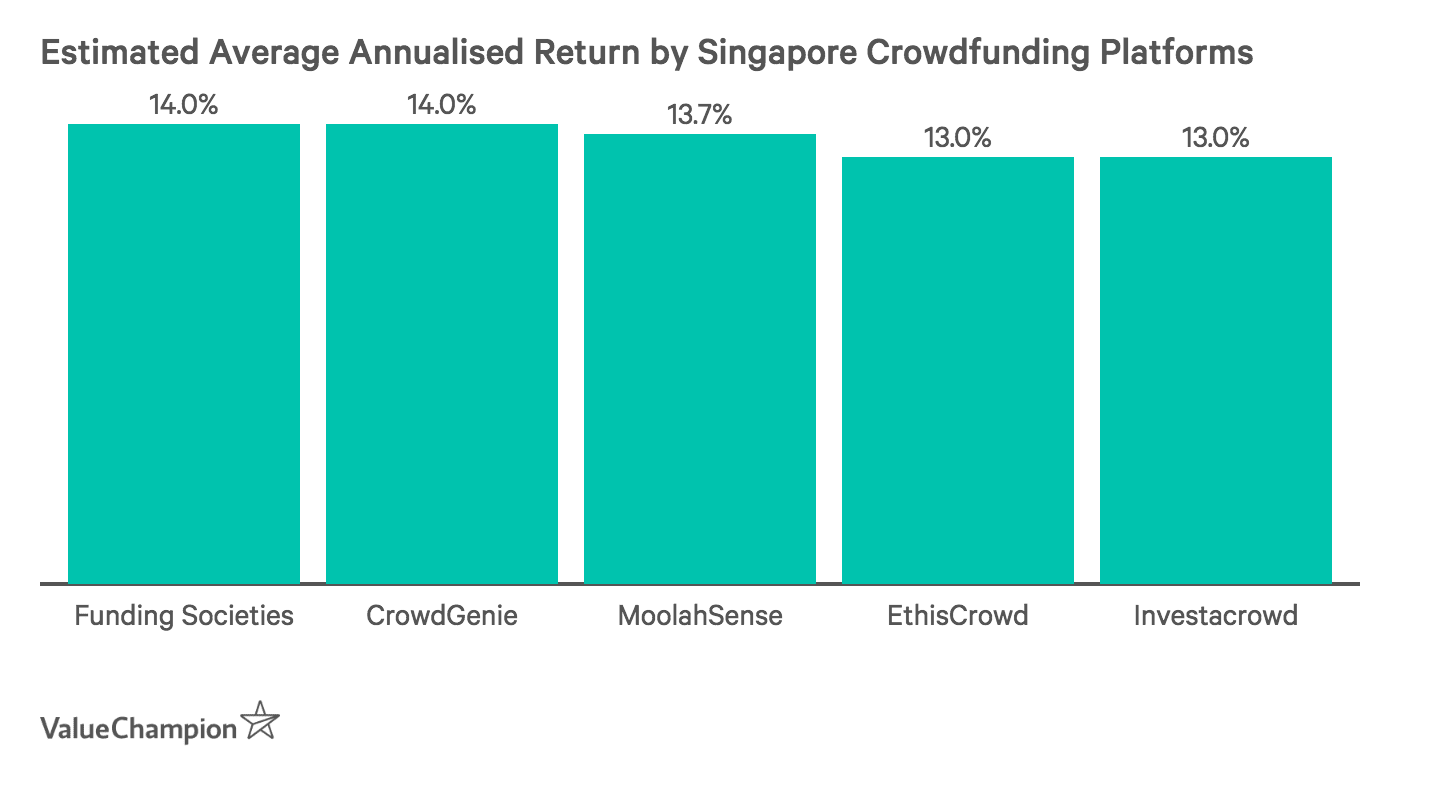
For example, crowdfunding platforms that offer small business loans and small business invoice financing tend to advertise average annualised returns of about 13 per cent to 14 per cent. Therefore, if you saw a platform advertising much higher returns for these types of investments, you would want to examine how the platform could offer such competitive rates before signing up.

Estimated Average Annualised Return by Crowdfunding Platforms in Singapore

2. Carefully analyse each crowdfunding campaign

While it is possible to avoid crowdfunding scams by choosing from the best available platforms, it is also essential to find legitimate campaigns on the platform that you select.

After all, Capital Springboard does have many legitimate deals despite being tied to the Vanguard Project Management fraud.

For this reason, it is important to consider several factors about the SME seeking funds in order to understand the risk associated with each campaign.

Also read: Crowdfunding is changing the world for the better

3. Ability to repay

The first criteria to consider in order to assess the risk of a business defaulting on its loan is the business’s financial capability of repaying the loan.

To the extent that it is possible, prospective investors should always review the SME’s financials. In particular, it is important to examine the amount of debt that the company owes to other lenders, whether its revenue exceeds its costs and if it has a positive net cash flow.

Also Read: Five trends in crowdfunding to watch in 2019

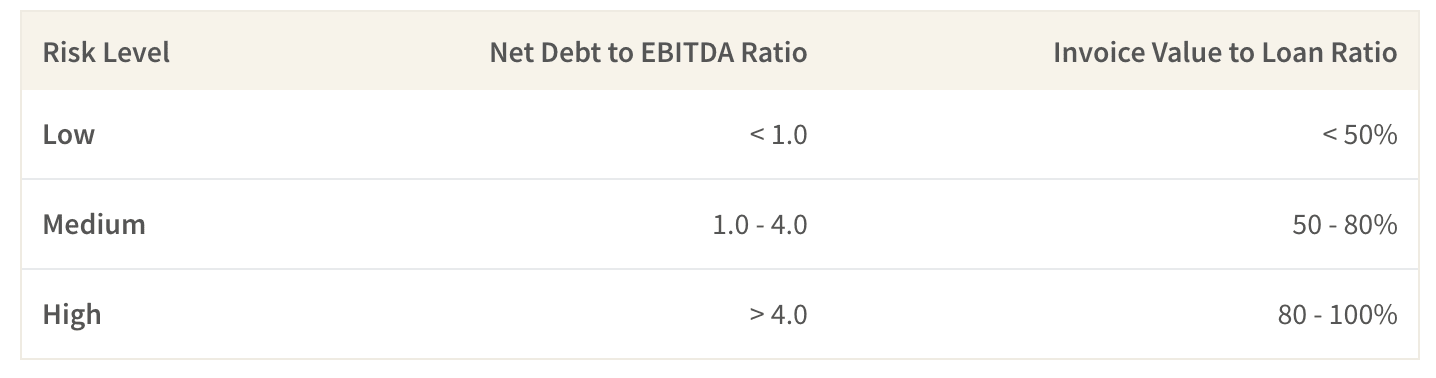
To assess the company’s financial strength, investors can calculate the company’s leverage ratios to understand how much debt it holds and the comparative risk of non-repayment, such as the net debt to EBITDA ratio.

This ratio can be calculated by subtracting the company’s cash from its total debt and dividing the result by its earnings before interest, taxes, depreciation and amortization (EBITDA).

In general, investors should be wary of SMEs with net debt to EBITDA ratios above 4.0.

Similarly, investors can assess the risk of an invoice financing loan by comparing the loan amount to the invoice amount. Typically, the smaller the loan is compared to the invoice, the less risk the investment poses. Additionally, some crowdfunding platforms provide their own analysis that estimates each borrower’s likelihood of repayment, which can be very helpful for less savvy investors.

—-


table ranking low medium and high risk leverage ratios

4. Financing needs

Another important way to understand the relative risk of each crowdfunding campaign is to examine why each SME seeks to borrow funds. Generally, specific-use loans are less risky from a lender’s perspective.

This is because these loans are going to be used for a specific purpose, which is typically more transparent to the lender. Some examples of specific borrowing purposes for small business loans include working capital, asset purchase and expansion.

5. Borrowing history

Yet another indicator of the likelihood that a business will repay a loan is to look at the business’s borrowing record. This will help you decide if the business has traditionally repaid its lenders on-time.

This factor is very important, even to the crowdfunding platforms. For example, some crowdfunding websites, such as Validus Capital even charge lower interest rates to SMEs that have a strong record of repayment through their platform.

6. Diversify your crowdfunding investment portfolio

Another way to minimise risk is to diversify your portfolio of investments. For example, by diversifying your invested funds among a few crowdfunding campaigns, you will be less likely to incur losses associated with a crowdfunding scam.

Of course, diversification alone will not prevent you from investing in a scam or in an SME that is likely to default on its loan; however, it helps you limit your exposure to risk.

7. Alternatives to crowdfunding

If you are still nervous about crowdfunding scams and would feel more comfortable investing elsewhere, you may be interested in opening an online brokerage account. There are many online brokerages and a variety of advantages and disadvantages to each type.

Also Read: 4 factors to consider before you invest in a crowdfunding platform

We strongly suggest that individuals that are new to investing are careful to choose a platform that fits their preferences for characteristics such as international market access, fees, and minimum investment amounts.

Additionally, novice investors should conduct a significant amount of research into investment strategies before investing any significant amount of money.

Editor’s note: e27 publishes relevant guest contributions from the community. Share your honest opinions and expert knowledge by submitting your content here.

Join our e27 Telegram group here, or our e27 contributor Facebook page here.

This article was originally published on ValueChampion.

e27 publishes relevant guest contributions from the community. Share your honest opinions and expert knowledge by submitting your content here.


The post 3 ways to avoid being a victim of a crowdfunding scam appeared first on e27.

Posted on

Specific digital marketing strategy considerations for Hong Kong

Key elements you should be focusing on to ensure your digital marketing strategy is optimised for Hong Kong


Hong Kong is a very unique place to market a website. With influences from both Chinese and Western cultures, websites need to be set up and marketed in a specific way to ensure they target the right customers in their industry sector.

Does your website need Chinese and English Language in Hong Kong?

Well, it all depends on your target market really…

What you need to remember about consumers and web users in Hong Kong is that they use websites and search in different ways. This is dependent on what industry your products target and also what consumer segments and demographics you are targeting in Hong Kong, as there are many.

The first step is to make sure you have your market research nailed because this will help you understand who you should be setting your website up for.

Some examples that highlight this are:

  1. Websites that promote and sell luxury items in industries like the fashion industry need to have English sections to their website, as consumer search and demand is often in English that ensures brand focus.
  2. Sites that target local-focused consumers need to have their websites predominantly in Chinese and additionally focus their website promotion strategy in Chinese. A personal finance website or a blue-collar jobs website are good examples of industries where the local focus is much more important.
  3. Websites that target mainly the expat market may only need to be English. If your product is mainly focusing on products more suitable to this demographic, then it may not be worth investing in time and resource in a Chinese section on your website.
  4. Websites targeting a certain age or generation may also need to be more focused towards a certain language. For example, an older audience is more likely to be unable to understand English and so may need to have a higher weighting towards a Chinese language site.

There is also the decision on whether to include two versions of written Chinese on your website, which brings us on to the next question…

What version of written Chinese does your website require in Hong Kong?

If you are including a Chinese section on your website or your entire website is in Chinese targeting Hong Kong, then you need to put your website in Traditional Chinese.

Cantonese is spoken in Hong Kong and the text used is in Traditional Chinese characters.

If you live in Hong Kong you’ll know this already, but worth bearing this in mind.

This is particularly pertinent If you are creating a multinational, multilingual site that includes Hong Kong, but you do not have a base in Hong Kong.


How should you configure multilingual websites in Hong Kong?

We suggest using /zh-hk and /en-hk as a subfolder on your .com or .com.hk website.

If you believe that your website will have a primary language in Hong Kong then you may want to have a no /language-country subfolder for your main language and only use a /language-country subfolder for your secondary domain. e.g.

www.example.com/this-is-the-primary-language-section and www.example.com/en-hk/this-is-the-secondary-language-section

Specify when you are using Traditional (targeting Hong Kong) and Simplified Chinese (targeting China) in your language code, in your subfolder URL structures and in hreflang code (which helps search engines to understand what language page version to show).


Chinese (Traditional)

      • Language code to include in HTML language settings: zh-Hant
      • URL structure to include www.example.com/zh-hant
      • Hreflang code to include <link rel=” alternate” href=”https://www.example.com/” hreflang=”zh-hant” />  along with other website language page variations on the same page


Chinese (Simplified)

      • Language code to include in HTML language settings: zh-Hans
      • URL structure to include www.example.com/zh-hans
      • Hreflang code to include <link rel=” alternate” href=”https://www.example.com/” hreflang=”zh-hans” /> along with other website language page variations on the same page


Should you be using Chinese URLs on your website in Hong Kong?

This really depends on what type of website you have and which location you are targeting.

For example:

      • If you are targeting the Chinese mainland as well as Hong Kong you may want to use Chinese URLs to help to rank in China’s Baidu search engines. Chinese URLs are not necessarily favoured in Baidu but this could help
      • If you have a lot of local content on your blog that targets local phrases and themes, then you may want to use Chinese URLs in your blog posts
      • If you have URLs that include content related to international themes or international brands then it may be better to use English URLs

One good way to decide could be to check out the search volumes in Chinese and English before deciding. Alternatively, you could look to see if both Chinese and English words are used in the keyword search phrases used.


How important is mobile in Hong Kong?

Mobile in Hong Kong

Source: http://gs.statcounter.com/platform-market-share/all/hong-kong/#monthly-201804-201809

The majority of websites in Hong Kong should be developed and marketed with a mobile-first approach as more people use mobile than desktop to research and browse the internet. This means making sure your website is mobile optimised by checking it through the Google Mobile-Friendly tool and also testing it on numerous devices. If you have a Google Search Console account set up Google will also send you mobile usability reports via the Google Search Console


Desktop still first for conversions

Whilst mobile is the leader for online browsing people often still prefer to convert on a desktop as shown in a recent Google Consumer Survey in the graph shown below as they have more trust in purchasing or filling in forms on desktop. They often do this on the 2nd visit to a website on Desktop.

Google Consumer Survey in Hong Kong

Source: https://www.consumerbarometer.com/en/graph-builder/?question=S34&filter=country:hong_kong_sar

Although mobile access is clearly important, it is obvious from the above graph that ultimately people choose to make their purchase through a desktop computer.

As previously stated, this may be due to a lack of confidence about completing purchases over a mobile network. Alternatively, people may be more confident to carry out their purchases at home rather than on the move, where they have more time to ensure that all information is correct.

From a digital marketing point of view, it is therefore important to adapt your website to ensure that it is adaptable to all forms of access.


App optimisation in Hong Kong

If you have an app and want to promote the app in app stores in Hong Kong then you need to remember that Apple has a much greater market share in Hong Kong than in other parts of Asia, where Android is most popular. So, your app promotion strategy may need to be focused more on the Apple App Store and your iOS app.

Mobile Vendor Market Share Hong Kong

Source: http://gs.statcounter.com/vendor-market-share/mobile/hong-kong/#monthly-201801-201809


How do you build your brand and promote your website in Hong Kong?

There are a few ways in which you can build your brand and promote your website in Hong Kong. One of the key initial tasks to carry out is to research your niche industry in great depth. This will help you to understand who your potential customer demographic is in Hong Kong and then, in turn, helps you to decide how you should set up your website.

You should also decide whether you are going to be local or more expat focused in your branding or maybe you need to decide whether you need a branding strategy for both demographics?

Next, you need to decide what social media channels you should use to reach your target audience(s). Using Facebook is likely to be more effective if you want to share video and blogs to a local audience for many B2C markets. LinkedIn is still used to a certain extent but more so within the B2B and expat focused markets.

Also read: 5 content marketing trends you need to heed

Finally, a core part of the strategy is the fact that you need to decide what type of content you should promote. Podcasts are not very popular in Hong Kong for example but watching videos is extremely popular as shown in the graph below taken from The Connected Consumer Survey 2017.

Graph online videos Hong Kong

Source: https://www.consumerbarometer.com/en/graph-builder/?question=V1&filter=country:hong_kong_sar


Large Percentage Using Search Engines On Smartphone

Source: https://www.consumerbarometer.com/en/graph-builder/?question=M7b1&filter=country:hong_kong_sar

As well as the video is a core activity that people engage in on their smartphones, social media also plays a key part in Hong Kong’s online activities, so your social media strategy needs to be as much of a priority as your website strategy. Smart to consider the use of social media in an overall digital marketing strategy.

Another key area stated in the data above is to the use of search engines, so having a clear Search Engine Optimisation strategy and also potentially a paid search strategy (depending on your industry and what demographic you are targeting) is important.

The need for holistic online and offline strategies into the purchase funnel

Source: https://www.consumerbarometer.com/en/graph-builder/?question=S7&filter=country:hong_kong_sar

Data from the Google Consumer Barometer Survey 2014/15  suggests that the majority of people in Hong Kong still make their purchase in a store or outlet. This means that people carry out the research online before going on to make a purchase in person.

Online and on the phone still plays a part in purchasing, so this needs consideration in how best to encourage people to go on and buy a product or service. Perhaps some thought is needed on how to encourage people via a digital strategy to act on their impulse to purchase.

Also Read: Current trends that can render popular e-commerce platforms obsolete

Having an optimised Google MyBusiness account can help provide a link between your online strategies and offline strategies. As it means that when internet users are searching for your brand in Google they will be able to find your store locations easily from where they can purchase products in-store.

There are a number of new features in Google MyBusiness that you can also leverage to gain further visibility online to offline.


Your digital marketing strategy for Hong Kong

Ensuring you know what Digital Marketing Nuances are most applicable to your brand and products is the most important thing to start and from there you can decide how to prioritize some or all of the factors mentioned in this post.


Editor’s note: e27 publishes relevant guest contributions from the community. Share your honest opinions and expert knowledge by submitting your content here.

Join our e27 Telegram group here, or our e27 contributor Facebook page here.

Image Credit: Simon Zhu

This article originally was posted on https://www.taksudigital.com/blog/the-digital-marketing-nuances-of-hong-kong

The post Specific digital marketing strategy considerations for Hong Kong appeared first on e27.

Posted on

3 digital tactics to foster your dream team culture using simple digital tools

Digital tools can provide a great way to promote the company culture by creating informal places online for collaboration, communication, and transparency

With the fast-paced implementation of technology and evolving work expectations, understanding the needs of your employees has never been more critical.

Globally, the work environment is changing rapidly.

With the fast-paced implementation of technology and evolving work expectations, understanding the needs of your employees has never been more critical.

Over the past five years, searches for workplace well-being have doubled, with the growing need to create workspaces driven by purpose.

Deloitte’s Future of Work examines improving culture and employee experience in the top-five transformational tactics for workplaces, alongside building connected teams, personal development, and design-thinking.

So what is the culture in today’s changing environment, and how is it measured?

Frei and Morriss give a great example of what culture is in a practical sense:

“Employees make hundreds of decisions on their own every day, and culture is our guide. Culture tells us what to do when the CEO isn’t in the room, which is, of course, most of the time.”

It goes back to purpose and finding a greater understanding of the “why” of everyday work.

In a team environment, culture often shapes the ways we communicate.

Create shared workspaces

We’ve all heard of flexible and remote working as an option for our team, but what does this look like practically?

PwC says, by 2030, the majority of the world’s workforce is expected to find flexibility, autonomy, and fulfilment in their job. Business leaders can make this a reality by creating spaces online where employees can have full access to resources and channels of communication they’d otherwise have in the office environment.

Also Read: How to deal with the challenges of a distributed team

This goes beyond emails and should be tailored to both the job role and industry. For example, if you are working in a design firm, you need access to a suite of tools, templates, etc. Often these resources need to be cloud-based to allow instant access via a simple security log-in.

Offer anonymous feedback

If you are trying to create a culture of honesty and trust where teams are eager to give each other feedback, you may want to consider encouraging company-wide feedback.

Doing this online is an effective method to streamline the process and offer a safe space for honesty. By incorporating a feedback form into a familiar setting—such as a collaboration tool, email system—you can formalise the process.

Also Read: Why team-building exercises won’t make your staff more productive

Let your employees know that the business is looking to improve continuously. Remaining anonymous can make feedback easier for people, and when the feedback loop is hosted digitally, you remove all barriers to honesty.

Implement democratic decision-making

Historically, decisions are often made from top to bottom, with little input from team members. Online polling tools offer a channel for staff engagement. The key here is to ask questions you want answers to. If you engage your team for the polls and don’t release the outcome, it can have quite the opposite effect creating a hostile and untrustworthy environment.

Also Read: 6 tips for building a successful software development team

Questions don’t need to be to make critical strategic decisions, instead pick topics that will put a smile on your team’s face. Ask for opinions, for instance, on new office spaces, themes for next month’s team workshop, etc.

Incorporating the polling process on an ongoing basis will improve your team’s connection, and in turn, creates a happier and more engaged workforce.

Don’t plan your digital strategy online; instead, take it offline. Challenge leadership to decide how you want your employees to perceive the company. Invite team members to the table. Finalise goals.

Digital tools are used to promote collaboration, engagement, and transparency; ultimately improving employee happiness.

When used effectively, digital tools can create unique moments online and engages each employee directly with the company’s vision.

Editor’s note: e27 publishes relevant guest contributions from the community. Share your honest opinions and expert knowledge by submitting your content here.

Join our e27 Telegram group here, or our e27 contributor Facebook page here.

Image Credit: Marvin Meyer

The post 3 digital tactics to foster your dream team culture using simple digital tools appeared first on e27.