Sony Ventures hits first close of US$217M Fund III
Sony Ventures Corporation, a wholly-owned subsidiary of Sony Group Corporation, has completed the first closing of its new JPY 25 billion (US$217 million) fund, Sony Innovation Fund 3.
Investors include Mizuho Group, Daiwa Securities, Sumitomo Mitsui Trust Bank, The Bank of Yokohama, The Shiga Bank, Koei Tecmo Group, Kawasaki Heavy Industries, Mitsubishi Estate, a university, and the Sony Group.
Established in July 2021 and managed by Sony Ventures, Sony Innovation invests in all stages of emerging technology companies and startups solving global environmental challenges. Its previous funds are Sony Innovation Fund (established 2016), Sony Innovation Fund by IGV (2019), a joint venture with Daiwa Capital, and Sony Innovation Fund: Environment (2020).
“We actively foster entrepreneurs and startups that lead the creation of next-generation technologies, promote open innovation, and contribute to the global environment and social development through our corporate venture capital activities,” said Gen Tsuchikawa, CEO of Sony Ventures Corporation. “Sony Ventures Corporation will not only invest in emerging technology sectors and high-growth startups but will further strengthen its ESG initiatives and eagerly support its portfolio companies.”
Employment Hero — an HR, payroll and benefits company in Australia — has closed a US$130 million funding round, led by existing investor SEEK Investments with participation from OneVentures, AirTree Ventures and others.
This brings the company’s valuation to AUD1.25 billion (close to US$1 billion).
This news comes on the heels of Employment Hero’s acquisition of workforce management and payroll solution, KeyPay. With this acquisition, Employment Hero now has over 80,000 SMEs, collectively managing more than 750,000 workers using its platform.
Key Pay will be retained as an independent brand and receive ongoing investment to grow its team. Together with KeyPay, Employment Hero now offers a leading suite of total employment management solutions that cover four key pillars: talent solutions, core HR, payroll, and e-benefits.
Founded in 2010, KeyPay has a presence across Singapore, Malaysia, Australia, New Zealand, and the UK.
—
Ready to meet new startups to invest in? We have more than hundreds of startups ready to connect with potential investors on our platform. Create or claim your Investor profile today and turn on e27 Connect to receive requests and fundraising information from them.
Last week marked the Lunar New Year celebrations and the ushering in of the year of the Tiger. With each new year comes a new meaning and new beginnings, a timely message as the world continues to recover from the pandemic and usher in a new normal.
So what might this look like for Southeast Asia’s payments sector?
Off to a fierce start
Given the volume of people who celebrate Lunar New Year (LNY) worldwide, it’s no surprise that sales figures beat the Christmas holiday season.
For comparison, in the five days from Thanksgiving to Cyber Monday last year, online sales in the US were projected to total about US$39 billion. In 2021, Chinese retail sales during the Lunar New Year totalled over US$129 billion.
This is a massive opportunity for retailers to drive sales and win new customers for the rest of the year.
Sellers keen to seize this opportunity often get creative with Lunar New Year sales and auspicious discounts featuring the number 8, the luckiest number in China, driving shoppers to purchase and transform retailers fortunes for the year ahead.
But once the discounts have ended and the celebrations are over, the question all sellers will be asking is: what will consumers be spending their hard-earned money on?
The tradition of giving hongbao (auspicious red packet) to wish prosperity and good fortune to the recipient was revolutionised in 2014 with the invention of digital e-hongbao, which became famous when WeChat allowed users to send virtual red envelopes of money to their contacts.
Now, seven years later, about 80 per cent of survey respondents say they prefer to send digital e-hongbao to physical envelopes.
This soar in popularity was well-timed. In the past, LNY has prompted vast masses of people working away from their hometowns to travel back to celebrate. The world’s largest annual migration means that as many as three billion trips would be made each year across China.
But the pandemic and national lockdowns changed things dramatically in 2020, 2021 and for many this year, too, with restrictions in Southeast Asia.
However, for those who could make it home to celebrate, festivities centred around gathering with family and friends to eat were plentiful. In fact, according to a survey ahead of LNY last year, around 77 per cent of Chinese respondents said they planned on buying food for the 2021 holiday.
About half of the respondents decided to buy alcohol or wine. Beyond this, many choose to give a gift with e-commerce supporting those who are still social distancing. According to Alibaba’s Spring Festival Consumption Report 2021, tech products such as sweeping and window cleaning robots exceeded 300 per cent YoY.
Customising payments is the key to cashing in
Research conducted in 2018 in China, India and Indonesia asked consumers to identify the main obstacles which prevented them from using online services to their fullest extent.
The number one obstacle, singled out by 76 per cent of correspondents, was language, and even today, lack of language localisation continues to be an issue across digital platforms.
To ensure maximum consumer acceptance and the best possible conversion rates, merchants must ensure that their site offers a range of familiar and trusted local payment methods. And with so many local payment methods in APAC and new ones emerging every day, this couldn’t be more true.
To serve today’s Chinese consumers, at a minimum, it is best practice to accept all three of the most popular Chinese payment methods: UnionPay, Alipay, and WeChat Pay.
LNY celebrations may be coming to an end for another year. Still, to realise roaring success in the year of the Tiger, merchants must think local first and tailor their payment offering to their customers, wherever they may be.
–
Editor’s note: e27 aims to foster thought leadership by publishing views from the community. Share your opinion by submitting an article, video, podcast, or infographic.
Singapore-based climate tech startup RIMM Sustainability today announced that it has raised a total of US$3 million in Pre-Series A funding round led venture capital fund BEENEXT and leading tech investor Mamoru Taniya.
Other key investors in the funding round include the Aswani family of the conglomerate Tolaram Group and Atlas Asset Management.
In a press statement, RIMM Sustainability said that the funding will be used to develop and launch its version 2.0 platform, release new features, and expand its team.
“We are delighted to have closed our preseries A round, the pedigree of our investors is a testament to our team, our platform and our roadmap. This is a great step towards our goal to become the world’s largest sustainability platform and create an ecosystem where companies, citizens and stakeholders can engage to identify and solve the most pressing sustainability problems of today and tomorrow,” Ravi Chidambaram, CEO and Co-founder of RIMM Sustainability, commented.
“The success of microfinance is based on banking the unbanked. At RIMM, our success as a sustainability platform will come from serving the unserved,” Chidambaram added.
Launched in 2021, RIMM Sustainability provides a SaaS platform that enables companies of all sizes to optimise their sustainability management effort. It builds tools for sustainability management, reporting and optimisation.
The company described its platform as “revolving around inclusivity and accessibility, focusing on unlocking an open world where sustainability is no longer elusive.”
Key features on the platform for SMEs include industry-specific assessments aligned to global sustainability standards (e.g. GRI, TCFD, SASB); benchmarking of sustainability performance against peers and industry, relevant and simplified educational guidance by sustainability experts; curated sustainability insights summarised on one comprehensive dashboard; Carbon Calculator to measure emissions across scope 1, 2 and 3; customisable sustainability reports for internal analysis and external communication to stakeholders; and access to strategy and recommendations report in improving company’s sustainability performance.
RIMM Sustainability was awarded a US$1 million Green Finance grant by the Tokyo Metropolitan Government and a grant from the Monetary Authority of
Singapore.
—
Ready to meet new startups to invest in? We have more than hundreds of startups ready to connect with potential investors on our platform. Create or claim your Investor profile today and turn on e27 Connect to receive requests and fundraising information from them.
Hong Kong’s event management solutions platform EventX bags US$8 million in Series B+ round
EventX, an Asian-focused event SaaS company providing event lead generation and event management solutions, announced it raised an additional US$8 million led by GL Ventures, bringing the company’s total fundraising in Series B to US$18 million.
The new funding will be channelled to develop new offerings, finance potential acquisitions, strengthen its international operations and expand the company’s presence in Asia, particularly in Taiwan and Southeast Asia.
Founded in Hong Kong in 2014, EventX’s virtual event platform serves companies to generate leads through engaging and interactive events with smart features such as all-in-one CRM management, event analytics, interactive exhibition halls, online registration forms, and email sending tools to streamline invitations.
So far, it claims to have provided solutions for high-growth event organisers across 100+ cities and now has served more than 5 million attendees.
Coinbase, Grab’s execs back GameFi startup Ethlas’s US$2.7M seed round
Singapore-based game finance (game-fi) blockchain startup Ethlas announced that it has secured US$2.7 million in seed funding from a slew of investors.
They include Sequoia Capital India, Yield Guild Games Southeast Asia, Global Blockchain Innovative Capital, Venturra Capital, Play It Forward DAO, Blockchain Space, Genesis Fund, Deus Ex DAO and Hustle Fund.
Executives from Grab, Coinbase, Switcheo and CoinMarketCap, also joined.
Ethlas is founded in November 2021 by four tech veterans, including American Gennady ‘Ari’ Medvinsky and Singaporean Elston Sam, who have stints in top tech companies such as Google, Microsoft, Grab, and Airbnb. To date, its team comprises more than 20 blockchain engineers, game developers, data scientists, cybersecurity experts and designers based out of Singapore, the Philippines and the United States.
Serving as a free-to-play, play-to-earn platform, Ethlas helps amateur players win and exchange cryptocurrency by participating in simple, easily-understood casual games such as the likes of Think Tetris, Candy Crush and Bubble Popper.
Ethlas said that its gamers only need to install MetaMask, a software crypto wallet or link their wallets, and start playing in the Ethlas metaverse on a PC or mobile phone’s browser without complicated onboarding rules or requirements to sign up with a hefty subscription fee.
The startup is going to mint its first series of non-fungible tokens (NFTs) called Komos to benefit both free-to-play gamers and crypto natives.
As of end-January 2022, the Ethlas GameFi metaverse, built on the Polygon blockchain, claims to have clocked over 100,000 crypto-wallet users globally and some three million gameplay on its platform.
Riverr raises US$1M seed round to verify health and vaccination data for SEA maritime
Riverr Co-Founders Martin (CPO), Kristina (CEO), William (CTO)
Riverr, a Singapore-based digital platform providing tools to verify health and vaccination data, announced to have secured a US$1 million seed financing round led by Kuok (Singapore) Limited’s venture arm KSL Maritime Ventures, which is dedicated to the incubation and commercial success of maritime technology startups.
Enterprise Singapore’s SEEDS Capital also participated, as part of a S$50 million (~US$37.15 million) co-investment scheme for maritime startups supported by Maritime and Port Authority of Singapore.
Launched in 2020, Riverr simplifies how health data can be verified across organisations and governments while maintaining the privacy of individuals. Its tools include patient booking, health records and payment gateways, which can be white-labelled and embedded into existing systems.
Furthermore, its online trust management platform is able to verify all 10 data standards for health records recognised worldwide and bridges the interoperability between different systems.
Riverr is introducing its platform to sectors with a higher frequency of cross border people movements, starting with maritime. The industry is said to lack secure tools to digitally verify the health information of seafarers on a single ship with multiple nationalities, vaccination and medical records.
With Riverr, a seafarer’s trail of medical and vaccination records can be instantly validated by ports authorities and necessary industry stakeholders, without needing them to hold or store the data themselves, Riverr noted.
The fresh funds will enable Riverr to accelerate its go-to-market roadmap with healthcare providers across Singapore, the Philippines, India and Indonesia.
The firm said that leading health clinics and labs with the likes of Acumen Diagnostics, Eurofins Clinical Diagnostics, Healthway Medical Group, Minmed Group and MiRXES, are also relying on its solution to securely manage the end-to-end process of verifying health data and records, which has witnessed a spike in attempted cyberattacks during the pandemic.
Bangladesh-focused OTA GoZayaan acquires Pakistan travel-tech platform FindMyAdventure
South Asian travel-tech platform GoZayaan has expanded its operations in a new market by acquiring Pakistan travel-tech platform FindMyAdventure.
This arrangement will support the collective ability of FindMyAdventure and GoZayaan to improve the region’s travel and tourism infrastructure with rapid technology adoption and improved access to travel.
Founded in 2017 by CEO Ridwan Hafiz, GoZayaan aims to make travel more convenient by creating an end-to-end holistic online travel booking solution for flight, hotel, inter-city bus and even tour booking.
The startup recently closed an undisclosed round backed by existing investors, Nordstar Partners, Saurabh Gupta, Partner at DST Global, and Alexander Rittweger, Founder of PAYBACK.
FindMyAdventure is a travel-tech platform specialising in adventure tours for the local market in Pakistan.
Pakistan and Bangladesh consist of 5 per cent of the world’s population and are equal to almost 60 per cent of South East Asia’s population, opening a huge opportunity for growth and market penetration.
Go-Ventures backs Indonesia jobs platform KitaLulus’s seed round
Indonesian-based professional networking and jobs platform KitaLulus announced to have scored an undisclosed amount of seed funding led by Go-Ventures.
Angels including Phil Opamuratawongse (CEO and Co-Founder Shipper), JJ Chai (CEO and Co-Founder Rainforest), Aldi Haryopratomo (previous CEO GoPay), YC Ng (Partner AC Ventures) and Abhinay Peddisetty (CEO and Co-Founder BukuWarung), also co-invested in the round.
KitaLulus will utilise this funding to expand its product and engineering team, as well as enhance its position in the Indonesian market, in which it has covered six metropolitan areas thus far.
Founded in 2021 by serial entrepreneurs Stevien Jimmy and Wei-Chuan Chew, KitaLulus aims to address the lack of access to the right networks and unequal access to opportunities for workers, as well as the mismatch between candidates and employers.
Through KitaLulus’s mobile app, members can take online courses to prepare themselves for government and professional exams (upskill), join relevant communities according to their educational and professional background (network), as well as create user profiles, view available jobs, take a short screening test and make direct contact with their potential employer via Whatsapp (find jobs).
To date, the platform claims to process one million job applications per month and facilitate over 20 communities for discussions, polls and experience sharing.
KitaLulus expects to enjoy strong tailwinds driven by the economic recovery from the COVID-19 pandemic as well as the expanding working-age population in the archipelago over the next five to ten years.
Insurtech bolttech acquires AVA Insurance in Singapore
Singapore-headquartered insurtech startup bolttech announce to have completed the acquisition of AVA Insurance Brokers and AVA Insurance Agency, a Singapore-based insurance intermediary and specialist broker.
The acquisition follows bolttech’s completion of its US$247 million Series A last year, with strategic investors including Singapore’s EDBI.
The acquisition of AVA will accelerate the deployment of bolttech’s insurance exchange in Singapore, connecting insurers, distributors and customers, making it easier and more efficient to buy and sell insurance.
With a suite of digital and data-driven capabilities, bolttech works with insurers, telcos, retailers, banks, e-commerce and digital destinations to embed insurance into their customer journeys at the point of need.
Since its inception in 2020, bolttech boasts of having served customers in 30 markets across North America, Asia and Europe.
The change in ownership is said to have no impact on AVA’s service to its partners or customers, and the existing AVA team remains intact post-integration.
—
Ready to meet new startups to invest in? We have more than hundreds of startups ready to connect with potential investors on our platform. Create or claim your Investor profile today and turn on e27 Connect to receive requests and fundraising information from them.
The past two years have been a crazy ride for the MICE and events industry, with event organisers having to revamp business models seemingly overnight, marketers having to pivot their event marketing strategies in a blink of an eye, and event attendees not being able to have the intimacy of face-to-face engagement.
With that, though, the event industry has evolved and innovated. Where previously there were challenges around building enough online functionality and capabilities for sponsors, organisers and attendees to have the same experience and audience engagement as a physical event, technology has truly enabled the industry for the past two years.
So how will technology shape the events industry in 2022?
Hybrid events become the norm, virtual events as a tool for marketers to generate leads
Before COVID-19, events were mostly physical events, and in 2020, events shifted to fully-online events. In the year ahead, we will see that hybrid events, which refer to events that are held concurrently online and offline, will become the norm.
With the objective of events to serve both attendees and partners, it’s important that both get an ROI even for hybrid events.
In a recent survey of over 3,000 event organisers globally, Markeletic found that 86 per cent of B2B organisations see positive returns from hybrid events, seven months after the event date.
With hybrid events providing both physical and online touchpoints for attendees and partners, there will also be greater attendee satisfaction for events (an 81 per cent contributor to satisfaction as voted on in the survey for Markeletic).
We will see events no longer limited by geographical boundaries, and businesses, attendees, and event organisers will gain increased value from hybrid events.
From greater capabilities for lead generation and greater data on attendees, event organisers and sponsors will undoubtedly be able to populate sales pipelines and understand areas that need to be optimised to improve attendee awareness, attraction, and acquisition.
The past few years have seen greater adoption and innovation around augmented reality (AR) and virtual reality (VR), but the real boost in this space came when Facebook announced their plans to go all-in on the metaverse.
Make no mistake, these are not new technologies, but they have been given a fresh breath of life because of the metaverse. We’ll also start to see more utilisation of AR and VR for events in 2022, providing more immersive experiences for attendees and more engagement opportunities for sponsors and partners.
The metaverse will permeate the events industry
By now, you would have at least an inkling of the concept of the metaverse. For one, it’s the future version of the internet, but fundamentally, these are 3D and virtually integrated spaces through AR and VR as touched on above.
With it touted to become a US$800 billion industry in 2024, this is something that should not be ignored. As of now, the likes of Epic Games and Roblox have already hosted concerts within their metaverses, whilst Unity is looking to provide live sports content and tools for the metaverse.
Several ways that businesses can dip into the metaverse include virtual stores, employee training material, customisation of products, and more! Other opportunities include interactive advertising opportunities for sponsors, gamification, visual-audio immersion and shopability.
Increased virtual networking opportunities at events
In the year ahead, we would already be hyper-familiar with online communication, with remote working becoming almost the norm for most people. We will also see this applied to virtual events, at a much deeper level.
From joining discussion tables and online video networking to virtual networking lounges and even networking in the metaverse, the number of innovative opportunities for event platforms has never been more significant.
Event data analytics will get more intricate and at a deeper level
Data helps us keep pace with our customers’ wants, needs and intentions. Online event platforms will have even deeper capabilities to provide event organisers with robust analytics in the year ahead.
We will also see more marketers implement trackable attribution to online and hybrid events, as this part of marketing attribution traditionally fell into a manual black hole.
From attendance to session watch times and audience engagement, event organisers will have even more data around which they can optimise and improve subsequent event flows, audience engagement, audience acquisition and more.
The rise of NFTs for events
Another highly-anticipated opportunity for the event tech industry is the use of NFTs in events. Think about it. Pop stars can create exclusive content and issue them as NFTs to attendees or put it up for an exclusive auction.
Art exhibitions in hybrid events can implement NFTs for authentication or digital art. Ticketing can come in the form of NFTs for more excellent authentication. The opportunities are endless!
Businesses and marketers will also need to think of the best ways to implement NFTs across their products and offerings, and once that is done, the shift to implementing NFTs in online events will be a much smoother process.
Increased investments in event technology
We will definitely see more investments in event technology and peripheral technology with the above trends. Today’s landscape for events is already highly-promising.
From automated business matching and virtual gift bags to automatic captioning and live translations, businesses’ opportunities to quickly scale their events have never been more significant.
However, businesses need to know the type of features and capabilities that they are looking for from an events platform and build a long term strategy around running events. This will undoubtedly ensure a strong short-term and long-term return on investment.
Personalisation for event attendees
Today, personalisation happens every second. From Spotify recommendations to Netflix suggestions, you are being analysed, and more relevant content is being delivered to you.
How this personalisation applies to the events industry can come in the form of recommendations of sessions to watch or which booth to visit.
Imagine you are attending one of the biggest startup events in this part of the world, RISE. There are hundreds of booths and sessions spanning the entire event. Which will you be interested in? With personalisation comes improved attendee experience, conversion rates and even lead generation.
As we head into the new year, one thing is for certain: events, as we knew back in 2019, will never be the same. With online merging with offline, opportunities will present themselves to businesses.
As the pandemic persists, event professionals must embrace hybrid and virtual ecosystems, champion diversity, prioritise health and safety, and create event experiences that keep attendees engaged and coming back for more.
Can you grab these opportunities when they come?
–
Editor’s note: e27 aims to foster thought leadership by publishing views from the community. Share your opinion by submitting an article, video, podcast, or infographic
MOU signing ceremony between VIZZIO and Institute of Technical Education (ITE)
VIZZIO Technologies, a Singapore-based 3D visualisation and reality capture startup, announced to have closed a S$9 million (~US$6.7 million) pre-Series A funding round joined by an undisclosed Singapore’s family banking office.
As per a press statement, the fresh funding allows VIZZIO to build the world’s largest 3D capture and virtualisation ecosystem, spanning objects, space and cities.
Founded in 2019 by CEO Jon Li, VIZZIO aims to democratise and simplify 3D for the “omniverse” – the next digital reality revolution which offers multiple cross-chain possibilities – as well as the growing metaverse demand.
VIZZIO employs AI-powered geospatial, 3D virtualisation and Digital Twin solutions to enable users – from novices to digital experts – to access 3D-as-a-Service offerings on-demand, helping them to co-create, virtualise and interact with digital realities.
Particularly, the startup assists governments and businesses in offering an immersive yet hyper-realistic digital environment. This allows customers or investors to interact with a digital avatar at a virtual marketplace or Annual General Meeting, or employees to use Digital Twins to build and test out city districts and buildings, complex machinery and related infrastructure.
So far, VIZZIO claims to have successfully delivered 10 new projects and signed on 25 new partners, helping both Singapore-based and international organisations transfer physical assets into the virtual world.
The company counts Singapore leading government agencies and companies including the Singapore Civil Defence Force (SCDF), Government Technology Agency of Singapore (GovTech), National University of Singapore (NUS), Surbana Jurong and AETOS, among its partners.
In collaboration with security and safety solutions provider AETOS, VIZZIO is working on developing Singapore’s largest digital twin for security and surveillance and integrated Facility Management services.
Last year, VIZZO teamed up with Surbana Jurong to undertake the digital modelling of Temasek Polytechnic’s 30-hectare campus covering landscape, linkways and 49 buildings on site.
In early February, the startup also formed a three-year partnership with the Institute of Technical Education (ITE) to launch a new Centre of Excellence – the Universal Omniverse Experience Centre – at ITE College Central.
Besides, VIZZIO is developing a digital human platform with its subsidiary company AUGMENTED HUMAN.
—
Ready to meet new startups to invest in? We have more than hundreds of startups ready to connect with potential investors on our platform. Create or claim your Investor profile today and turn on e27 Connect to receive requests and fundraising information from them.
Singapore-based Appboxo today announced that it has raised a US$7 million Series A funding round led by RTP Global.
Existing investors such as Antler and 500 Southeast Asia, as well as new investors SciFi VC, Gradient Ventures (Google’s AI-focused venture fund), and business angels Huey Lin and Kayvon Deldar also participated in the funding round. This funding round marks SciFi VC’s first investment in Southeast Asia.
Appboxo plans to use the funding to develop Shopboxo, a platform that helps entrepreneurs, brands and SMEs create online stores to offer their goods and services directly to consumers; expand its merchant ecosystem by bringing more businesses to the app, and build out its international partnerships and presence.
With its global expansion plan, the company plans to initially focus on the Asia Pacific region, followed by Europe and the US.
Appboxo provides a platform for developers to create mini apps to be turned or integrated into super apps. Example of mini apps includes mobile wallet platforms that can be integrated into larger e-commerce or lifestyle platforms.
In 2021, WeChat, one of the biggest super app platforms in the world, reported a 12.5 per cent growth in daily active users of its mini app services, bringing the total active user count to a remarkable 450 million.
In addition to Shopboxo, Appboxo also offers Appboxo Miniapp Platform which aims to simplify the process of transforming any app into a super app with user-friendly software development kits (SDKs) and application programming interfaces (APIs).
The startup was established in 2019 by founders Kaniyet Rayev (CEO) and Nursultan Keneshbekov (CTO). It counted companies such as GCash, Paytm, and VodaPay.
“The last couple of years have been incredible for us, and we are continuing to gain momentum as we head into the new year with our Series A funding. We have built a strong global team with fantastic experience behind it and can’t wait to dive into strengthening our products, scaling our business, and establishing new partnerships across the globe in 2022. We are grateful to all our investors for their trust and support,” said Kaniyet Rayev, Co-Founder and CEO of Appboxo, in a press statement.
In December 2020, the company announced a US$1.1 million seed funding from Founders Fund and 500 Startups.
—
Ready to meet new startups to invest in? We have more than hundreds of startups ready to connect with potential investors on our platform. Create or claim your Investor profile today and turn on e27 Connect to receive requests and fundraising information from them.
Over the last decade, the rising popularity of the sharing economy has extended to ride-hailing services, which has transformed the way we commute globally.
Burgeoning demand for this new travel modality is already reflected in the industry’s growth forecasts, especially in Southeast Asia. The region’s ride-hailing industry is expected to grow at a compound annual growth rate (CAGR) of 6.3 per cent – almost double the global average.
Uber and Grab have long established themselves as major ride-hailing players in Southeast Asia. But despite sharing an industry, both have very different approaches to research and development (R&D).
Grab’s approach appears to be more market-driven, led by insights from customer feedback. In contrast, Uber seems to be more science-driven, emphasising the breadth of its patent portfolio and aiming to diversify its patent base across multiple technological fields.
There is a wealth of academic literature exploring the relationship between intellectual property and corporate technological strength. In the case of Grab and Uber, patent applications highlighted the difference in strategies both adopted to grow in Southeast Asia.
With the acquisition of Uber’s Southeast Asian operations by Grab in March 2018, it appears at first glance that Grab’s market-driven R&D has given it an edge. This raises an interesting question: is market-driven or science-driven R&D more important as a competitive enterprise strategy?
Grab’s ascension story
In 2012, Grab started as the undeniable underdog compared to Uber. However, it grew quickly and soon cemented its position as a leading competitor, culminating in its Uber acquisition in Southeast Asia by 2018. In that year, both Grab and Uber had comparable market shares with active users of around 25 million and 22.3 million, respectively.
One key lesson derived from Grab’s continued success was the importance of localisation as a strategic approach to effectively engage diverse, fragmented markets over the long term. This was the forefront of Grab’s plan, and the company focused on developing a sound understanding of customer preferences and making intelligent investments in infrastructure.
Choosing a differentiated strategy enabled Grab to secure a broad swathe of the market. By 2021, Grab had surpassed its predecessor and was the category leader in Southeast Asia – top-ranked in mobility, delivery and e-wallet services.
Patent filings can be a leading indicator of future service offerings in different geographies. Using PatSnap’s Innovation Intelligence Platform, we reviewed the patent applications of both Grab and Uber between 2015 to 2017, noticing specific differentiators between both companies that influenced their respective growth strategies in Southeast Asia and eventually led to Grab taking the lead.
Based solely on the number of patent applications, Uber appeared to have an overwhelming advantage. They had a significantly higher number of patent applications per year, including an all-time high of 19 applications in 2016 alone, while Grab only had one patent in that year.
Before their acquisition, Uber submitted 38 patent applications within Southeast Asian jurisdictions. In comparison, Grab applied for only 15.
However, numbers alone do not tell the whole story. While Uber had more patent applications before 2018, Grab focused on tailoring its applications to meet local consumer needs, adjusting its services based on local market conditions, and engaging in collaborative R&D with market experts across Southeast Asia.
We also found that while Uber’s applications were principally in Singapore, Grab was diversifying its patent applications more broadly, with some 30 per cent submitted across other regional jurisdictions.
Uber’s hesitation could be attributed to regulatory differences and frequent changes in rules across Southeast Asian countries for ride-hailing. The Philippines first introduced new regulations in May 2015 and temporarily ceased services in some regions.
Malaysia’s regulators only passed bills to legalise ride-hailing in 2017, while Indonesia changed their regulations several times in 2017 and limited ride-hailing rates in 2019.
These cases highlight the uncertain legal environment the industry is exposed to, possibly affecting the tradeoff between potential returns on investments and securing a presence in local markets through the protection availed by intellectual property rights.
But despite that, Grab’s patent presence demonstrates its keen appreciation of and strategy in approaching Southeast Asia as a diverse set of 10 different markets. The company tailored its offerings to address local needs and forged ahead with its patent applications, which highlights its relative strength against Uber in these markets.
As we reviewed significant patents across two critical dimensions in the ride-hailing industry– the provision of services and requests for such services– it was evident that Uber focused on covering the bare business essentials in its applications, which was matching customers with suppliers of ride-hailing services. In contrast, Grab recognised market gaps and created value by striving to plug them.
It focused on identifying under-supplied regions and availing relevant information to drivers. It even applied for patents covering technologies to forecast request patterns in specific geographical areas to enhance driver reliability and availability further.
Unsurprisingly, Grab’s patent applications have been a leading indicator of its rising valuations in later fundraising rounds.
Patent filings may be public, but what is unseen is the work engaged before that stage– the activities are undertaken with a keen eye to customers’ preferences, and tailored solutions thoughtfully crafted to address them. We believe that Grab’s success can be attributed, at least in part, to its IP strategy– as reflected by its patent applications.
While the outlook for the ride-hailing industry is promising in Southeast Asia, it is clear that – as with all industries – the region’s fragmented markets and unique dynamics require an in-depth understanding of a diverse set of local needs.
Grab’s patent filings reflected its decision to pursue a localisation strategy that aimed to provide customised solutions across each market, instead of expecting the market to adapt to the solution.
The results speak for themselves. Today, Grab is Southeast Asia’s largest ride-hailing company and operates in over 465 cities in eight countries – and this is only the beginning of more to come.
This article first appeared on Vertex Holdings’ Newsroom.
–
Editor’s note: e27 aims to foster thought leadership by publishing views from the community. Share your opinion by submitting an article, video, podcast, or infographic
Grow Commerce, an e-commerce aggregator launched by serial entrepreneur and Berrybenka co-founder Jason Lamuda, has emerged from the stealth mode.
Grow Commerce, which acquires Southeast Asian D2C and online marketplace brands, has also secured US$7 million in seed funding led by AC Ventures, with participation from East Ventures and South Korean investment firm Irongrey.
As per a press statement, the new startup differentiates itself in localising Thrasio-style brand roll-up play to Southeast Asia’s unique context — a vast majority of mobile-first internet users, a mix of DTC and marketplace channels for the online, and continuing relevance of offline retail.
Besides Berrybenka, a fashion e-commerce platform Lamuda launched in 2013, Grow Commerce has a portfolio of four more brands, with an annualised revenue of US$20 million. Berrybenka is backed by transcosmos, GREE Ventures, and East Ventures, among other investors.
The firm will drive the next series of brand acquisitions with the seed capital and build technology and operations capabilities to turbocharge its growth.
“…we understand many of the pain points and the end-to-end needs from a brand owner perspective. We look forward to partnering deeply with many more local brand owners and entrepreneurs,” said Lamuda, Founder and CEO, Grow Commerce.
“Grow Commerce is an Indonesia-focused, online-first brand aggregator that has already created a significant moat through their current infrastructure — online and offline distribution channels, supply chain and logistics network. With the current round, they have created a robust plan to acquire fast-growing brands, scale top-line sales, and expand its wider supply chain,” said Adrian Li, Founder & Managing Partner, AC Ventures.
The aggregator leverages proprietary data analytics and technology to select potential categories and brands for acquisitions. It offers brand owners flexible exits through a transparent and straightforward buyout process or the opportunity to partner through the brand’s growth journey with Grow Commerce.
As marketplace experts, the Grow Commerce team keeps a close view of the brand’s supply chain operations and customer experience to ensure they keep step with the rapid sales growth and the brand’s customer trust does not drop.
Grow Commerce has already scaled its team to more than 150 and expects it to grow significantly over the next six months, along with its revenue.
Grow Commerce invites consumer businesses across categories to reach out via their website for an introductory meeting to discuss what joining the Grow Commerce universe can do for your brand.
—
Ready to meet new startups to invest in? We have more than hundreds of startups ready to connect with potential investors on our platform. Create or claim your Investor profile today and turn on e27 Connect to receive requests and fundraising information from them.
I am writing this article as the stock market suffers its worst week in about two years. S&P 500 is off to its worst start since 2016! Tech stocks are hit hard. Bitcoin and Ethereum are not doing great, causing a ripple effect throughout the crypto space.
All that happens as the central bank of the US pulls back its massive stimulus programmes. Programmes launched in the early days of the pandemic to address the enormous uncertainty but resulted in a bull market.
Yet I couldn’t help it, here I am, writing an article on investing. Writing down my reflections on wealth creation has been on my mind for a long time. But I took it a step forward and dug deeper. The end product covers why I started to invest so late, my investment strategy, portfolio, and tools.
While all markets are taking a beating, things will get better; they always do.
We all have regrets in life. One of my biggest ones is not investing earlier. So I want to take my learnings from the past few years and share them as transparently as possible.
I hope that by sharing my thoughts, I will be helpful to others in their investing journey. Yet, please take into consideration how this is not investment advice.
When deciding where to invest, I follow the seven powers framework by Hamilton Helmer:
Does the business demonstrate economies of scale? Companies where the unit cost declines as production volume increases. Think of Netflix.
What about network effects? A network effect occurs when a product or service becomes more valuable to its users as more people use it. Think of Uber and Airbnb.
Is there a counter positioning play? This occurs when a newcomer adopts a new, superior business model to what incumbents are offering. At the same time, the legacy company refuses to mimic the model due to anticipated damage to their existing business. Think of personal (disruptor) VS mainframe computers (disrupted).
Are there any switching costs? A dynamic where transitioning from one tool to another results in considerable costs for the user. So competitors will need to compensate consumers for the switching costs. Examples include SAP and Oracle.
How strong is the brand power? Apple is perhaps the most famous example here. Anything carrying the apple logo can be sold at a higher rate than alternatives.
Are there any cornered resources? Of course, the most common cornered resource is intellectual property like patents. But it could be extraordinary founders like Elon Musk and Steve Jobs. That’s why I am a believer in founder-led organisations.
What about process powers? The best example in this category is Toyota’s production system. Their process required many years to be developed, and the company let competitors study it. Many books have been written on Toyota’s lean manufacturing process. Yet, the company remains the second most valuable car automaker globally (after Tesla).
Having one of the seven powers is sufficient. The more powers a business has, the higher the probability of consistent growth in the years to come. Therefore, the more power a company can demonstrate, the higher my conviction to invest.
But above all that, I ask myself, am I using this product, and how does it make me feel?
If the answer is positive, I understand the value proposition and how the product works. That naturally results in an even higher conviction to invest. So you can argue that my philosophy boils down to investing in things you use and understand.
This year, I plan to add my first investments into startups and real estate. Anyway, given how much I have to learn, I plan to take my time when writing big cheques. Today, my investment portfolio is diversified in the following way:
Stocks
I started with investments in individual stocks of companies I know, use, and understand. Then I drifted into taking small positions in companies I do not use but have read a lot about them.
In such scenarios, I consider the seven power framework. Over time, and as I started managing some of my girlfriend’s money, I have added ETFs to reduce the risk.
I have tried a lot of things and made a ton of mistakes. But, perhaps the most significant mistakes were:
Not having a clear reason why I am investing in a company
Selling during the market crashes
Using the wrong investment platform.
Thanks to those mistakes, I have learned to control myself better. As a result, while I expect more mistakes to follow, I feel more comfortable with my portfolio.
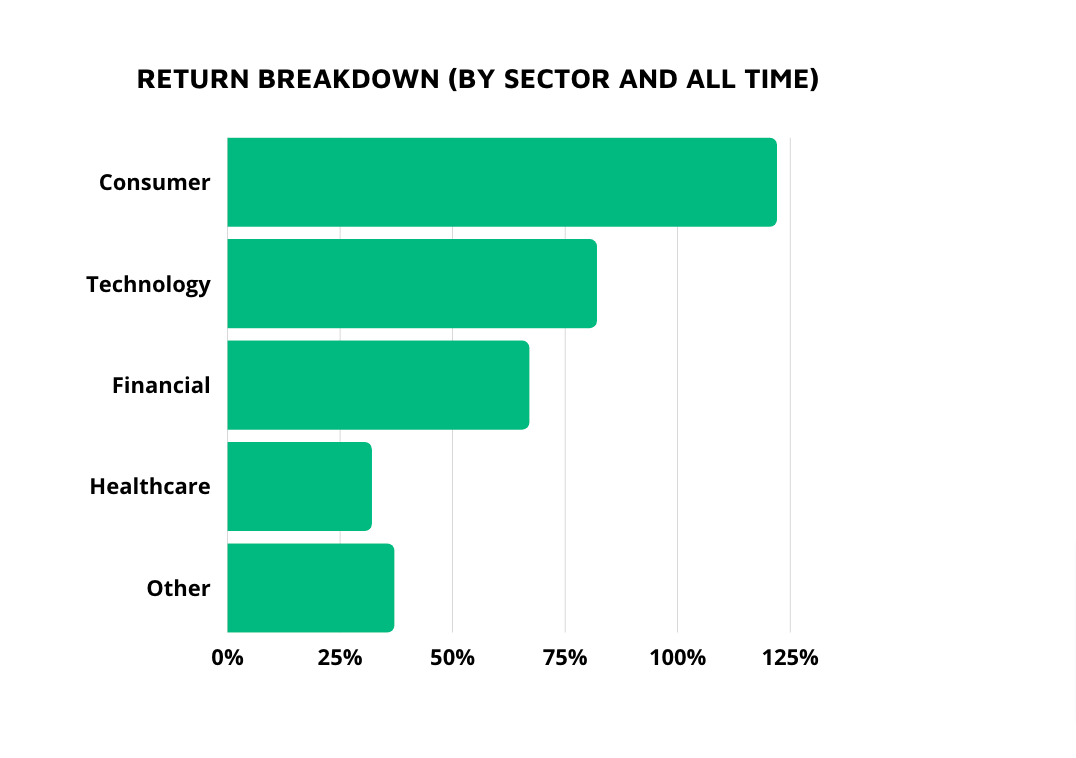
Breakdown of my stock investment returns
Crypto
Once I felt confident enough with my stock investments, I added crypto.
As you might have noticed, I have been spending a lot of time lately learning about and investing in crypto. That led to joining one of the world’s largest finance communities to support their crypto arm with resource curation. Moreover, recently I got invited to speak at Bulgaria’s largest crypto show about my Web3 2022 projections.
While that may sound great, it’s been a bumpy ride. Only now, I start feeling a little bit more confident with my crypto strategy.
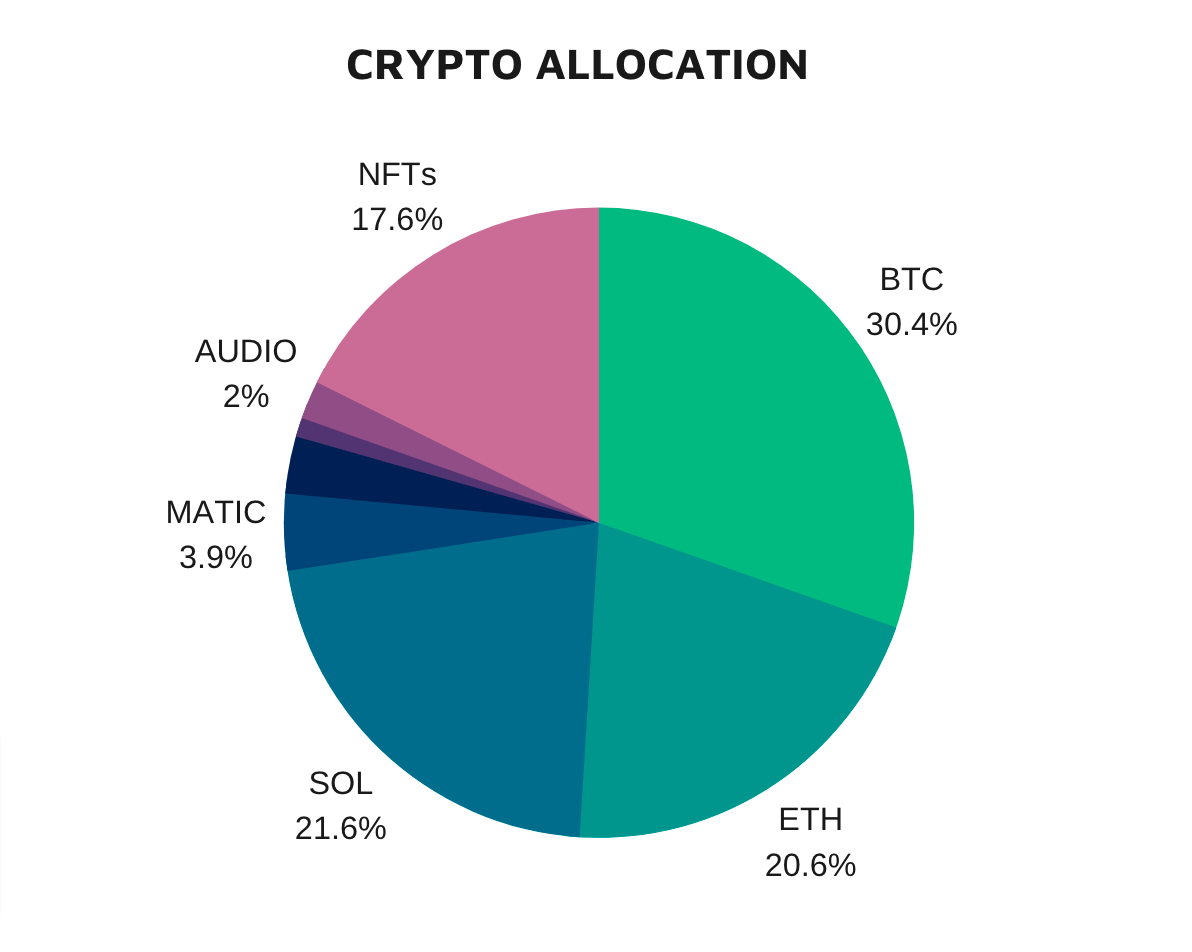
Bitcoin and Ethereum make up most of the global crypto market cap, representing 51 per cent of my crypto portfolio.
Additionally, I am bullish on Solana, so 21 per cent of my budget is in SOL. Next, I have invested in other layer-one blockchains like MATIC and AVAX. The remaining has been allocated to stablecoins (so that I can readily invest) and a few other experiments. Last but not least, I have started playing with NFTs too.
Overall, I stay away from meme coins that follow the sentiment on Twitter and Reddit (e.g., SHIBA and DOGE). My schedule does not leave me with any time to stay on top of such hype. I prefer to put money into projects with high utility.
Next, I plan to allocate a bit of money into more layer one blockchains. Think of the likes of Polkadot and Polygon, plus some DeFi protocols like AAVE, Chia, and a few others.
In general, I prefer to have fewer positions with more conviction than a messy portfolio.
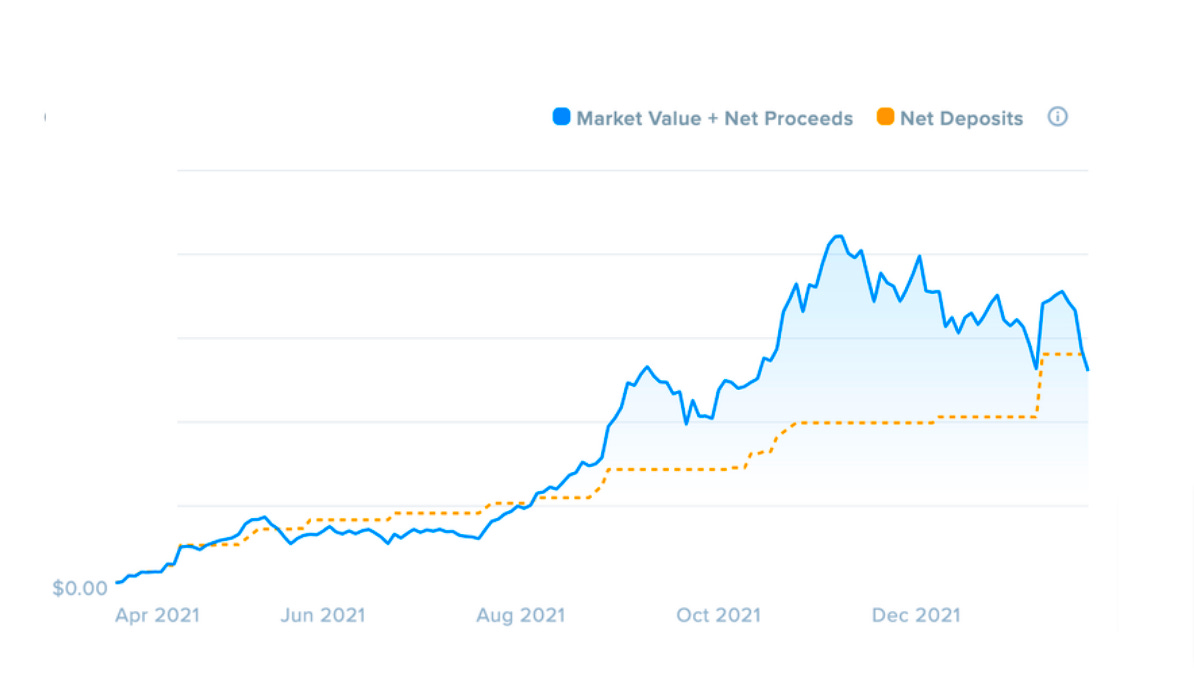
I started tracking my investments via CoinTracker in April. Unfortunately, the product makes many mistakes, and I constantly need to fix discrepancies.
Tools
When assessing what platform to use, I pay attention to two things, UI/UX and fees. When I am new to a field, I prefer to have intuitive UI and UX over fees. In my mind, the high fees are an investment in education. A better UX/UI gives me the confidence to invest without being confused half the time.
That was precisely the case with crypto. First, I started with Coinbase because it was the easiest platform I tried out, despite its high fees. Then, as I got more confident, I started using Binance, Crypto.com, FTX, and a few others.
Next, as I started investing more and more, I started thinking of security. That led me to move my assets in what the industry calls hot wallet, aka software wallet.
To begin with, I got Coinbase Wallet. Over time, I have added Metamask and Phantom (the latter precisely for SOL). The wallet acts as your bank account and identity on the blockchain where you can store your assets. In addition, it gives you self custody.
But with great power comes great responsibility. Since no third party manages your wallet, you need to avoid losing your keys. Otherwise, your funds will be lost forever.
A few months ago, I started shifting my crypto investments to what is often referred to as cold storage, aka a hardware wallet. I use Ledger Nano X as it’s one of the most popular wallets out there (plus I received it as a birthday gift). In the same way, your hot wallet requires you to be very cautious with your keys; you need to be very careful with the cold storage.
For analytics purposes, I use Cointracker, the free version is not perfect, but it’s good enough. Under the paid version, the platform helps you estimate your crypto taxes, too (if any).
When it comes to stocks, I have tested several platforms and narrowed down my choices to:
Revolut – for individual stock investment
Gotrade – for ETFs
To summarise, I hope this article comes in handy when planning your investment strategy. As discussed above, I am new to wealth creation, and there is much to learn. However, writing all that down has helped me better understand my process and what I need to improve.
At the same time, if more people would share their investment journey transparently, that could be a fantastic educational asset.
Unfortunately, there is plenty of generic advice on the web that pisses me off. I prefer tactical over vague advice, but it’s hard to find credible, transparent, and well-intended content.
Having said that, nothing beats having skin in the game, so the earlier one starts, the better. That’s why my brother’s gift for his graduation was me coaching him to invest while providing the necessary resources.
That definitely taught him a few valuable lessons. Nowadays, he is texting me weekly to ask for guidance on how to invest, and he is only 23. I wish someone had helped me the same way when I was his age.
Lastly, I want to thank all the people who have been writing great content and guiding me over the last few years.
Disclaimer
None of the information contained here constitutes an offer (or solicitation of an offer) to buy or sell any currency, product or financial instrument, to make any investment, or to participate in any particular trading strategy.
This article does not take into account your personal investment objectives, specific investment goals, specific needs or financial situation and makes no representation and assumes no liability to the accuracy or completeness of the information provided here.
The information and publications are not intended to be and do not constitute financial advice, investment advice, trading advice or any other advice or recommendation of any sort offered or endorsed by the author.
The author also does not warrant that such information and publications are accurate, up to date or applicable to the circumstances of any particular case.
Any expression of opinion (which may be subject to change without notice) is personal to the author and the author makes no guarantee of any sort regarding accuracy or completeness of any information or analysis supplied.
The author is not responsible for any loss arising from any investment based on any perceived recommendation, forecast or any other information contained here. The contents of these publications should not be construed as an express or implied promise, guarantee or implication by the author that readers will profit or that losses in connection therewith can or will be limited, from reliance on any information set out here.
–
Editor’s note: e27 aims to foster thought leadership by publishing views from the community. Share your opinion by submitting an article, video, podcast, or infographic