Posted on

In Brief: OYO Indonesia names new Country Head, Zomato raises US$52M to kick off IPO

The OYO Indonesia team at a charity event

OYO Indonesia names new Country Head

The story: Celebrating the second anniversary of its operations in Indonesia, India-based hospitality tech startup OYO named Agus Hartono Wijaya as its new Country Head.

Who is Wijaya?: Wijaya was previously the Country Business Development Head at OYO Indonesia for almost two years. He is replacing former Country Head Eko Bramantyo.

What you also need to know: OYO has also launched its coffee brand Kopi Cinta for the Indonesian market. It has also secured a partnership with Simas Insurance and Qoala to provide insurance for hotel guests. The company said that it has recorded 5.5 million bookings during its two years in Indonesia and created a job field for 20,000 workers in the hospitality sectors.

During the COVID-19 pandemic, OYO Indonesia introduced initiatives such as Sanitized Stays, donated US$200,000 to support hospitality industry players, and collaborated with Habitat for Humanity Indonesia.

Zomato raises US$52M to kick off its IPO

The story: India’s food delivery giant Zomato has raised an additional US$52 million from Kora Investments, as part of its ongoing US$600 million funding round, according to Economic Times.

Also Read:  Ecosystem Roundup: Nanofilm plans to raise up to US$375M via IPO on SGX; Singapore’s face scan plan sparks privacy fears

Funding use: It is speculated that the company is raising funding in order to kick off its IPO by mid-2021.

More about this: Despite COVID-19 significantly slowing down sales during the lockdown period in April, the company has reported that the sales volumes are back to normal and recovering.

120 Indian startups form association against Google

The story: 120 startups are forming an app developers’ association within a month to protest against tech giants such as Google, Facebook, Twitter, and Apple, according to Livemint.

“We as a group of Indian startup developers will come together to make an independent congregation. They (Google) cannot be a single gatekeeper to the whole Indian internet ecosystem, especially when they claim to be a non-Indian entity. This is similar to the ‘Salt Movement’,” Paytm founder Vijay Shekhar Sharma said.

The reason: This news comes after Google faced accusations for charging Indian developers using its Play Store 30 per cent commission.

Image Credit: OYO Indonesia

The post In Brief: OYO Indonesia names new Country Head, Zomato raises US$52M to kick off IPO appeared first on e27.

Posted on

Why Trivago co-founder thinks having lots of money as a startup is a challenge

Bill __ Rolf

I am the founder and CEO of StackTrek and we specialise in using algorithms and data to build and scale programming teams for tech companies. Each week, I chat with top executives about startups, culture, and tech hiring.

Sharing insights from my recent conversation with Trivago co-founder Rolf Schrömgens.

What is the most important thing for an entrepreneur to remember when launching his/her own startup?

Schrömgens: For me, as an entrepreneur, it’s all about yourself. I like to trust myself because I realised and I learned that whether I’m getting financing or hiring the right people, in the end, there’s only one person I can blame and that is myself.

Also, as a manager, you have to make the first decision. Everything starts with you. You create the ecosystem and when your people make the wrong decisions or you hired the wrong people, you are responsible. Although, I’m not so much into making decisions myself but more into building the right ecosystems where good decision-making is possible.

What is the most difficult challenge yet you have encountered when you launched Trivago?

Schrömgens: The first challenge for us was to survive. We had very few resources when we started and we did the coding ourselves. So, basically, our first challenge was that we had no money. Our second challenge was having money.

You start getting your first investor in and from having no money and then now you have a lot of money and you ask yourself, “Now, what do we do with the money?” Now, you’ll have to do more and be faster and so on. But you might not have the right structures in place yet.

Also Read: Do not fall victim to the 7 biggest startup mistakes of all time

That’s really challenging because it puts a disruptive element in the culture. You haven’t yet built a culture and then you get money in and it changes how you operate.

For Trivago, we only did two small financing ground at the beginning. We never did that again but it has helped us grow the company out of the cash flow. This helped us maintain our culture and sustain our internal organisation.

What kind of leader are you in terms of leading your company?

Schrömgens: You can be a great innovator like Steve Jobs, who has all these amazing ideas and pushes them through the organisation. That’s one way to be successful. I don’t consider myself one of those people. For me, innovation has to happen through the organisation. I think it’s more stable that way.

If innovation can happen to many people in the organisation, it’s more stable and more sustainable. So, from my perspective, my job is to create an environment where innovation can happen. I think the strongest innovation for a product – in creating value for your users – is through building a perfect organisation.

That’s what I’m trying to do; building a perfect organisation where creativity can thrive and you can execute on it and create great products.

Trivago has been growing into a bigger company recently. What is your strategy to make sure that your company is stable?

Schrömgens: Trivago is an agile company. We work hard to keep this alive by using agile concepts, even with a thousand hundred people. We believe in trying and believing in an evolutionary process more than a strategic one.

For that, you’d have to put a lot of things together like the culture, the kind of organisation you created, and the motivations of the organisation. It’s a tough thing to do and it gets tougher the bigger your organisation grows. You have to be radical in your approaches if you still want to be able to innovate in high pacing. You need to exclude all ego from your organisation and make sure that your people are not extrinsically motivated but intrinsically strong and motivated. You also have to find the right setting in place.

Also Read: How to get the most out of agile development

Back then, we followed the traditional leadership model where you have one leader in a team but that didn’t work for us anymore. We changed it to have more or less three leaders per team. It may be hard to do this in an organisation where there are a thousand hundred people but I think it worked in Trivago because we fostered a culture where this is accepted.

Our culture isn’t about status or titles; it’s about driving the company forward towards creating a great product. This culture took about many years to cultivate in our company.

You’ve been talking a lot about managing organisation and people. Trivago as a tech product and Trivago as a company, which one do you focus on more?

Schrömgens: It depends on the stage of the company. When we started, I coded the first version of Trivago myself and there was a lot of focus on the end-product. We stayed there for a while but when you start having a thousand people in your organisation, you have to pull the creativity out of those people. You can’t just pull the creativity out from yourself – that would be very inefficient.

So, eventually, your scope has to change from focusing on the product to creating a good product through creating a good organisation. That’s where I invest my time now.

My time investment has changed drastically from being the one creating the product to guiding people to create the product, to deliver ideas to the product, and to the delivery of ideas for changing the organisation. Communication is also very important in this process.

When you entered this industry, there were a lot of naysayers. How did you react to them?

Schrömgens: For me, it’s a question of how you expose yourself to these noises. We all have a tendency to be insecure and get confirmation from others that’s why we talk to a lot of people.

But I think, sometimes, you just have to say no and focus on your product, your customers, and your users. That’s the most important thing. It’s not about your competition in the industry.

Also Read: 8 proven tips for successfully scaling an e-commerce business

You’ve experienced dealing with investors for your company. What is the one you’ve learned out of that experience? What advice would you give to those who are also looking for investors for their company?

Schrömgens: I think that it’s not healthy for investors to lead the company. I think they should be hands-off. I’ve also been an investor myself and I would rather that investors not interfere with the day-to-day operations of the company and instead, look at their long-term performance.

You don’t have to put a show for your investors; just focus on your product and make sure that it solves the problem of your users.

What is your advice to those who are launching their first startups?

Schrömgens: If you want your product to have great value in the future, you need to focus on one thing. Especially when you have a lot of competition in a specific industry, you need to find your niche and find a vertical where you can deliver a great product value. Just work with one problem and try to deliver a great solution for it.

Each week, Billy Yuen talks with top entrepreneurs, investors and executives about startups, hiring and building awesome teams. This interview has been edited for space and clarity.

Editor’s note: e27 aims to foster thought leadership by publishing contributions from the community. Become a thought leader in the community and share your opinions or ideas and earn a byline by submitting a post.

Join our e27 Telegram group, or like the e27 Facebook page

The post Why Trivago co-founder thinks having lots of money as a startup is a challenge appeared first on e27.

Posted on

What this digital shift means for people with disabilities in SEA

The Southeast Asian region (SEA) can pride itself in being one of the most promising markets for technology in the world.

To start, the region is home to over 650 million people or 8.5 per cent of the world’s population. A digital wave is also sweeping SEA led by tech-savvy millennials. Internet connectivity and mobile phone use are rapidly increasing.

In 2019, SEA saw a double-digit growth in internet penetration, mobile connectivity, and social media penetration. It now has over 400 million internet users.

Local tech startups have taken advantage of this. SEA is home to 10 unicorns including ride-hailing platform Grab, online marketplace Lazada, and digital content and entertainment company VNG. The region’s internet economy is predicted to hit US$300 billion in 2025.

However, one crucial aspect that must not be overlooked in all this growth is digital accessibility. The rapid digital adoption in the region is steadily prompting people to shift their daily activities online.

Elsewhere in the world, accessibility has become quite the hot topic. Laws such as the US’ Americans with Disabilities Act (ADA) and the European Accessibility Act provide for equal access to people with disabilities.

Just last year, pizza chain Domino’s lost a case filed by a blind man claiming that Domino’s website was not accessible to visually impaired users. The ruling affirmed that accessibility laws cover digital channels.

More parties are filing similar claims and suits prompting businesses to bring their websites and applications up to standards. And now, Radioshack was recent sued.

Also Read: These 8 Southeast Asian startups work with people with disabilities to build a more inclusive society

The W3C’s Web Content Accessibility Guidelines (WCAG) is currently in revision 2.1 and promotes support for a variety of disabilities including visual, auditory, motor, and cognitive impairments. Companies are striving to achieve compliance with these standards.

Since then, businesses started looking for ways to improve their site’s accessibility.

Even solutions providers are actively looking to advance digital accessibility. Recently, leading web design publication Web Designer Depot reviewed AccessiBe, an accessibility software that leverages AI to make websites compliant with the WCAG and usable to people with disabilities. The company recently secured a US$12 million round led by private equity K1.

Searches for the ADA and the WCAG rose by more than 400 per cent after the Domino’s case was validated. But while demand for digital accessibility is increasing elsewhere in the world, things appear to be progressing slower on the SEA front.

As of this writing, popular e-commerce marketplaces in the region such as Lazada and Shopee still have accessibility issues if check using web accessibility evaluation tools. This likely means that users with disabilities who try to access these platforms may not be able to enjoy the convenience that these platforms offer.

There are already accessibility laws and efforts being put in place but there still remains a gap in implementation.

In the Philippines, for example, the Department of Information and Communications and Technology (DICT) is working with the National Council on Disability Affairs and the Philippine Web Accessibility Group (PWAG) to push websites to adhere to the standards of the WCAG.

Yet, in 2019, no Philippine government website hosted by the Government Web Hosting Service achieved web accessibility compliance despite adopting the WCAG in 2017.

There are positive developments. All countries in the region are signatories to the United Nation’s Convention on the Rights of Persons with Disabilities. Collaboration across various advocacy groups in the region are ongoing.

Also Read: Digital transformation is now real: How COVID-19 has sparked innovation in tech companies

In the Philippines, advocacy groups successfully compelled news programs to include sign language interpretation as part of their broadcasts covering the coronavirus pandemic as it is mandated by law in the country. Filipino Sign Language courses are now also available online.

SEA tech startups are also starting to target the disabled for their products and services. Kerjabilitas and Difalink in Indonesia provide accessible job search and recruitment platforms. Singapore’s Embodied Sensing manufactures assistive devices like Knoctify a sensor that lights up or vibrates to notify deaf people when someone knocks on their door.

Still, efforts to improve web accessibility have to intensify. The rapid growth in internet use in Southeast Asia proves how technology can offer services and bring convenience to the public. No one, especially people with disabilities, must be left behind. It’s high time that SEA stakeholders put pressure on site-owners and businesses to finally do the right thing.

Editor’s note: e27 aims to foster thought leadership by publishing contributions from the community. Become a thought leader in the community and share your opinions or ideas and earn a byline by submitting a post.

Join our e27 Telegram group, or like the e27 Facebook page

Image Credit: Elevate on Unsplash

The post What this digital shift means for people with disabilities in SEA appeared first on e27.

Posted on

How e-tailers should prepare for Singles’ Day amidst COVID-19

On Singles’ Day (November 11) last year, Chinese e-commerce giant Alibaba banked a whopping US$38.4 billion (EUR32.2 billion) in sales, shattering its 2018 record in the process.

The year-on-year growth of the world’s largest shopping event was impressive but noticeably slower — a trend that analysts attributed to China’s weakening economy, and its trade war with the US.

The shopping festival is in the spotlight again this year. Despite dampened global economic sentiment and a drop in consumer spending due to COVID-19, there are silver linings.

According to a survey on Asian consumer behaviour by global measurement and data analytics agency Nielsen, the pandemic has not only increased online shopping spends , but also converted many offline shoppers to online.

During the pandemic, our global logistics network has already seen shipment volumes surpass that of our traditional peak season between November to February, which coincides with the Lunar New Year holidays.

We have also observed how traditional businesses without a digital presence have taken the opportunity to venture into e-commerce, and how retailers are doubling down on e-commerce to recoup losses from the COVID-19 fallout. Meanwhile, e-commerce marketplaces and sellers are running on all cylinders to fight for a slice of the online market.

The peak is still to come as we anticipate a 40 per cent surge in daily volume passing through our network during Singles’ Day and the year-end holiday season, even before considering the effects of COVID-19 on e-commerce.

Also Read: Asia’s food delivery potential is set to unlock post-COVID-19. Here’s why

While we pull out all the stops to keep goods moving, businesses too need to start preparing early for this 24-hour shopping extravaganza and the year-end peak season. Here’s how yours can go about doing so amid the pandemic:

Forecast demand

Looking at data collected in recent years can indicate specific peak periods for the demand that your business is likely to face.

With COVID-19, the situation could be different, but mapping this out in advance will give you ample time to implement measures to plug the gaps that may arise when demand soars.

In the case of Singles’ Day, this could include securing additional manpower to cope with the peak season volume and training them ahead of time to ensure familiarity with the processes.

Referencing past data could also guide businesses in determining their inventory levels and identifying supplier alternatives — by geographies or product types, for instance — in the event of overwhelming demand.

Clear shipping policies

The unexpected shipping charge that only appears at checkout could turn customers away from the business. An e-commerce survey by audience measurement company Comscore revealed that up to 55 per cent of shoppers would abandon their carts if they are suddenly hit with hidden charges that were not clearly communicated.

You can avoid such instances with a well-defined shipping policy that sets clear expectations with customers, ensuring a seamless purchasing experience.

Shipping charges, duties, or any other surcharges should be transparent and outlined, preferably in a prominent spot or pop-up window on the website.

Also Read: 5 reasons to be bullish on logistics tech in Asia

Any restrictions related to shipping to certain countries, or special handling involved, should also be specified to avoid confusion.

On-demand shipping

During the pandemic, changes in movement restrictions mean consumers might be alternating between working from the office and working from home.

To better cater to your customers, flexible alternatives must be offered to them to ensure they are available to receive their orders at a time and place of their convenience. By leaving the decision with them, the fulfilment of last-mile delivery will likely improve as the instances of failed deliveries will be lowered.

Empowering your customers to customise their deliveries, in turn, raises their satisfaction with your business for offering such convenience, and may even encourage repeat purchases.

End-to-end shipping visibility

Supply chain experts have cited shipment visibility as one of the key attributes consumers look for during the busy holiday season.

Given the additional rules and changing regulations due to the pandemic, holiday shipping across borders may be impacted, making shipment visibility all the more important.

The ability to track a shipment online and knowing if it would arrive on the scheduled delivery date is essential to keeping your customers satisfied.

Enabling the capability as a self-help function further reduces the number of inquiries and, in turn, minimises extra costs for customer support.

Also Read: Singapore tech entrepreneurs raise funds to help Indonesian daily wage workers during COVID-19

Your business also stands to gain by addressing issues promptly, with a bird’s eye view of the order fulfilment process with the tracking function, thus improving service delivery standards.

Contactless delivery

The safety of customers should be prioritised especially in the thick of the COVID-19 pandemic.

To reduce the risk of transmission, contactless delivery should be made a default option to protect the health and safety of your customers and the delivery personnel.

The standard practice of the consignee signing on the courier’s scanner to acknowledge receipt of the shipment should be temporarily shelved.

This can be simply replaced by a release option that allows the courier to leave the parcel at an agreed-upon area for the consignee’s collection without a signature.

If possible, this arrangement should be communicated to your customers early so they are aware of what to expect when their parcels arrive.

Be ready for returns

It would be best if you also remembered to prepare for the influx of returns generated by online shopping once Singles’ Day and the holiday shopping season comes to an end. That is when shoppers will return most of their unwanted gifts or clothes.

Providing a smooth returns experience is the priority as it serves as another opportunity for your business to engage the customer. You can make it easier by adding a return label with every delivered shipment, making it less of a hassle for the customer.

Managing returns has proven costly for large retailers and small businesses alike. Given the peak shopping season, extending the returns period may be another alternative to avoid stressing resources. What matters most is that businesses think through this in advance before the season officially begins.

Editor’s note: e27 aims to foster thought leadership by publishing contributions from the community. Become a thought leader in the community and share your opinions or ideas and earn a byline by submitting a post.

Join our e27 Telegram group, or like the e27 Facebook page

The post How e-tailers should prepare for Singles’ Day amidst COVID-19 appeared first on e27.

Posted on

Ecosystem Roundup: Nanofilm plans to raise up to US$375M via IPO on SGX; Singapore’s face scan plan sparks privacy fears

Singapore’s world-first face scan plan sparks privacy fears; From next year, millions of people living here will be able to access government agencies, banking services and other amenities with a quick face scan; Singapore is frequently accused of targeting government critics and taking a hard line on dissent, and activists are concerned about how the face scanning tech will be used. AFP

Singapore’s Nanofilm to raise up to US$375M in largest local IPO in years; Nanofilm would be the first local tech unicorn to list in the city-state; If successful, it would be the largest listing on the SGX; Nanofilm makes coating materials for smartphones, TVs and smartwatches among others. Reuters

How SEA’s states are tightening the screws on tech giants; Based on publicly available info and insights from industry experts, Big Tech can expect enhanced oversight from SEA regulators in the areas of data, content, tax and merger control; The effects of this greater scrutiny will be felt not just by Big Tech but by startups and investors as well. TechInAsia

Rethinking Telkom Group’s plan to invest in gojek; The state-owned telco’s investment will likely focus on the opportunity for the two companies to collaborate — gojek will gain benefits from Telkomsel’s 172M customers and vice versa; However, Telkom does not have a very bright history with managing digital businesses — several of its innovation had sunk with the latest being Blanja. e27

Singapore’s e-sports platform EVOS raises US$12M Series B; Investors include Korea Investment Partners, Mirae Asset, Woowa Brothers, Insignia; To date, EVOS claims to have worked with more than 150 brands and 400 gaming influencers, who earn US$30K-US$60K a month via the platform. e27

Thai point exchange platform ChomCHOB raises Series A from InVent; ChomCHOB is an app that collects points from credit/debit cards; Users have the option to convert all of their credit/debit card points into ChomChob reward points, which allows them to purchase different kinds of products and services. It claims to have over 500K merchants and claims to have about 2M user downloads. e27

TechCrunch founder’s VC firm Arrington XRP Capital leads US$3.7M in Persistence; The Singapore’s blockchain startup, founded by an ex-Golden Gate employee, is focussing on powering institutional DeFi/OpFi adoption; Persistence tokenises real-world assets and puts them on the blockchain and these assets can then be used by companies as collateral for acquiring loans. e27

Singapore e-motorcycle startup ION Mobility secures US$3.3M; Investors incude Monk’s Hill, 500 Durians; It plans to launch its first EV in 2021 in Indonesia, one of the biggest motorbike markets globally, with 2019 motorcycle sales at 6.38M units; ION is also set to expand its team and operations across Singapore, Jakarta and Shenzhen. e27

Thailand’s e-commerce fulfilment startup MyCloudFulfillment (MCF) raises US$2M funding; Backers are ECG-Research, Gobi, NVest, SCB 10X; MCF claims it recently passed milestones of over 100K SKUs in storage, 50K of maximum daily orders, US$16M worth of transactions during H1, 2020. e27

Indonesia’s Social Bella expands its beauty e-commerce biz into Vietnam; The expansion is through its e-commerce unit Sociolla; This comes shortly after it raised US$58M Series E from Temasek, Pavilion Capital, Jungle Ventures; Social Bella is estimated to serve around 30 million users in 2020. e27

Tencent is reportedly setting up its first Singapore office at JustCo; The WeChat owner will have almost 200 seats at JustCo’s co-working space in OCBC Centre East at Raffles Place; The deal paves the way for Tencent to make Singapore its beachhead for a push into SEA. The Straits Times

Vietnam’s mobile commerce is set to open up avenues for startups; The country ranks third in SEA in terms of the total sessions on shopping apps (Android), accounting for a whopping 19.5% of the region’s market share; Vietnam ranks only behind Indonesia and Thailand, missing the second place by only 0.2 billion sessions. e27

Here’s how to foster a culture of creativity within your company to attract creators; COVID-19 has only accelerated the importance of creativity in the workplace; Organisations are realising that creativity plays a role not only in successful marketing, communications, and R&D but also in maintaining a productive and engaged workforce during these unprecedented times. The Next Web

Are your influence skills ready for remote work?; Studies show it is difficult to influence people through digital interactions; One study, for example, looked at changes of opinion in response to differing info; When contrasting info was revealed in a f2f discussion, 38% of participants changed their mind; Conversely, only 10% did so when the info was revealed through an online discussion forum. e27

AI park will help Malaysia take the lead in digital future; Last year, G3 Global partnered China’s SenseTime Group and China Harbour Engineering to set up Malaysia’s first AI park, with a total investment of more than US$1B over the next 5 years; AI technology is expected to contribute some US$115B to Malaysia’s GDP by 2030. The Star

Are digital assets and blockchain poised to become mainstream in Singapore?; With government blockchain project ‘Project Ubin’ moving closer to commercialisation, Temasek’s involvement in Facebook’s Libra, Opencerts managing the digital certificates of 2020 local graduates and more businesses accepting Bitcoin as a way to transact, local businesses are feeling positive about the industry’s prospects going forward. Tech Coffee House

PoC to prototype to MVP: Software development 101 for early-stage tech startups; The purpose of PoC is to test a concept, product, or process basically to validate your assumptions as well as those of your potential customers; The prototype enables you to actually see how the product will operate in real life. It is the physical embodiment of the ideal concept. e27

Vietnamese tech firms export more 5G devices to the world; VinSmart has agreed to ship about 2M of its Vsmart 5G smartphones to the US this year; VinSmart has partnered with Qualcomm to launch 13 smartphones both in Vietnam as well as in Spain, Russia, and Myanmar; This July, it launched its first 5G-enabled smartphones, the VinSmart Aris series. Vietnam News

Vietnam’s vision and goals for a digital nation; As per a report, Vietnam’s digital economy was valued at US$12B in 2019; Over the past 5 years, its e-commerce market grew by over 25% per year and its digital economy is forecast to contribute 5% to its GDP and is expected to reach US$43B by 2025. Open Gov

‘Online-first’ habit boosts e-payments, cross-border trade, says PayPal; Shoppers in SEA are likely to remain cautious even after the pandemic is contained and are also inclined to lean on contactless means for their needs, PayPal Senior Director and Head of Sales (SEA) Rajkishore Agrawal said. ABS-CBN News

B2B distributors look at a digital future beyond COVID-19; The pandemic has permanently shifted more business buyer behaviour online and accelerated the growth of B2B e-commerce; COVID-19 also is accelerating the rate at which B2B organizations of all sizes will purchase online in 2021. Digital Commerce 360

Leaders advance digital investments to future-proof from disruptions; A survey says despite ongoing economic pressures, only 22% of the 100 local business leaders surveyed said that they plan to reduce their digital transformation budgets, whilst 1 in 3 kept their budgets unchanged; Amongst industries, the banking sector was most likely to be in-sourcing its digital initiatives, with 61% indicating so. Singapore Business Review

Open banking is a bigger disruption force to incumbents then digital banks, says DBS; Open banking will allow consumers to aggregate their banking, insurance and investment info across banks and financial institutions on a single platform, allowing for easier comparability and higher level of competitiveness in the banking industry. Fintech News

How Indonesia is developing Sharia fintech; Sharia FinTech platforms continue to provide common services like crowdfunding and P2P lending, with some differences: borrowers share investment profits and losses with their lenders; money is only invested in Halal projects; and investors are encouraged to help low-income groups. Gov Insider

Indonesia’s Ministry of Industry launches Startup4industry 2020; The overarching theme of Startup4industry 2020 is ‘Indonesia Is Confident in Domestic Technology’; Utilising modern tech, the initiative has two main aims: positive social impact on citizens and mitigating the impact of the pandemic in the industrial sector. Open Gov

Image Credit: Unsplash

The post Ecosystem Roundup: Nanofilm plans to raise up to US$375M via IPO on SGX; Singapore’s face scan plan sparks privacy fears appeared first on e27.

Posted on

Top contributions this week: StackTrek founder’s conversations with Trivago co-founder on managing cashflows and more…

e27 contributor programme

Hello community

This week was full of exciting conversations in our contributor community. While DHL Express MD reminded startups on the upcoming logistics challenges as holiday season approaches, an academic from the University of Michigan shares his psychology secrets for a remote work life.

From the emerging economies world, the CEO of a Burmese fintech startup opened our minds to the massive potential in Myanmar’s digital payment scene and marketing guru at iPrice highlighted Vietnam’s rising mobile commerce.

Raking in the moolah

Why Trivago co-founder thinks having lots of money as a startup is a challenge by StackTrek founder Billy Yuen:

“For Trivago, we only did two small financing ground at the beginning. We never did that again but it has helped us grow the company out of the cash flow. This helped us maintain our culture and sustain our internal organisation.”

How understanding culture can drive digitalisation of payments in Myanmar by CEO of fintech startup NearMe, Lynn Htaik Aung

“Nonetheless, the time seems ripe for Myanmar to take the leap. Infrastructure is in place and expanding – Myanmar’s mobile phone connectivity is over 95 per cent and almost three-quarters of Myanmar’s working population owns a mobile phone.

The COVID-19 pandemic has also compelled the Myanmar government to show strong support for digital payments as it reduces physical contact between people.”

Shop till you drop

How e-tailers should prepare for Singles’ Day amidst COVID-19 by Yasmin Khan, Commercial Head of Asia Pacific and the MD of 10 Emerging Markets in DHL Express

“We have also observed how traditional businesses without a digital presence have taken the opportunity to venture into e-commerce, and how retailers are doubling down on e-commerce to recoup losses from the COVID-19 fallout. Meanwhile, e-commerce marketplaces and sellers are running on all cylinders to fight for a slice of the online market.

The peak is still to come as we anticipate a 40 per cent surge in daily volume passing through our network during Singles’ Day and the year-end holiday season, even before considering the effects of COVID-19 on e-commerce.”

The cheapest e-commerce platform in Singapore –and what it means for competition landscape by Duckju (DJ) Kang, CEO of ValueChampion:

“While brick-and-mortar stores have their benefits, online shopping comes with its own perks of cheaper prices due to lower operational costs and overhead. However, do all e-commerce sites provide the same great deals to their customers?

To find out, we explored how four of Singapore’s largest e-commerce platforms compare on price across 73 everyday products.”

Vietnam’s mobile commerce is set to open up avenues for startups by Đặng Đăng Trường from iPrice Group:

“The sudden arrival of COVID-19 in early 2020 became of definitive turning point for Vietnam’s e-commerce to accelerate the process. With more people staying at home, and with the increasing demand for online entertainment, Q2 became the ideal condition for e-commerce startups to apply the features they have been testing.”

The post COVID-19 life

Are your influence skills ready for remote work? by Maxim Sytch from B-school professor at University of Michigan:

“By some accounts, 61 per cent of the global workforce is now remote. And, while it is unclear whether and by how much this number may change in the next few years, it is clear that remote work is here to stay in a significant capacity.

What does this mean for you and your influence skills? Modern organisations feature flatter hierarchies, matrix structures, and cross-functional workflows, with great degrees of involvement from external stakeholders, such as alliance partners, suppliers, investors, and even rivals.”

What this digital shift means for people with disabilities in SEA by fintech enthusiast and our regular contributor, Kay Banzon:

“SEA is home to 10 unicorns including ride-hailing platform Grab, online marketplace Lazada, and digital content and entertainment company VNG.

However, one crucial aspect that must not be overlooked in all this growth is digital accessibility. The rapid digital adoption in the region is steadily prompting people to shift their daily activities online.

Elsewhere in the world, accessibility has become quite the hot topic. Laws such as the US’ Americans with Disabilities Act (ADA) and the European Accessibility Act provide for equal access to people with disabilities.”

How edutech startups can accelerate active learning by our regular contributor Ong Kai Kiat

“The key challenge of digital education would be to engage and gain the attention of the students. Even during Zoom education, the students can be passively looking past the Zoom screen to a Netflix film on the television screen behind them as they put themselves on mute.”

Editor’s note: e27 aims to foster thought leadership by publishing contributions from the community. Become a thought leader in the community and share your opinions or ideas and earn a byline by submitting a post.

Join our e27 Telegram group, or like the e27 Facebook page

Image credit: “My Life Through A Lens” on Unsplash

The post Top contributions this week: StackTrek founder’s conversations with Trivago co-founder on managing cashflows and more… appeared first on e27.

Posted on

Rethinking Telkom Group’s plan to invest in gojek

Reports about Indonesian state-owned telco Telkom Group becoming an investor in tech giant gojek continues to circulate. According to an investigation by Tempo, Telkomsel –Telkom Group-backed mobile operator– is set to invest IDR2.2 trillion (US$150 million) and the process is close to being finalised. DailySocial has attempted to reach out to Telkomsel to confirm the news but has not received any response by the time this article was published. Even with the information openness on the Indonesia Stock Exchange (BEI), Telkom is yet to provide commentary regarding the report.

Rumours of the investment have begun circulating since 2018. By the time, the amount of the investment was said to double the reported number today at US$400 million, but this proposal was rejected by then minister of the state-owned enterprises (SOEs). It is said that the current minister gives the investment a green light as he has also been aiming for digital transformation among state-owned enterprises.

This corporate move is worth our attention as there is a great amount of public fund being at stake –Telkomsel is owned by two companies, Telkom (65 per cent) and Singtel Mobile (35 per cent).

High risks

In Indonesia, conglomerate groups that have taken part in gojek’s investment rounds are Astra and Djarum (through Blibli). With its decacorn status, gojek will continue to attract the attention of global investors. But as a startup with an emphasis on growth, the strategy that the company is implementing involves pumping its valuation in order to dominate the market.

In various opportunities, before the pandemic, gojek has revealed plans to execute corporate profit-making strategy through GoFood and GoPay. In 2019, GoFood is said to have made a revenue of US$2 billion, 50 million monthly transactions, and 2.5 growth. Meanwhile, GoPay contributed US$6.3 billion although the growth rate was not mentioned.

Also Read: Ecosystem Roundup: gojek acquires WePay; Carousell close to becoming unicorn; Patamar launches US$50M fund for SEA’s female founders

But these numbers do not guarantee that investing in gojek will generate profit for its investors. A highly dynamic market may contribute to various factors that can threaten the business.

First, there is still gojek’s greatest competitor –Grab. Both companies hold the decacorn status and are reaching out to the same target audience, with a similar product offering.

gojek also owns many business units that are operating independently: GoPay and GoPlay. In the Indonesian digital payments landscape, according to various reports, GoPay is competing with OVO, Dana, and even ShopeePay. Meanwhile, GoPlay has to compete directly with Netflix, iflix, Viu, and many more.

Second, there is the challenge of the never-ending validation process. gojek may have secured millions of users but they have to continue on making adjustments.

The company even had to shut down all the services under its GoLife business unit and laid off 430 employees. The pandemic has radically affected user behaviour, forcing startup founders to reconsider their business strategy.

When considering these two challenges, Telkom Group’s investment in gojek will likely focus on the opportunity for the two companies to collaborate. gojek will gain benefits from Telkomsel’s 172 million customers –which also includes merchants– and vice versa.

It is not easy to guess on the kind of collaboration that can happen between the two companies, as their core business differs greatly. The difference also lies in their business culture. Some of their business units are also competing directly.

Also Read: Ecosystem Roundup: Bangkok Bank picks 1% stake in gojek; Grab in talks with AIA, Prudential for US$300-500M funding; Vietnam’s Do Ventures launches US$50M fund

By June, gojek’s valuation is predicted to reach IDR184 trillion (US$12.5 billion). If Telkomsel walks in with a US$150 million investment, there is a great possibility that they will own no more than one per cent. With this percentage, it is certainly unrealistic to expect great returns in the short run, especially since gojek’s IPO plan remains unclear.

Telkom in the Indonesian startup ecosystem

Telkom does not have a very bright history with managing digital businesses; several of its innovation had sunk with the latest being Blanja. As the result of its collaboration with eBay, Blanja failed to compete in the local market.

But the company remains eager to compete. Their latest move included the appointment of Bukalapak Co-Founder Fajrin Rasyid as its new Director of Digital Business.

The state regulation on SOEs (UU No. 19 2003) stated that the goal of an SOE is to contribute to the national economy by making profits. Considering the end goal, it is crucial for corporations to put profits first.

Telkom and Telkomsel have more luck in the startup investment sector through MDI Ventures and TMI. They have made a rather glorious achievement with five exits through M&A and IPO last year, according to DailySocial reports. It was the highest among local VC firms in that time frame.

Telkom has recently launched a US$500 million fund to invest in startups. MDI is managing a total of IDR 11.6 trillion (US$760 million) while Telkomsel’s TMI manages US$40 million.

Let us see how this potential collaboration with gojek is going to end up for Telkom Group.

The article was written in Bahasa Indonesia by Randi Eka Yonida for DailySocial. English translation and editing by e27.

The post Rethinking Telkom Group’s plan to invest in gojek appeared first on e27.

Posted on

The cheapest e-commerce platform in Singapore –and what it means for competition landscape

e-commerce cheapest Singapore

It’s no secret that the outbreak of COVID-19 and the start of Singapore’s “stay-at-home” order caused many residents to change the way they operate, by replacing in-person activities with virtual ones. As a result, many e-commerce websites have seen an increase in customers, as more Singaporeans switch to online shopping.

While brick-and-mortar stores have their benefits, online shopping comes with its own perks of cheaper prices due to lower operational costs and overhead. However, do all e-commerce sites provide the same great deals to their customers?

To find out, we explored how four of Singapore’s largest e-commerce platforms compare on price across 73 everyday products.

We collected the best selling products across different categories that were available on the top four e-commerce platforms in Singapore. The products included in this study were limited to items that were mutually available on all four sites.

We then refined our list of data so that each product shared the same quantity, weight, and/or model number to ensure that the data was being accurately compared. This process left us with 73 products spanning over seven different shopping categories.

Once the data was collected and sorted, we analysed who had the cheapest prices based on item and overall product category.

Key Findings

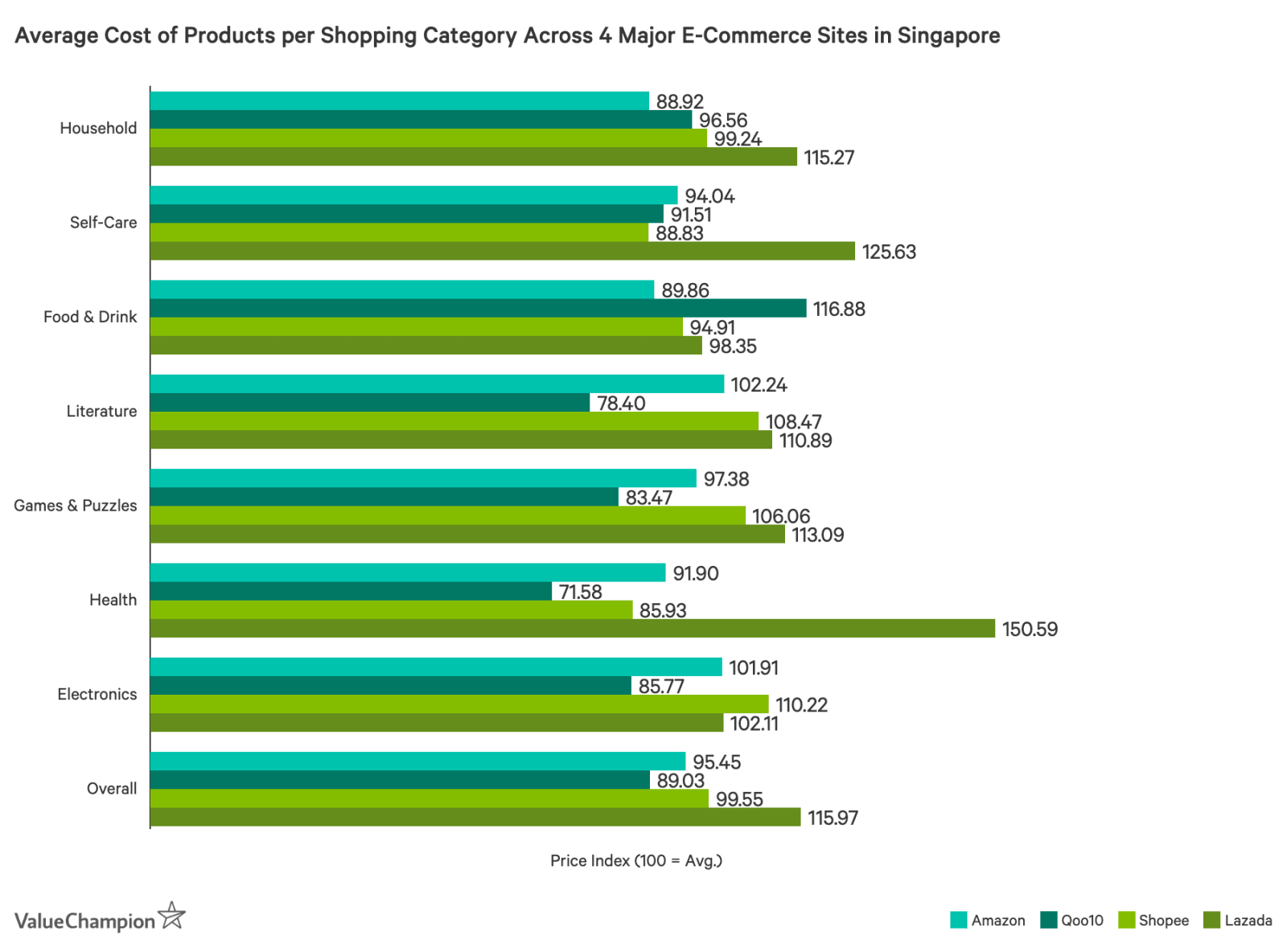
  • Qoo10 and Amazon consistently have the lowest prices across categories, costing 10.97 per cent and 4.55 per cent less on average than their competitors
  • Amazon dominates the household and food and drink categories, while Qoo10 dominates the electronics, games and puzzles, health, and literature categories.

Also Read: Flash Express secures US$200M Series D to expand its e-commerce logistics service in SEA

Smaller contenders seem to be the cost leaders

While Shopee and Lazada are the most popular e-commerce sites in Singapore, we found that they don’t actually offer the cheapest prices. Instead, our data suggests that the less prominent e-commerce sites, Qoo10 and new entrant Amazon, provide some of the best deals to customers.

Average Cost of Products per Shopping Category Across 4- Major E-Commerce Sites in Singapore

Overall, Qoo10 had the cheapest prices on average out of all the e-commerce platforms we analysed, with 35 out of the 73 items being the cheapest. Prices were typically 10.97 per cent cheaper than average.

Amazon was the second cheapest platform, with 30 items that averaged 4.55 per cent cheaper than average. In contrast, Singapore’s most popular e-commerce site, Lazada, was 15.97 per cent more expensive on average for the categories we analysed.

Different platforms dominate different categories

While Qoo10 is generally the cheapest e-commerce site, there are still instances where you can find cheaper products on other platforms.

For instance, while Qoo10 was the price leader in the electronics, health, games and puzzles and literature category, with prices ranging from 14.23 to 28.42 per cent below average, Amazon specifically controlled the household and food & drink categories, with prices 10.14 to 11.08 per cent below average.

Also Read: 5-step strategy for agri e-commerce startups to engage customers

Price comparison of popular items

Item Category Amazon Qoo10 Shopee Lazada
Dasani Drinking Water, 1.5L (Pack of 12) Food & Drink S$7.20 S$10.16 S$8.80 S$7.60
Kleenex Ultra Soft Bath Tissue, 200ct (Pack of 20) Household S$13.44 S$14.72 S$13.95 S$13.44
Monopoly Classic Game Games & Puzzles S$39.99 S$29.16 S$49.90 S$39.80
Philips 4200 32PHT4233/98 32-Inch Slim LED TV Electronics S$178.00 S$135.19 S$189.00 S$160.00
Blackmores Odourless Fish Oil, 400ct Health S$26.48 S$14.54 S$23.90 S$47.99
The Subtle Art of Not Giving a F*ck (Book) Literature S$25.73 S$17.14 S$25.80 S$23.73
Listerine Mouthwash Total Care, 1000ml Self-Care S$8.57 S$11.08 S$11.90 S$11.90

Singapore’s e-commerce landscape

Looking forward, e-commerce platforms in Singapore will be looking to capitalise on this increase in online shopping activity.

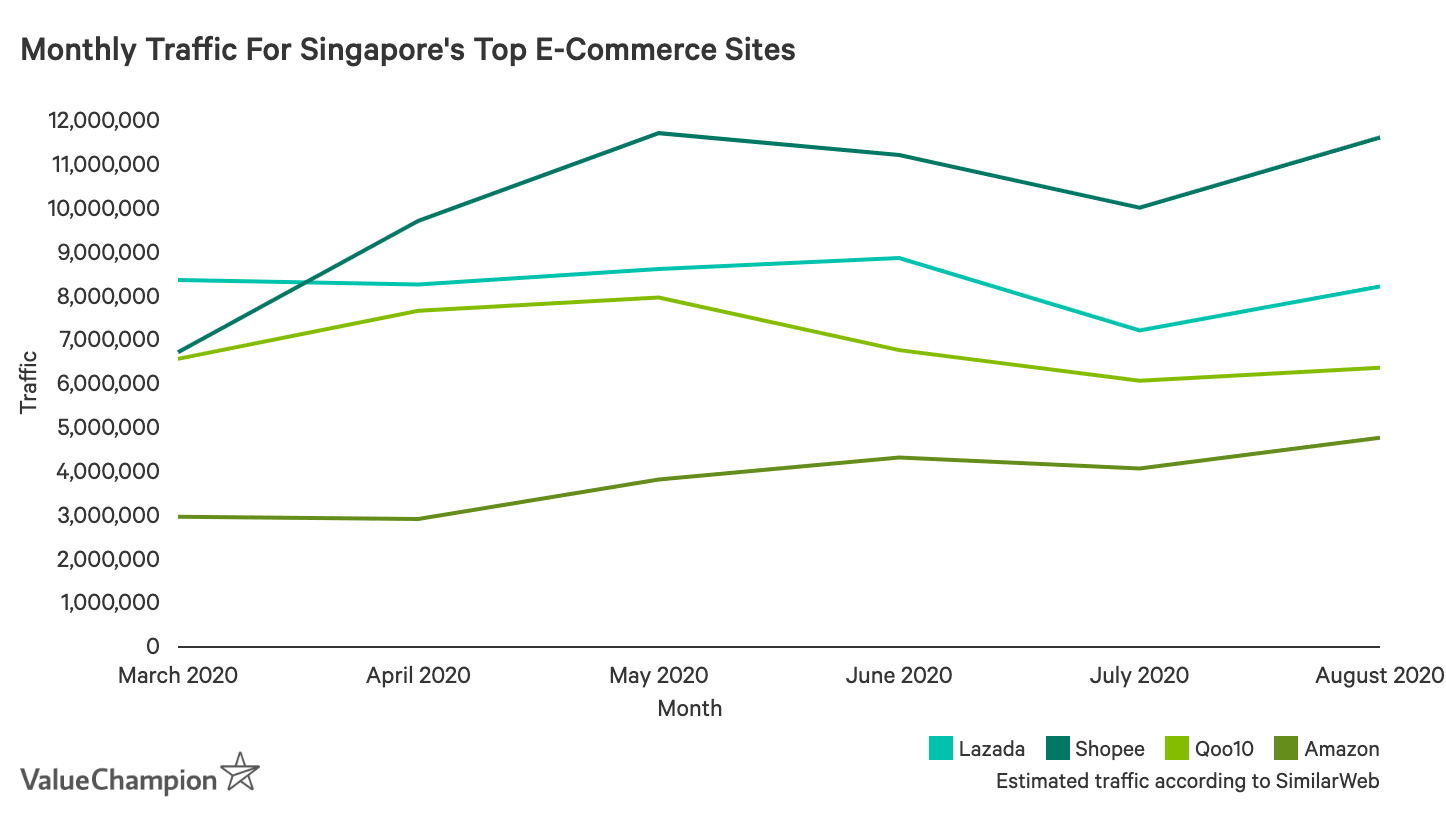
While the current market leader seems to be Lazada and Shopee, boasting an average of 8,241,667 and 10,150,000 visitors per month respectively, Amazon’s rapid traffic growth may be an indicator that the global e-commerce giant may cause a shake-up as consumers move towards platforms that provide the same goods for less.

For instance, despite being the most recent entrant in Singapore’s e-commerce space, Amazon has aggressively climbed the ranks with a 61.02 per cent increase in traffic since March 2020. Not only that, as we noted earlier last year, Amazon also provides superior consumer experience in not just price but also in its Prime subscription (i.e. faster delivery and Amazon Prime Video).

Since Amazon is using Singapore as its foothold to jump deeper into the wider Southeast Asian (SEA) region, the fact that it is growing successfully while providing superior prices and delivery is an encouraging sign for the company’s future.

On the other hand, both Lazada and Shopee may need to find new ways to pass down savings to their customers or to provide different value-adding elements.

Monthly Traffic For Singapore's Top E-Commerce Sites

Editor’s note: e27 aims to foster thought leadership by publishing contributions from the community. Become a thought leader in the community and share your opinions or ideas and earn a byline by submitting a post.

Join our e27 Telegram group, or like the e27 Facebook page

Image credit: Bermix Studio on Unsplash

The post The cheapest e-commerce platform in Singapore –and what it means for competition landscape appeared first on e27.

Posted on

PoC to prototype to MVP: Software development 101 for early-stage tech startups

Before the product, there is an idea. As a passionate entrepreneur, it is easy for you to get ahead of yourself in your belief that your idea will be the “next big thing”. But do not let emotions blind your judgment and immediately commit everything you have (career, house, family) on the get-go. 

This is why bringing your idea through the stages of Proof of Concept (POC), Prototyping, and Minimum Viable Product (MVP) is a necessity. By following the process through these three stages, you can conservatively commit your limited resources in the most efficient way, to bring the idea and product to market.

Disclaimer: If the characteristics above don’t apply to you, the general concepts are still applicable, but specifics may differ.

Proof of Concept (PoC)

You may have your idea on the back of a napkin, but that does not mean you can go straight to hiring a developer and get things started. Instead, you should always start with a PoC.

The purpose of PoC is to test a concept, product, or process; basically to validate your assumptions as well as those of your potential customers. It ignores all UI/UX issues while focusing on proving the potential use-cases and operational feasibility.

In fact, the PoC does not have to be about a software product or something technical. It could be as simple as observing the execution of your ideas by using simple tools such as pen-and-paper forms, spreadsheets, or following a checklist of tasks, formulae, and processes while making sure that it solves the problem you have identified, or improves the efficiency of processes you are trying to optimise.

Prototyping

Once you have validated your idea through your PoC, you may want to embark on the prototyping process.

The prototype enables you to actually see how the product will operate in real life. It is the physical embodiment of the ideal concept. 

A prototype in software development has two different stages:

User Interface/User Experience (UI/UX) Prototype

A UI/UX Prototype shows how your inputs are collected and how your outputs are presented in the product you are building. As a result, startups will have to work closely with stakeholders to develop a UI/UX that is useful and usable.

Often, a prototype of this stage consists of static paper sketches or digital drawings or web pages that are interactive and clickable.

Working prototype  

Once the UI/UX is done, a working prototype might be developed and tested with a small group of potential stakeholders to ensure that the prototype function just like how they wanted. The defining point of the working prototype over a UI/UX prototype is that it works on real data. It may also reflect a more accurate UI/UX.

Depending on the scale of the product, a working prototype may not be required. It is advisable to build a working prototype if your product depends on a lot of inputs with different processing paths. 

For example, your PoC was a fairly complicated spreadsheet, or your checklist of tasks and processes spans many pages, to ensure that you can replicate your PoC realistically.

Minimum Viable Product (MVP)

An MVP is a product with a minimum number of essential features and remains viable. This is your version 1 release where features should be selected based on the feedback of the PoC/Prototype users instead of assumptions.

Also read: Things to consider before you build a profitable SaaS MVP

It is a common misconception that the MVP is the same as a Prototype. However, an MVP is actually shipped to the early adopters. Beyond the initial release, your MVP is further developed through an iterative process based on your early users’ reviews to identify pain points and eliminate them.

As an MVP is considered the very first version of your product, a preliminary business/monetisation plan should be available before this stage to help you use some rudimentary form of cost/benefit ratio to decide on the core features to develop.

Comparison at a glance

Proof of Concept Prototype (UI/UX) Prototype (Working) Minimum Viable Product
Timeline Variable


If you have run your concepts by a few potential users and they all/mostly come back negative, then this concept is not viable. 


Stop, review, and decide if you need a new concept.

1-2 months for developing UI/UX prototype and obtaining user feedback.  Takes 1-2 months to develop a working prototype 3 to 6 months on average
Resources Yourself  


Optional technical expert (if you want to develop your PoC in an electronic form or to ensure you gather enough technical knowledge)

UI/UX Designer  


Your potential users for feedback

UI/UX Designer (To reconcile any technical requirements)  


Developer (Nominally 1-2 freelancer/outsourced developer)  


Your potential users for feedback

Maximum 3 developers


UI/UX designer 


A long-term technical expert, who could be one of the developers.

Takeaway Have information written down/documented for someone else to carry out the concept.


If everything is still in your head, you probably have not developed the concept sufficiently.

Your UI/UX designer should understand your PoC very well. If not, it means you need to revisit your PoC.  


You have a good prototype of the product you want to develop. 


You and potential users are fairly happy with how it has turned out.

The developer understands your PoC very well, just like the UI/UX designer.  


Real-life data gathered during the PoC phase continues to work/be valid.  


Many people confuse this step with developing an MVP. It tends to overlap due to how most people develop their MVP but making it distinct may save you time in the future by not having to test the basics out on a live or production system.

For most start-ups, anything beyond 18 man-months/6 calendar-months just means you are targeting too much in your MVP.


Look at re-prioritizing your feature set and get it down to a maximum combination of 18 man-months AND 6 calendar-months.


Be ready to start selling/marketing your product at the beginning of the last third of development. 


Most importantly, this is your production system.

When it comes to assessing the feasibility of your product’s potential, each of these stages is useful on their own. PoC is great for a completely new product and idea while the prototype allows testing product viability in an internal user group. On the other hand, MVP is the best option for improving the product by letting the mass to validate its potential.

Still, It does not mean you must go through all stages sequentially and not skip any stage. A startup may, ideally, go through all the stages according to the software development stages. 

However, depending on the business idea, you might find that it is unnecessary to spread out the resources across all stages of product development. This may sometimes occur when your product is the digitalization of existing processes, where the existing processes form your PoC.

When to go MVP mode

As mentioned before, you might want to choose the MVP approach or go for it after developing a PoC, UI/UX prototype, and finally, a working prototype. 

So let’s take a breather, and consider these questions below before venturing into the MVP stage. 

Do you have an experienced technical expert/advisor onboard? 

It is crucial for ensuring that you have a long term expert or advisor. Ideally, this should be a co-founder or your very first technical hire. 

Funding and monetisation plans? 

When you know what to build, the next question is ‘how?’. In a very early stage start-up, development is your #1 cost factor, and you need to show something to your customers to get their buy-in. As the saying ‘you need to spend money to earn more money’ goes.

Clear business requirements for development? 

Imagine assembling a car without knowing how the individual parts connect. Sounds awful, right?

This goes the same for product development in tech startups. They need to know what they are building and expectations. Being able to document what your product is all about is extremely important. 

Also read: How to launch your MVP faster and smarter

This should be a living document. The good news is that it gets better each passing day. 

The Proof of Concept will help in verifying the feasibility of your idea, and Prototyping helps to refine it even further, while the MVP will be the very first step of your product’s life outside the internal development cycle.

With that in mind, one should consider these stages as a measure of your progress.

Editor’s note: e27 aims to foster thought leadership by publishing contributions from the community. Become a thought leader in the community and share your opinions or ideas and earn a byline by submitting a post.

Join our e27 Telegram group, or like the e27 Facebook page

The post PoC to prototype to MVP: Software development 101 for early-stage tech startups appeared first on e27.

Posted on

Are your influence skills ready for remote work?

remote work

For majority of organisations in Asia Pacific, the COVID-19 pandemic has accelerated the transition to remote work by at least five years. But remote work should not come as a surprise.

Organisations’ growing preferences for remote work have been building for several years due to enhanced broadband connectivity, competition for global talent, and workers’ changing inclinations. By some accounts, 61 per cent of the global workforce is now remote. And, while it is unclear whether and by how much this number may change in the next few years, it is clear that remote work is here to stay in a significant capacity.

What does this mean for you and your influence skills? Modern organisations feature flatter hierarchies, matrix structures, and cross-functional workflows, with great degrees of involvement from external stakeholders, such as alliance partners, suppliers, investors, and even rivals.

To succeed in these environments, you cannot rely on your formal authority alone, that is, the influence that stems from your job rank. Instead, to successfully engage stakeholders over whom you do not have direct authority—colleagues from other functions, business units, or from outside your organisation—you need to rely on informal influence and persuasion and on building and leveraging relationships with others.

So, how good are you at getting work done without relying on formal authority and instead using informal influence and persuasion?

To lead effectively using informal influence and persuasion has always been challenging. The transition to remote work has made it even more challenging than it already was.

Studies have shown it is more difficult to influence people through digital interactions. One study, for example, looked at changes of opinion in response to differing information.

When contrasting information was revealed in a face-to-face discussion, 38 per cent of participants changed their mind. Conversely, only 10 per cent did so when the information was revealed through an online discussion forum.

Compared to face-to-face interplay, computer-mediated interaction reduces the degree of social presence—acoustic, visual, and physical proximity—with the people you are trying to influence. Reduced social presence makes it more difficult for you to influence others.

Also read: Why remote working is the future for startups 

Consider these three characteristics of digitally mediated interactions that make influence more difficult.

Asynchronous communication

In some digital channels, interactions do not occur at the same time. For example, with emails and texts, exchanges are not immediate. This reduces the fluidity of interaction and opportunities to clarify ambiguities. Such ambiguities could, in turn, lead to wrong attributions (Why is he not responding to my email? Did I say something he did not like?)

Reduced social image

It takes longer to build your social image, especially with people you do not know. Who is this person? Where does she come from? What’s her background? What’s her interest in this project? Can I trust her?

Limited use of non verbals

Non verbals are inevitably harder to leverage in an online environment. Even in video calls, during which we largely remain seated, we are often limited in the use of body poses. The influence benefits of movement and proximity are not available.

What can we do about it? When considering the nuances of digitally mediated influence, think about the following practical tips:

Favour rich channels for influence

A video call gives you more opportunities for influence than a phone call. You can use non verbals such as gestures and facial expressions, and you can respond to the non verbals of your audience. And a phone call is better than an email. It is synchronous, and you get information on paralinguistic cues (tone, pace, intonation). It is particularly important to use rich digital channels when influencing those you do not know well.

Favour lean channels to protect yourself from unwanted influence

Flip the logic for protecting yourself from unwanted influence and use leaner channels to buffer yourself. For example, if someone insists on a video call, ask them to outline the situation and the request in an advance email. It is more difficult to say no to a request on a video or a phone call than in an email. Even if the video call is inevitable, asking for the advance email gives you a chance to preface your position with a preliminary email response.

Expand the number of channels used

To influence others on issues that encompass complex messaging, expand the number of channels you use to communicate. For example, conduct a video call on the issue and follow up with an email. Studies show that influence that activates multiple senses (e.g., both hearing and reading) reduces information overload among those you are trying to influence and produces better results.

Enhance relational closeness

When using digital communications do not focus just on your message at hand. Ask people about their day, the team, the weather, or the performance of their favourite football team. Get to know them on a personal level. For example, experienced executives often hop on conference calls early or stay behind to catch up with teammates.

Also read: The future of remote work is happening now, here’s how

Check-in with people not only when you need something from them. Keep in mind that people vary greatly in the degree of closeness they experience while working through digital channels, and yet closeness fundamentally shapes how well people respond to your message.

Allow more time

When you’re trying to influence, your audience builds a mental model of you: Are you credible? Trustworthy? What are your intentions? Proving these qualities to others is essential for influence and yet they take longer to form in digitally mediated communication. Be patient and allow yourself more time to get people on board.

Leverage reduced majority pressure

Certain forms of computer-mediated communication (e.g., online chat rooms) put people at ease, allowing them to express their opinions more readily. In video-based communication, some platforms (e.g., Zoom) allow you to seamlessly and easily poll people privately, which can further reduce the effects of majority pressure.

Leverage private communication in group meetings

On most platforms, you can send private messages to others during a meeting. The goal here is not to be sneaky. Instead, private chats can enable your team to regroup during a client negotiation, entice participation, or ask a question without interrupting the speaker.

For example, try hosting 150 employees on a call and asking for feedback on a new initiative. In this case, crickets is likely your best outcome. If you privately text one of the people on the call, however, you can ask for direct feedback: “Cindy, the team would really appreciate hearing from you on this issue.”

If you would like to learn about enhancing your influence and persuasion skills, consider the new online course on “Maximizing Your Influence and Persuasion” offered by the Ross School of Business.

Editor’s note: e27 aims to foster thought leadership by publishing contributions from the community. Become a thought leader in the community and share your opinions or ideas and earn a byline by submitting a post.

Join our e27 Telegram group, or like the e27 Facebook page

Image credit: Priscilla Du Preez on Unsplash

The post Are your influence skills ready for remote work? appeared first on e27.