Posted on

What COVID-19 taught us about sustainable choices and climate change

The pandemic has shown us how we can clean up the planet. Many climate activists and governmental bodies like the Intergovernmental Panel on Climate Change (IPCC) warned that we must reduce emissions so that global warming is limited to 1.5°C.

But actions to limit warming have fallen short of this goal. However, there is hope. In the first half of 2020, global CO2 emissions actually dropped enough to put us on this path, declining by 17 per cent in April 2020.

Unfortunately, experts are expecting that we will reach pre-pandemic levels of emissions once again, putting us back on the path of three or more degrees of warming.

Here’s one example that awaits us in the post-pandemic world, revenge travel, sparked by the pent-up demand of many to finally board a plane again. With the first lockdowns, air travel dropped by around 40 per cent, preventing 915 million tonnes of carbon from being emitted.

As borders reopen, spending on tourism and quick-fire flight bookings surge as people try to make up for the perceived lost time. Singapore’s Immigration and Checkpoints Authority is receiving about 6,000 passport applications daily, triple the daily average of 2,000 from just two years ago.

At Amasia, the venture capital firm where I am a partner, we strongly believe that we don’t have to bound back to our old behaviours. There is immense, under-recognised potential for bottom-up behaviour change that will help us fight this climate crisis.

How we got here

Lockdowns due to the pandemic have led to an unprecedented “digital migration” in every aspect of life, work, entertainment, learning, and shopping. When people stayed home and bought less, our seemingly unachievable climate goals were suddenly not so remote.

Also Read: Climate tech is in a chicken-and-egg situation in Southeast Asia

Research supports this seemingly simple observation. But as we proceed into the new normal, how can we ensure that we are not bringing our most destructive habits back from the dead, too?

First, we need to know what spurs these bad habits in the first place.

“Mimetic desire,” or making decisions based on the desires of the people around us, has led to runaway overconsumption and the ravaging of the planet. We want more not because we need more, but rather because we are heavily influenced by our social environment.

This is fuelling an unfulfilling and damaging behavioural cycle of wanting to own, yet being less satisfied while owning more things.

The rise of new digital media and hyper-targeted advertising techniques further reinforce the idea that well-being comes from material wealth and from owning the latest products. This mindset has to change and that needs to happen now.

At the onset of the pandemic, we saw that dramatic behaviour change with a positive impact on the environment is, in fact, possible. So what if we strive to not return to pre-COVID-19 habits and instead retain some of that more environmentally-friendly life of the past two years?

Take the revenge travel example. Instead of immediately taking the next travel opportunity, consumers can be more aware of their impulses and try to moderate them to avoid further damage to the environment. The potential impact is massive.

Mass consumer behaviour change has accomplished far more in less time than international agreements, corporate pledges, or political legislation alone could ever hope to achieve. One could argue that the behaviour during the pandemic was the result of mandatory policies that confined people at home and closed businesses.

Then, how can we now encourage people to voluntarily adopt more sustainable consumer behaviours to get closer to the 1.5°C targets?

What this means for us

There are a few solutions here. NGOs and governments need to meet consumers where they currently are and help make sustainable living an easier, “no-brainer” choice.

Also Read: There’s a mismatch of investment and entrepreneur focus in SEA’s climate tech: Steve Melhuish

Brands must be held accountable for leading customers astray and for pursuing practices that run against a healthy amount of consumption. For politicians and decision-makers, now is the opportunity to implement bipartisan measures which will more organically encourage more sustainable behaviours, even if these imply higher costs.

For example, Singapore has committed to achieving net-zero emissions by or around mid-century, and it is currently on track to reach its 2030 targets, promoting green technologies and alternative low-carbon solutions.

Change is predominantly needed in affluent nations, with the top 10 per cent accounting for 52 per cent of carbon emissions. The rich serve as role models, so it is essential for them to moderate their consumption first. We’re not asking people to live in huts, but rather to eliminate the more astounding aspects of their exorbitant lifestyles.

Policy interventions such as raising carbon taxes can deter businesses and individuals from overconsumption, encouraging them to take actions to moderate their emissions. With Singapore toughening on its carbon tax, with a view to reaching SG$50 (US$36.35) to SG$80 (US$58.17) per tonne by 2030, those with the highest carbon usage will be taxed commensurately to their output.

We need a dramatically different vision for this world and our society if we are to save our planet. The world we are aiming for is one in which we engage in much less business travel and have fewer things that last a long time.

It’s a world in which our homes and cars have been “right-sized” and where we eat less and waste less food. In this world, most things that can be digitised are digitised, and we realise that physical proximity is no longer the key requirement to getting to know people in faraway lands. It’s a world in which we spend more time in our own locality, neighbourhood, or city.

Our role models are folks who want to build this kind of world. We need to get there if we are to avoid climate catastrophe.

Editor’s note: e27 aims to foster thought leadership by publishing views from the community. Share your opinion by submitting an article, video, podcast, or infographic

Join our e27 Telegram groupFB community, or like the e27 Facebook page

Image credit: Canva Pro

The post What COVID-19 taught us about sustainable choices and climate change appeared first on e27.

Posted on

Meet the 11 startups that have received grants from Maritime and Port Authority of Singapore

Peer sharing by the maritime tech startups at the Smart Port Challenge 2022

The Maritime and Port Authority of Singapore (MPA) announced on Friday the 11 maritime tech startups that have received the Maritime Innovation and Technology (MINT)-STARTUP grant for prototype development and test-bedding, bringing the total number of grant recipients to 50 and the total funding disbursed since 2017 to over S$2.45 million (US$1.78 million).

These startups are collaborating with maritime corporate partners from PIER71 –the result of a collaboration between MPA and NUS Enterprise– on pilot projects that focus on the use of smart sensors, vision and data analytics, artificial intelligence and wearables amongst others.

The companies are:

EcoWorth Tech

A project that builds an enhanced oil removal solution to provide better marine oil spill response. According to a statement, the project aims to develop a prototype that would put Carbon Fibre Aerogel (CFA) material into the optimal form that is suited for the industrial needs in the maritime industry. This would allow validation of CFA in comparison to other competitive products in the market. Based on laboratory tests, the CFA is at least 100 per cent more absorbent on a per weight basis than traditional single-use absorbents.

EnvironSens

A project that builds technology for robust testing and monitoring of drinking water quality onboard vessels. The current manual process requires human expertise and interference in the steps of filtration, staining and colorimetric analysis, which is not feasible for vessel usage. This technology aims to automate the manual processes of their current bacterial monitoring sensor system.

Eupnoos

A technology to enable lung function test for occupational disease by allowing shipyard workers to check for the first signs of lung disease by blowing into the
microphone of their device. The AI model will identify symptoms associated with disease and flag the results to the user. It can be used as a tool to support smoking cessation efforts.

Also Read: Greywing attracts US$2.5M seed funding to tackle maritime industry’s carbon impact

eyeGauge

A non-invasive online condition monitoring for high-speed passenger ferries in real-time. It will extract and digitise analogue signals from the main engine, electrical generators, and other onboard equipment to guide maintenance activities for the ferries and improve asset availability for utilisation.

FlexoSense

FlexoSense developed a patent-pending pressure sensor technology for insoles to promote worker safety and productivity. Through the project, the company aims to enhance and tweak their smart in-sole for the maritime and marine and offshore sector to detect Slips, Trips and Falls (STF).

ITAAS

A product to monitor and provide early detection of health conditions.

The startup aims to redesign its current in-ear wearable technology to aid in the detection of cardiovascular-related health conditions to enable early intervention in a marine environment. The solution will also provide supervisors with real-time visibility of their crew’s health conditions.

MAGES Studio

Building games to facilitate seafarer’s onboarding training. In this level-based game, the boat will be travelling from point A to B and the player will face multiple emergency situations along the way. The player must resolve the emergency situations by performing the correct actions in the right order and ensuring smooth sailing throughout the journey.

MagicPort Digital

Procurement and collaboration platform for ship supplies and services. It includes a digital marketplace and collaboration platform for ship owners and ship
managers; a comprehensive directory that provides information on ports, suppliers and services providers, vessels, and owners; and work on the Request For Quotation processor which can help ship suppliers automate the process of preparing the quotations.

Also Read: How Signal Ventures aims to sail towards new opportunities in global maritime tech scene

Temus

Detection and prevention of near-miss workplace fall injuries without Vision Analytics. To leverage on their existing Connected Worker System (CWS) platform suite, which consists of TAGU and NaviSafe and enhance their wearable device so that it can detect Slips, Trips & Falls (STFs) or Fall From height (FFH) accurately. TAGU is an IoT wearable device, while NaviSafe is a software application hosted on the cloud.

Vilota

The startup builds a 3D vision-based solution for Rebars Distance Management, leveraging their proprietary 360-degree vision-based sensor and developing a prototype to provide recognition and counting with high accuracy, a diameter measurement of rebars, and information for automated tallying within a port environment.

WeavAir

A loss prevention platform that aims to create value for ship owners, ship managers and marine insurers by developing a digital portal which can improve benchmarking, accelerate decisions, improve forecasting, and risk rating. The digital portal will help ship owners and ship managers simplify the data collection process for marine incidents that required by marine insurers.

In the same event, MPA and NUS Enterprise also announced the launch of Smart Port Challenge (SPC) 2022 under Port Innovation Ecosystem Reimagined
@ BLOCK71 (PIER71).

Tech startups based in Singapore or abroad are invited to submit proposals on solutions to any of the challenge statements spanning across the 15 areas or in other areas related to the maritime sector in an Open Category. The closing date for the submission of proposals is July 8.

Shortlisted startups will be mentored under the PIER71 Accelerate programme and might be eligible for a MINT-STARTUP grant of up to S$50,000 (US$36,000)

Ready to meet new startups to invest in? We have more than hundreds of startups ready to connect with potential investors on our platform. Create or claim your Investor profile today and turn on e27 Connect to receive requests and fundraising information from them.

Image Credit: PIER71

The post Meet the 11 startups that have received grants from Maritime and Port Authority of Singapore appeared first on e27.

Posted on

How to successfully onboard your remote team in the virtual world

Your employees are just starting their journey with your organisation. They are just as excited as you to embark on their new journey as you are to welcome them to be part of the remote team.

Before the pandemic, your new hires will come to the office for their first day and finally meet their colleagues for the first time, get introduced to the whole department, and have a little tour of the office before they get to know their role better on the training.

But it’s not like that to onboard your remote team. You are probably not even in the same time zone as your new hires. And most likely, your whole remote teams are all in different time zones.

However, onboarding is crucial to guide the new hires to navigate within the organisation regardless of their prior professional experience. According to CareerBuilder and Silkroad Technology, up 10 per cent of the employees are leaving due to poor onboarding experience.

Onboarding is very important that even Amazon emphasizes it as part of their company culture called Day one. Day one is about being constantly curious, nimble, and experimental. A lack of guidance and direction during the first few days of a new job can be frustrating and disheartening.

What is included in the onboarding process?

Each company will tailor its onboarding process depending on its needs and culture. However, it generally consists of new hire document collection and introduction to the company.

Also Read: Why HR tech will make Asia’s next unicorns

If your company does not have one, creating a thorough onboarding process will benefit your company and new hires. Here are some of the must-have onboarding items that need to be checked after sending away the offer letter to the candidate.

Introduction to the company and culture

No alt text provided for this image

Every company has a different working culture, and it is essential to let your new hires understand on the get-go. Sending away a culture playbook will help your new hires know what to expect and how to act upon the company’s culture properly.

Understanding the company’s value, vision, and mission will guide your new hires to align their vision and mission with the company. To replace the traditional office tour and colleagues’ introduction in person, it is important to provide a document where they can find a certain material or who they can reach out to for a certain issue in virtual onboarding. In this session, you can provide the hierarchical structure within the company.

Introduction to the company’s communication channel and management tool should be included in this session. Be sure to explain this part as clearly as possible.

Otherwise, your remote new hires’ productivity might be in jeopardy due to the confusion in navigating their way through the remote workspace.

Product/service introduction

No alt text provided for this image

Not often do your new hires come from similar industry backgrounds to your company. Therefore, your product might be completely foreign to them.

Even if they come from similar industry backgrounds, it doesn’t guarantee that they know about your products/services already. Failing to educate your new hires about the product/service might result in frustrations and miscommunications.

This might result in your new hires not being able to optimally perform their roles and responsibilities aligned with the product’s growth direction.

Whether or not the new hires’ position is closely related to the development of the product/service, this part of the training should not be missed!

Legal document collection

No alt text provided for this image

It is necessary to collect some legal documents to proceed with the employment process. These often include personal identification, employment contract, social security number, work permits, tax forms, and other legal documents.

Authenticating these documents can also be an issue when it comes to remote hiring. What type of documents to collect varies in every country according to each country’s local labour law.

Also Read: Top 3 signs your business will need a remote tech team

Failing to collect the right documents and not promptly might result in putting your new hires’ employment status at risk and on hold. They will handle this section for you if you are hiring through the Employer of Record (EOR) service. It will save your company time and hassle when outsourcing this particular process to a staffing agency.

Legally speaking, your new hires are not officially hired unless this process is completed.

Slasify supports your company to onboard candidates within 15-30 days and will directly collect all the legal documents from the candidates and provide them with all the company’s benefits such as social contributions package and insurance.

How to conduct the onboarding process for your remote team?

Time should not be an issue because these onboarding items can be delivered in a group meeting, one-on-one meeting, or a written (pdf, ppt, printed booklet, etc.) document for the new hires to review on their own.

If time is the essence of your team, you can combine written documents with virtual meetings. However, it’s not suggested to replace the virtual meetings with only written documents completely.

Whether you are a small or big company, creating a solid onboarding plan is a great investment to build a strong and sustainable team. If you are thinking of expanding your team globally, start building your virtual onboarding program, and playbooks will be a great start for your remote workforce.

Editor’s note: e27 aims to foster thought leadership by publishing views from the community. Share your opinion by submitting an article, video, podcast, or infographic

Join our e27 Telegram groupFB community, or like the e27 Facebook page

Image credit: Canva Pro

The post How to successfully onboard your remote team in the virtual world appeared first on e27.

Posted on

How to generate winning startup ideas

Startup lore is filled with stories of heroic underdog entrepreneurs with unconventional ideas who silenced their haters, riding market forces that others seemingly couldn’t see, and taking their place in the pantheon of startup greats.

Many believe that coming up with a winning business idea is an act of divine inspiration, and it’s easy to see why. But the reality is that coming up with ideas for winning businesses is about as mystical as baking a cake. If you know the right recipe, anyone can do it.

So how do you consistently dream up successful business ideas? Certain kinds of ideas, and certain ways of generating them, are much more likely to succeed than others.

Below, I’ll share a handful of methods that are simple, effective and impactful. These have all been learnt and honed by Rainmaking Venture Studio, where we have built 65 startups with Fortune 500 partners and invested in thousands more.

The essential ingredients

Most business ideas begin in one of two places, either by solving an observable problem or by building a vision of the future. Good business ideas do both, they solve a problem and build toward a vision of the future. 

The very best ideas, however, solve a problem, build the future, and capitalise on the individual strengths of the founders and team behind them. Let’s discuss each of these ingredients and how they make a recipe for great ideas.

Ingredient 1: Solve observable problems

Great startup ideas begin with a specific problem to solve.  

Much of our time at Rainmaking Venture Studio is spent looking for big, important problems, and then taking deep dives to understand the needs of different stakeholders surrounding those problems. There are a few approaches that both aspiring startup founders and large organisations can take to find the right problems to solve:

Build what you wish someone else would build for you

Starting with a problem you have personally is one of the most productive ways of generating ideas. Not only is it a great source of ideas, but you have the benefit of starting with yourself as a customer from day one. Get in the practice of noticing when something is frustrating and wondering, “why do I have to do it this way?”

Internal frustrations are also a great source of ideas for corporate ventures. Amazon Web Services famously started as an internal solution that made it easier for IT teams to launch new web servers. As of writing this, AWS generates 13 per cent of Amazon’s total revenue and 100 per cent of its operating income

Look into industries that seem broken 

Industries that are inefficient or outdated are ripe for disruption and change. Looking into these industries for problems and inefficiencies is a great starting point for startup ideas. 

Rainmaking has built a large number of ventures in industries such as construction, logistics, and energy precisely because they largely have not been updated for the digital age and one can observe many inefficient, manual processes that are generally accepted as the status quo. While most people may see the challenges, few believe that there could be a solution because it can seem that things are simply “stuck” the way they are

The cash advance lending industry is another example of such an industry. Jake Hill, founder of the startup DebtHammer, realised that payday lenders regularly overcharge borrowers in interest and the legal costs of disputing it are often more than the loan itself.

Also Read: 9 steps to create a successful product launch strategy

Most accept this as an unfortunate and unavoidable side effect, but Jake decided to dig deeper under the surface and realised that the actual legal process for disputing is itself not very complex, and could be done without a lawyer, but most people simply do not have the time or know where to find the right information.

He then designed a way to automate the dispute process to bring down costs and then set borrowers on an attainable plan to get out of debt.  

Ask people what is most stressful and painful about their lives

This strategy involves asking people questions about their lives to discover the challenges and problems that they face. The challenge with this approach is that people do not naturally talk about their problems, in fact, many people are not aware that they have challenges at all. They have simply accepted the status quo. 

Sometimes we can ask directly and people will point us to their challenges, but more often, we need to look for clues that indicate people have an unmet need.

For example, where are they hacking together their own homemade solutions? What do they spend significant amounts of time on despite them viewing it as low value? Likewise, where do they hate spending money but have to anyway? What behaviours or tasks do they ritually repeat, and most importantly, why are they doing them? 

Caution! Pitfalls ahead

These are three reliable ways to generate ideas based on problems. But even following these recipes, there are several common mistakes I see founders and venture teams making.  

The first pitfall is choosing a problem that isn’t big enough. A large number of people need to have the same problem or the problem needs to be of a significant cost for each person for there to be a compelling market opportunity for the solution. There’s a gap in the market, but is there a market in the gap?

When looking for a problem to solve, many people already have a solution in mind. While having a hypothesis is useful, being too closely attached to this solution can close them off to other potential opportunities that are much bigger, more compelling, and much more attainable.

We call this a ‘solution looking for a problem’. Unfortunately, only a small per cent of these solutions ever find their problem, and too many hours and dollars are wasted chasing shadows. 

The third pitfall is not going deep enough on the problem to really understand it. By no means does this mean exhaustive, lengthy, academic research, quite the opposite, we want to move fast.  But very few problems are shallow. 

Most have deep roots and we need to understand those roots if we are to really nail the customer problem. As they say “a stitch in time saves nine”, and an investment of time upfront almost always pays dividends later down the line.

Ingredient 2: Build a vision for the future

But what about those more revolutionary, unconventional, “spark of genius” ideas?  Instead of narrowly focusing only on the problems of today, forward-thinking startup founders can form a thesis about what is likely to happen in the future, and anticipate the second and third-order effects many steps ahead.

By looking at trends in technology, macroeconomics and society, one can identify ‘signals’ of what the future holds and then imagine different scenarios that might play out. These scenarios are the spark of inspiration to imagine businesses that could either create new value or solve problems in the future.  This approach is often referred to as ‘Futures Thinking’.  Let’s look at an example in action.

While working in the energy utility industry, Fabian Le Gay Brereton realised that the direction of change for the energy industry meant a massive shift away from fossil fuels toward distributed solar panels and batteries. 

While that might be a widely held view, few people have thought about what that transition will mean for society and the energy industry. Instead of selling and building static power plants, power companies will need to design small, interdependent systems that dynamically communicate and send power when and where it is needed. This is no easy thing to design when all of the current engineering & pricing models are based on an old paradigm of centralised energy generation. 

Also Read: Guide to successfully start realising your product ideas

In anticipation of this paradigm shift, Fabian built Gridcognition, an analytics software that helps renewable energy developers design and optimise distributed energy systems. Fabian began building the solution in 2020, and if he had asked developers then whether they needed a powerful software to design renewables systems they would have said that all they needed was a spreadsheet. Fast forward just two years and Gridcognition is seeing adoption from the world’s largest solar power developers.  

For corporate ventures, however, this approach can be more powerful and more challenging.  On the one hand, corporations start with a massive advantage, they have established scale and competitive advantage that ought to enable them to dominate emergent sectors of the market with ease. 

On the other hand, their existing assets and footprint create conflicts of interest. If a future scenario is likely to undermine my core business, why would I want to invest in that scenario and accelerate that threat? This is what Clay Christensen famously dubbed the ‘Innovator’s Dilemma’.  

The great thing, even for corporate teams trapped in this dilemma, is that anyone can learn to practice Futures Thinking. All it requires is observation, imagination and maybe a little courage. Amy Webb from the Future Today Institute has great perspectives on trends of directional change and many resources that show you how to spot ‘signals’ of what is coming.         

Focus on what is probable, not just possible

On the other hand, it is easy to make mistakes on timing when painting a vision of the future.

For example, if we look at the impact of artificial intelligence on cars and self-driving capabilities, one probable future is that all cars in the future will be capable of self-driving.

One possible result is that nobody will need to own a vehicle because autonomous fleets of cars will drive around the city and pick us up whenever we need as a concierge batmobile. Many startups in the past 10 years have bet their future on this reality. 

Unfortunately, a great many of these startups radically underestimated the timeline of this future and underestimated the human desire for ownership and hoarding. One day, perhaps none of us will own cars. 

But that day is not today and it does not appear to be very soon.  The result is that the future painted by these startups is taking far too long to reach, and they are running out of cash long before the world catches up to their vision.

Ingredient 3: Play to strengths

The final recipe is to leverage personal strengths as the bed of knowledge to generate winning ideas. Successful startups will have a strong team-solution fit to do exactly that.

A strong team-solution fit means having a founding team of uniquely qualified individuals who are able to use their personal strengths and knowledge to identify the right challenges to solve, with the skill sets to develop the solution. The strengths of the team can range from industry experience, such as renewable energy, to personal passions, such as stamp collecting.

Playing to strengths is equally important for corporate ventures, but rather than the strengths of individuals, organisations should look more broadly at core assets & capabilities that could provide a competitive advantage.

Here’s an example:

One of our corporate partners is one of the world’s largest renewable energy producers. They have a world-class ability to deploy project-based financing and have a strong balance sheet on which to finance infrastructure assets. So, we asked ourselves how could we apply this strength to a market that is outside the organisation’s core business and what other kinds of infrastructure could be financed?

The result was an IoT startup that helps restaurants save energy. The startup benefits from using the corporation as a project financing partner to invest in IoT hardware. The corporation, being a Fortune 500 company, has a cost of capital lower than the startup or its competitors could achieve on their own, giving the startup a significant competitive advantage.

Don’t overlook intangible soft strengths

Especially when working with large organisations, we find that people tend to identify and value hard strengths, such as physical assets and technical capabilities, more readily than the less tangible “soft” strengths.

Soft strengths are anything which could be advantageous that cannot be physically or legally transferred, for example, consumer trust, networks of people and partners or a unique perspective on a market. While the intangibles might be more difficult to identify, they are no less useful for generating ideas and can be powerful boosters for new ventures. 

Also Read: How to pursue a product idea into a successful business

When looking for soft strengths that we could leverage with corporate partners, we always ask a few questions to help tease them out, what is the mission of the organisation and how could it galvanise internal support for a new venture with a similar mission?

What groups of people outside the company does the organisation’s network provide access to and how could they be potential customers, collaborators or supporters for a new venture? What is the brand known for and how could we bring the same values to another niche or sector?

Pull it all together

The very best businesses are those that can pull on all three recipes; they solve an observable problem, have a bold vision of the future, and play to strengths.

Stripe, the unicorn online payments company is a prime example. The founders, Patrick and John Collinson, were working on several internet startup ideas prior to Stripe and wondered why it was so difficult to accept payments online. They had found a problem worth solving

At the time, the online payments market was not particularly large, and seemingly well covered by companies such as PayPal. But, the Collinson brothers believed that a mainstream shift to online commerce was coming soon and that solving the friction with payments would unlock a massive new market opportunity. They had a vision of the future

The brothers are both engineers with the technical know-how to personally build the solution. They played to their strengthsStripe is now a market leader in online payments and is still growing at nearly 50 per cent a year.  

It can seem that good ideas are difficult to generate. Actually, they’re easy to find, because there are many, many problems in the world, and more avenues to shape the future than ever before. If you’re having trouble finding them, it’s just that you haven’t yet learnt the right recipe. 

Once you learn how to notice good startup ideas, you’ll see them all over the place.

This article is written as part of the Corporate Venture Launchpad programme. The SG$10 (US$7.5 million) million pilot programme by EDB New Ventures aims to enable large, established companies new to corporate venture to launch a new venture in Singapore within six months. 

Editor’s note: e27 aims to foster thought leadership by publishing views from the community. Share your opinion by submitting an article, video, podcast, or infographic

Join our e27 Telegram groupFB community, or like the e27 Facebook page

Image credit: Canva Pro

The post How to generate winning startup ideas appeared first on e27.

Posted on

How startup leaders can delegate to prevent burnout  

Startup founders and executives often struggle to delegate. As a result, they get overwhelmed and burn out.  

Jessica Lessin, CEO of The Information, recently wrote:   

“A few weeks ago, I was reporting on two possible M&A deals and asked my sources why each company was looking at a sale versus an initial public offering down the road. In both cases, the answer was the same: The founders were done. There’s not a founder or CEO I talk to these days that doesn’t have some version of that story. They are exhausted.”  

Samuel Ajiboyede, the author of the book The Entrepreneur’s Diary, said, “One reason a lot of startup founders and entrepreneurs get burnt out is the tendency to take on too many responsibilities.” His message is, “Don’t be afraid to delegate.”  

If you are like a lot of startup leaders, several beliefs keep you from delegating:  

  • You think you save money by doing everything yourself.  
  • You think no one will care as much as they do.  
  • You believe it will take more time to teach someone to do tasks than doing it yourself.  
  • You do not want to put more work on others’ plates.
  • You do not know how to delegate.
  • You have a tough time giving up control.  

These beliefs are reasonable when you are small. But if you do not delegate, your business cannot grow beyond the time you can spend on it. You also run the risk of exhausting yourself.  

What you should delegate  

If you want to delegate, you have to decide what you should hand off to others. A valuable tool for choosing what tasks to offload is the Eisenhower Matrix, based on former general and U.S. President Dwight Eisenhower’s statement, “I have two kinds of problems, the urgent and the important. Urgent problems are seldom important, and important problems are seldom urgent.”  

Steven Covey turned this comment into a matrix with four quadrants to organise your tasks and who should do them.

  • Tasks that are urgent and important, must be done by you
  • Tasks that are important but not urgent, schedule these for later
  • Tasks that are urgent but not important, delegate these
  • Tasks that are neither urgent nor important, eliminate these tasks  

Also Read: 6 leadership lessons I learned after we raised our seed round

What tasks are urgent but not important? It is a little misleading because calling anything unimportant can be confusing. For example, an Asana report found that managers spend 58 per cent of their time on administrative tasks like:

  • Email triage
  • Calendar management
  • Travel planning
  • Expense reports 

Calling these tasks unimportant is misleading. They are important but do they need to be done by you? Probably not. Consider this:  

  • Most executives spend three hours a day on email
  • It takes 25 minutes to schedule a business meeting  
  • It takes 12 hours to plan a door-to-door business trip
  • It takes 30 minutes to complete an expense report  

You can easily hand off these tasks to others. Other candidates include:  

  • Invoicing and payment processing
  • Contact management and CRM maintenance
  • Document prep
  • File management 

Does it save money to do this work yourself? Think about it this way, you are paying yourself to do tasks that you can outsource to others at a lower cost.  

What you should not delegate  

Going back to the matrix, to decide what you should not delegate, list the tasks that only you can do. These tasks require your judgment, experience, and leadership, and the buck stops with you. Examples include:  

  • Defining and amplifying your vision and mission
  • Business strategy and planning
  • Hiring the key executives
  • Terminating executives
  • One-on-one meetings with direct reports
  • Fundraising
  • Meeting with investors, partners, and key accounts
  • Board meetings and reports
  • Keeping your team aligned and inspired  

These are executive functions core to your business that only the top executive in a company can do. Depending on the size and status of your business, you might also be responsible for:  

  • Product definition and roadmap
  • Sales strategy
  • Go to market strategy

Who you should delegate to  

One reason executives don’t delegate is that they don’t want to give others more work to do. That makes sense when you look at the nature of the tasks you should offload. They are administrative tasks, and you may not have a team member at the appropriate level with the right skills to do that kind of work.  

Also Read: The 5-part agile leadership guide that will make you a better business leader

You could hire some to do your administrative work, but it is probably not a full-time job, and administrative assistants are hard to find. The Lensa Index found that administrative assistants are the third most challenging position to fill. Also, the time and expense of recruiting, hiring, onboarding, and training become one more distraction.  

Consider virtual assistants  

Startup executives and owners are turning to virtual or remote executive assistants as a cost-effective way to delegate time-consuming administrative tasks. The virtual assistant market grew by 40 per cent in 2020 as remote work became the norm and executives realised offsite personnel can be productive and effective.  

The virtual assistants usually work in areas of the world where college-educated, English-speaking talent is plentiful but opportunities for meaningful work are scarce. And most virtual assistants are already trained and have experience supporting executives, and have developed best practices for the tasks you want to offload:  

  • Email organisation  
  • Calendar management  
  • Travel planning
  • Expense reports  

There are a few ways to find virtual assistants, all with pros and cons.  

Hire a freelancer through a job board:  

  • Pro: the lowest cost option
  • Con: risk of a bad hire, you must do the management and quality control

Hire an independent contractor through a virtual assistant agency:  

  • Pro: more vetted candidates make this less risky
  • Con: You still must do the management and quality control

Use a managed virtual assistant service provider:  

  • Pro: the service provider hires, trains, and supervises the virtual assistants, so you do not have to
  • Con: not the least expensive option

Develop your superpower  

Sam Corcos is a four-time founder and CEO. Sam says, “Delegation is a superpower. It also takes practice.”

If you have internal resources to take on administrative tasks, great! This guide should help you get started. If not, there are people from around the world eager to help.

Editor’s note: e27 aims to foster thought leadership by publishing views from the community. Share your opinion by submitting an article, video, podcast, or infographic

Join our e27 Telegram groupFB community, or like the e27 Facebook page

Image credit: Canva Pro

The post How startup leaders can delegate to prevent burnout   appeared first on e27.

Posted on

Base.vn founder’s new SaaS startup True Platform attracts US$3.5M seed funding

The True Platform founding team

True Platform, a business SaaS startup, has closed a US$3.5 million seed funding from January Capital, Alpha JWC Ventures, Beenext, FPT Corporation and other unnamed angels.

The startup will use the funds to accelerate product development.

True Platform was founded in late 2021 by Hung Pham, who previously founded Base.vn, an enterprise SaaS platform in Vietnam. Base.vn was acquired by FPT Corporation, one of Vietnam’s largest corporations, in May 2021.

The startup is preparing to launch two major products later this year. They are Success.net, a customer-centric platform to help companies accelerate sales and services, and Rework.com, an operation platform to help companies work together.

Also Read:  SaaS platform Base.vn secures funding from Nextrans

“Today, SMEs globally lack budget and bandwidth to evaluate, provision, and maintain the different tools for their respective functions (e.g. HR, operation, customer support, finance). We recognise a need to provide a unified and affordable operating system for SMEs that enables a consistent user experience. More importantly, we support the founder, who has previously founded a SaaS company to achieve 7,000+ customers in six years,” said Jason Edwards of January Capital.

“We shared about the foundation of True Platform and its capital call with just a very few VCs, with who we have connected for long. We got an initial commitment of more than US$5 million in one month of talking. However, US$3.5 million is well enough at this stage of the company…we strive for creating not just the most usable software but also software affordable by millions of companies,” said True Platform Founder Hung Pham.

Ready to meet new startups to invest in? We have more than hundreds of startups ready to connect with potential investors on our platform. Create or claim your Investor profile today and turn on e27 Connect to receive requests and fundraising information from them.

The post Base.vn founder’s new SaaS startup True Platform attracts US$3.5M seed funding appeared first on e27.

Posted on

The 5 pillars of digital transformation that meet business objectives effciently

Digital Transformation (DX) among businesses during the COVID-19 outbreak was a watershed moment, as it required businesses to relocate to online platforms in order to stay viable. Over the last two years, there has been an increase in DX among SMEs but there is still a percentage of businesses that are truly hesitant to adopt it.

In my opinion, the main issue lies in the interpretation of digitalisation for first-time users of technology. Business owners who are used to traditional methods of operating would be greatly affected as they do not know where to start, leading to a sense of hesitancy even in exploring the possibility of digital adoption.

Therefore, we have to be able to make digitisation more understandable by breaking it down into smaller, more digestible pieces that will eventually help them overcome their fear of technology.

In working with multiple businesses over the last 10 years, I believe that painting an accurate picture of the benefits that the adoption of digital tools will result in is the most effective way of convincing business owners who are reluctant to explore these innovative changes.

Understanding that clear, realistic returns on investment (ROI) and noticeable added value are what business owners prioritise, I think that it is crucial that technology consultants like SRKK take the time to give them a step-by-step guide on how the digitalisation journey will unfold for their individual companies.

At the same time, making sure that they adhere to preparing, planning, prioritising, and executing the five key pillars of digital transformation so their digital transformation journey meets their business objectives.

Leadership mindset and alignment

The first pillar is maintaining a leadership mindset and alignment because a DX journey begins with a robust mindset at a leadership level. This ecosystem of leaders needs to collectively agree digital transformation will reap benefits for them, and is feasible while being worth the time, money, and effort spent.

Very often, leadership teams can be either aware or unaware of their internal problems. Leaders who are unaware tend to view digital transformation as an impossible feat, and mostly subscribe to the mindset of “if it isn’t broke, don’t fix it”.

Also Read: How can design-thinking promote consumer trust in the digital world

This can be remedied, as a start, by attending tech vendor workshops, webinars, and events to build confidence in digitally transforming.

Team leaders who are aware of their organisation’s problems believe in DX and are taking baby steps to solve urgent and important problems with technology, although they don’t yet have a clear picture and roadmap.

This can be overcome by using an impact/effort matrix to prioritise and get the easy wins that continue to fuel the DX journey. Impact/effort matrices help companies course-correct fast, align team priorities, and identify the best solutions to a problem whilst saving time and effort.

Once the organisational problems are identified, leadership teams should adopt a solution-aware mindset to build robust digital transformation roadmaps with sufficient resources to support well-thought-out initiatives to ensure sustainable, long-term growth.

Business-led technology roadmap

Once a company’s leadership mindset has been fixed and they have a better understanding of the benefits of digitalisation, they would need to build a successful business roadmap. When creating this guide, I believe that simplicity is best for beginners and the simplest way to a robust, actionable roadmap is to divide it into two main categories:

  • Business value drivers
  • Environment, infrastructure and governance

These parameters ensure that the company leaders know what they are trying to digitalise, what the economic impact will be, how can they reach their goal and which area to prioritise.

Currently, the SRKK team has created a templated roadmap that has been leveraged by our consultants when they speak to different customers. It has helped us to engage the customers’ pain points better and we realised that more than 70 per cent of businesses benefitted from the clearly defined SRKK DX framework and started their DX journey.

For example, during the COVID-19 pandemic, a Malaysian government-linked company (GLC) focusing on palm oil plantation, farming and livestock businesses embarked on their DX journey that included adopting Microsoft 365 for hybrid work.

As we have customised the different phases to help improve the customer’s business processes including their cybersecurity, when the customer decided to improve email security for their 744 information workers, the IT team reported a significantly lower amount of support calls related to malware, phishing and spam emails.

We believe that by having a curated DX methodology that suits the customers, they can keep progressing on their DX journey at a speedy pace yet at a lower cost.

Appointing talents to drive the digitalisation effort

Complement having the right leadership mindset and a robust roadmap are strong key talents to power this transformation process. Firstly, a  technology-literate business leader with an in-depth understanding of the company’s overall strategy and roadmap is needed to prioritize and sponsor projects throughout the DX journey.

Also Read: Why Singapore’s traditional sectors need a digital makeover

Moreover, this role will involve ensuring that implementations are value-driven. Next, a passionate change champion who is articulate, persuasive, and persistent is necessary to motivate change across departments, convincing their team members in embracing new challenges.

Furthermore, it goes without saying that having an excellent IT manager to coordinate and facilitate the tech selection process, and assist in pilots and implementations, while relating to their IT environment is a key role to have. Last but not least, whether in-house or outsourced,  Technical Resources are required to implement digital transformation decisions.

Culture

A common misunderstanding is that DX is completed when a company upgrades its technology. However, digital transformation is not about software or technology; it is about organisational agility. In an agile environment, employees are not penalised for “failing fast, and learning”, boldness is encouraged over caution, and there is more action and less planning.

Agility allows your company to respond quickly to changing market conditions brought on by DX whilst also allowing leadership teams to focus on strategic decision-making. It is important for companies to start practising a DX-friendly culture as it challenges the status quo and is unafraid of change.

This would eventually create a safe space for employees to try their strengths and discover their weaknesses, further fueling l innovation.

Delivery and adoption

Finally, whether your company’s digital adoption is successful depends on whether the implementations have improved the company’s performance.

To get a good idea of this, two-way communication between technologists and end-users is very much needed so that feedback is constantly communicated, thus leading to better adoption rates.

A more convenient way to implement this method of communication is through a Scrum and Agile framework where ‘scrum’ is a framework of rules, roles or events that are used to implement ‘agile’ projects efficiently.

This framework should be considered during implementations to ensure that cross-functional teams are communicating regularly, aligned on priorities, closing the feedback loop, and delivering value rapidly.

Hence, I hope business owners have gained a few ideas on how they can have productive conversations and effectively brainstorm around the five pillars mentioned here, and better prepare, plan, prioritise and pull off their DX journey.

With the reopening of borders and more businesses starting to bounce back, I hope that more traditional businesses use this opportunity to start digitalising their businesses with the help of these five pillars as I’m confident that it will make a huge impact on our country’s economy.

Editor’s note: e27 aims to foster thought leadership by publishing views from the community. Share your opinion by submitting an article, video, podcast, or infographic

Join our e27 Telegram groupFB community, or like the e27 Facebook page

Image credit: Canva Pro

The post The 5 pillars of digital transformation that meet business objectives effciently appeared first on e27.

Posted on

Pakistan startups, the last massive untapped opportunity in the world

The Pakistan Monument in Islamabad

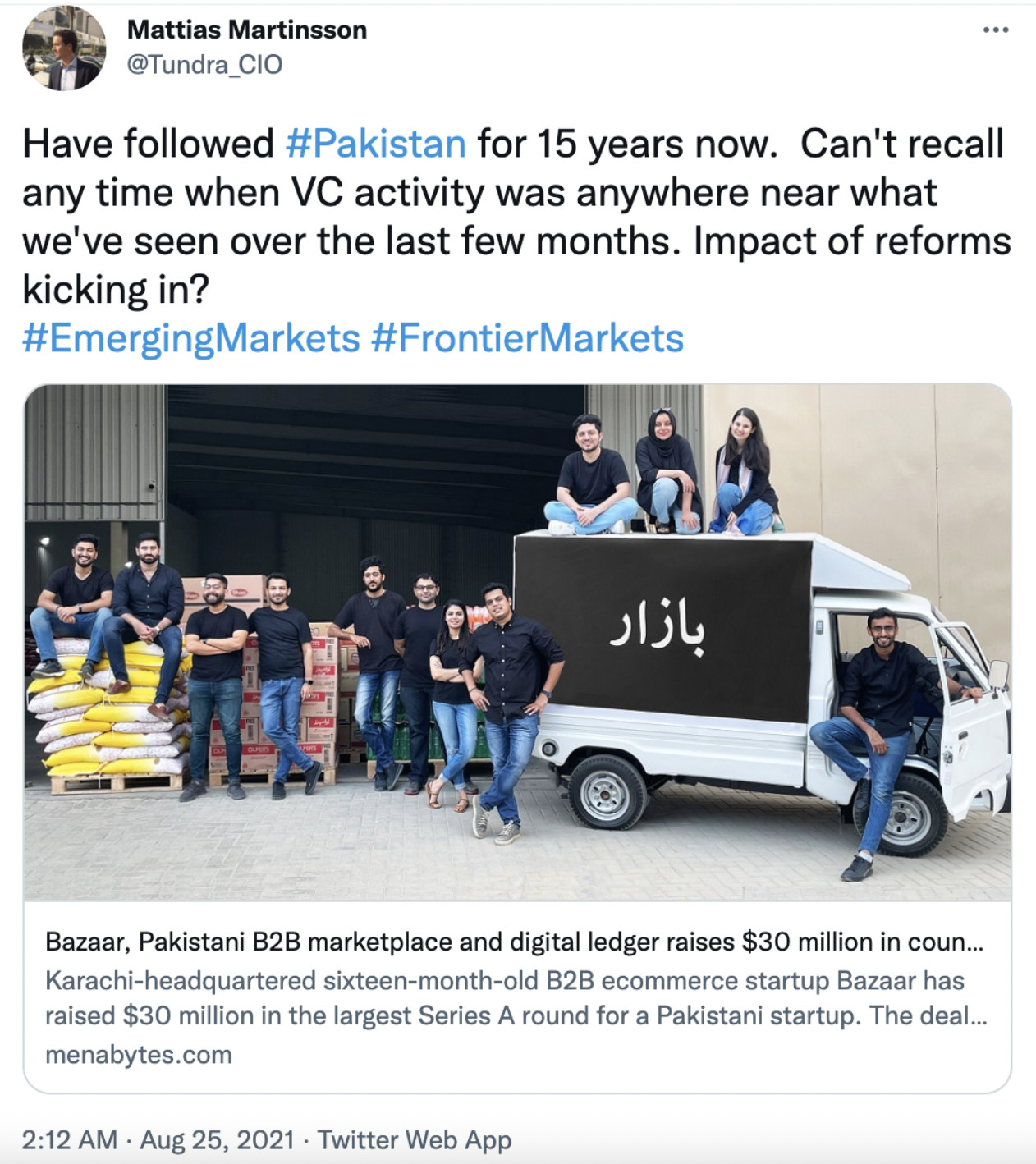
On August 25, 2021, a tweet by Mattias Martinsson, Chief Investment Officer at Tundra Fonder, a Swedish asset manager specialising in frontier markets, drew the attention of many.

“Have followed Pakistan for 15 years. Can’t recall any time when VC activity was anywhere near [that] we’ve seen in the last few months. Impact of reforms kicking in?”, he tweeted.

The tweet, which referred to the record amounts of venture funding being poured into Pakistan in 2021, well captured the changing market sentiment.

And this positive sentiment could, well, mark a new dawn for the Islamic republic’s startup ecosystem.

However, the picture was totally different until three-four years ago. Pakistan, plagued by security concerns for many years, had not been a preferred destination for foreign VCs. The unrest in neighbouring Afghanistan, following its invasion by a US-led coalition in the 2000s, had ripples in Pakistan. Consequently, the country faced several massive terrorist attacks. Its unpredictable and unstable political system added to the woes.

This precariousness scared away global investors from investing in the nation.

While Pakistan was struggling to check the growing terrorist activities and shed its image as an insecure nation, its arch-rival India was marching ahead, attracting billions of dollars in VC money. India, whose digitisation rate grew fast in the recent years, also minted around 100 unicorns in the last 10-plus years, whereas Pakistan produced none.

Finding the feet

After two decades of uncertainty and confusion, Pakistan’s tech startup ecosystem appears to have finally found its feet — if the growing VC activity is any indicator. In 2021, a record US$352 million was raised by more than 50 local startups, statistics by consulting agency Invest2Innovate (i2i) showed. To put this in context, local startups secured only US$465 million between 2016 and 2021 (see the graph).

What made the 2021 boom more exciting was that a big chunk of the dollars came from international investors. Among them were notable VCs, such as Kleiner Perkins (the US), Defy Partners Management (the US), Wavemaker Partners (Singapore), and Zayn Capital (UAE).

The kind of VC money invested in 2022 so far also brings cheers to the ecosystem. In the first three-month period, startups secured 7x as much investment as in Q1 last year, with names such as Indus Valley Capital, Defy Partners, Acrew Capital, Wavemaker Partners, B&Y Venture Partners, and Zayn Capital injecting capital.

Also Read: The 5 women in tech from Pakistan you must know

Many factors are attributed to this investor confidence. The primary reason is the improved security situation; the number of terror-related incidents in the nation has dropped in recent years. An improved digital infrastructure also worked in its favour. Pakistan, with a population of 228 million, had 82.90 million (about 36.5 per cent) internet users as of January 2022.

Besides, Pakistan recently introduced new reforms to become more startup-friendly. The previous PTI government, led by Imran Khan, realised the importance of startups to the country’s economic growth and wanted it to be a hub for new businesses, along the lines of Silicon Valley. The government had also been very responsive to the growing startup ecosystem and instituted several policies from “tax holidays” through special zones to regularising holding companies to creating fintech licenses.

In February this year, the government also established Pakistan Technology Startup Fund worth one billion rupees (US$5.4 million) to provide seed financing to 50 startups annually.

In addition to these initiatives, the central bank, the SBP, introduced new legislation that allows international investors to invest in an entity registered in a foreign land but has operations in Pakistan (it was disallowed earlier).

The reforms also included a legal framework for Electronic Money Institutions (aimed at offering innovative payment services to the general public), the Digital Banking Policy (aimed at granting the license to set up wholly digital banks), and the setting up of Special Technology Zones.

With all this in place, Pakistan now has an active startup ecosystem, with many incubators and accelerators, including i2i, the National Incubation Centers, Nest IO, Plan 9, and Plan X. Several co-working places like COLABS, Daftarkhawan, and The Hive have also emerged recently.

Many early-stage VCs and angel networks are also operational in the nation. The names include CresVentures, DotZero, Planet N, Lakson Investments, Fatima Ventures, Deosai Ventures, 47 Ventures, i2i Ventures, HBL ventures, Indus Valley Capital, Virtual Force, Karavan, Zayn Capital, Walled City Co.

According to Kalsoom Lakhani, Co-Founder and General Partner of i2i Ventures (the US$15-million VC arm of i2i), the pace at which things are moving in Pakistan right now is probably 20x faster than she had ever seen. Moreover, the time between two successive financing rounds is also getting shorter, she says.

As a result of the changing business environment, many foreign-educated young Pakistanis have started quitting their overseas plum jobs at MNCs like Morgan Stanley and McKinsey to set up their own ventures back home. For instance, Aatif Awan, with over a decade working for tech behemoths such as LinkedIn, came back in early 2020 to launch his own VC firm Indus Valley Capital. This early-stage VC firm has already backed eight companies, including Bazaar (a B2B e-commerce marketplace, which recently secured US$70M in a Series B round) and Airlift (a quick commerce startup that bagged US$85M in Series B in 2021).

According to Awan, Pakistan now has all the necessary ingredients to grow — quality startups, a critical mass of internet users, and smart VC money. It is geographically smaller and well-connected, with fewer provinces. Regulatory barriers are also lower.

All these factors have attracted foreign VCs to Pakistan — the last big untapped market globally.

However, the road ahead is still more than bumpy for local startups.

Lack of exits a problem

As startups make waves and put their names on the global map, new problems worry the ecosystem. They include lack of access to growth-stage capital and reluctance among people to open bank accounts (about 100 million adults don’t have access to formal and regulated financial services).

As for exits, the higher valuation of startups is a common concern for many investors. This effectively closes the possible exit routes for startups. According to Suleman Rafiq Maniya (Head of Advisory) at Vector Securities, it may be hard for VCs to get an exit through the stock market because the valuations of startups are higher compared to listed companies.

Exit through acquisitions is also scarce, likely discouraging investors from investing further in local startups. Barring Alibaba’s acquisition of Daraz and Ant Group’s buying of a 45 per cent stake in Telenor’s EasyPaisa in 2018, there have not been any major exits in the past three years. Awan says that the market is still too early for material exits, and it will take the ecosystem a few years for more substantial exits to materialise.

The Pakistan Startup Ecosystem Report 2021 by i2i warns that if foreign VCs don’t see clear long-term prospects locally, they may desist from cutting bigger cheques or making strategic investments.

The Series A and growth-stage capital crunch also poses a problem to Pakistan like any other emerging ecosystem. “There is a lot that a government can do here but I think it is the private sector that should take the lead here. The government can ensure a fair playing field. For that reason, early-stage Pakistani VCs should take the lead to fill the gap. If they fill this gap, they will be able to attract foreign VCs,” says Taraec Hussein, an investor with Gobi Partners, one of the most active VCs in Pakistan.

What future holds for Pakistan

Indus Valley’s Awan believes that the momentum that Pakistani startups gained in H1 2021 will continue in 2022. More top investors, including traditional and cross-border VC funds, will come to invest in Pakistan. Global accelerators like Y Combinator and 500 Global will also double down on local startups.

“The Pakistani startup ecosystem has had a late start, but it’s taking off quickly. The year 2021 saw more VC funding than all prior years combined, and 2022 seems on track to more than double that. By 2025, the VC funding in Pakistan is projected to exceed US$2 billion annually. In the next three-five years, several unicorns will be minted in Pakistan across B2C e-commerce, B2B e-commerce, logistics, and fintech,” believes Awan.

Also Read: Gobi-backed Pakistani startup Airlift raises US$12M Series A led by Uber investor First Round Capital

“We expect the new government to continue with startup-friendly policies. There is broad recognition across the political spectrum on tech being the major driver of foreign direct investment (FDI) and exports, so all parties recognise the importance of investing in the tech ecosystem,” Awan shares.

Conrurrs Gobi’s Hussein: “Venture capital is now a key economic pillar of any country and for that reason, it will be extremely foolish for the new government to pull back some of the reforms brought by the previous government. Also, there is so much buzz, interest and hype around VCs and entrepreneurship, founders and startups in Pakistan.”

However, Awan warns that there will be some failures in the local startup scene. “As more and more startups get early-stage funding, the founders will realise that capital isn’t the hardest part of building a great company. Finding product-market fit is hard. Building a world-class team is hard. Competing with multiple well-funded startups and going after the same market is hard.”

Some startups may scale to a certain level but then fail to go past that thanks to any of the reasons mentioned above. It is not a bad thing but is actually a positive thing for the ecosystem. “Because in the long run, people will learn from these experiences and go on to build something bigger and better,” Awan concludes.

Copyright: sakhaphotos

The post Pakistan startups, the last massive untapped opportunity in the world appeared first on e27.

Posted on

A beginner’s guide into the world of NFTs

NFTs are tokens that can be used to portray possession of unique items. They enable us to tokenise things such as collectibles, art, and even real estate.

They can merely have a single official owner at once, and they’re guarded by the Ethereum blockchain; nobody can change the record of possession or copy/paste a fresh NFT into existence.

It stands for non-fungible token. An economic term that you might utilise to explain things is non-fungible such as a song file, your computer, or your furniture. These things are not exchangeable for other items since they have unique characteristics.

On the contrary, they can be switched because their worth defines them instead of their unique properties.

Now that we know what NFT is, let’s jump into its standards.

Ethereum blockchain

The ERC721 was the novel non-fungible token standard constructed on Ethereum. Ethereum was the pioneer in this space and is even currently the most broadly utilised blockchain platform for developing and introducing NFTs.

However, the Flow and Tezos blockchain protocols are keeping up fast and will possibly exceed Ethereum in the near forthcoming.

Transactions on entire blockchain platforms have a connected cost, generally an insignificant figure. The transactions on Ethereum are worked in ‘gas.’ When Ethereum was established, gas was connected to the cost of ETH on the open market; the pioneers didn’t anticipate the price of ETH to increase to the point where it would become exorbitant to transact on the platform.

Also Read: NFTs: The good, the bad, and the future

Ethereum’s inherent language is Stability. Ethereum also began with the evidence of work agreement mechanism and planned to change to the evidence of stake consensus mechanism.

Flow blockchain

To comprehend Flow, we require to begin with Cryptokitties. An NFT founded game that enables users to purchase, trade, gather and reproduce digital cats is Cryptokitties. It was started to utilise ERC721 tokens. It became so famous that it blocked the Ethereum blockchain network.

The game is set out to resolve this issue by the team behind and in the procedure formed Flow, a blockchain that was created with crypto-collectibles and games in mind.

Tezos Blockchain

The liquid-proof stake consensus mechanism is utilised by this decentralised blockchain known as Tezos. Tezos has an inherent cryptocurrency named Tez. The platform makers acknowledge that transaction fees require to be low for broad adoption and comfort of use.

How does an NFT work?

Over a blockchain, NFTs survive, that is, a shared public ledger that registers transactions. You’re possibly most habitual with blockchain as the fundamental operation that builds cryptocurrencies feasible.

Particularly, NFTs are usually retained on the Ethereum blockchain, even though other blockchains assist them moreover.

An NFT is established from digital items that depict both intangible and tangible objects, including:

  • Art
  • Designer sneakers
  • Videos and sports highlights
  • GIFs
  • Virtual avatars and video game skins
  • Collectibles
  • Music

You won’t believe that even tweets matter. Jack Dorsey, the Twitter co-founder, sold the tweet that was posted by him first ever on the platform for more than US$2.9 million as an NFT.

Even a piece of digital art was sold for US$69 million Non-Fungible Token (NFT).

Basically, NFTs are objects that are collected only digitally. Hence, rather than acquiring a tangible oil painting that can be hung on the wall as a masterpiece, the purchaser gets a digital file.

They also acquire exclusive rights of ownership. You read it right: It can only have a single proprietor consecutively. NFTs’ special data build an easy way to validate their possession and move tokens among owners.

Even the creator can reserve particular information within them. For example, artists can signal their work of art by including their signature in an NFT’s meta-information.

What are the uses of NFTs?

Through NFT marketplace development and blockchain, artists and content makers get an extraordinary opportunity to add monetary worth to their work.

For instance, the artists no longer need to depend on auction houses or galleries to trade their art when there is an NFT marketing agency. Rather, the artisan can directly trade to the client as an NFT, which also allows them to maintain extra profits.

Furthermore, artists can schedule royalties so they will obtain a sales percentage anytime their art is traded to a new owner. This is an appealing feature as artists usually do not obtain future income after first selling their art.

To create money with NFTs art isn’t the only way. Brands such as Taco Bell and Charmin have invited themed NFT art to increase charity funds. Charmin labelled its offering non-fungible toilet paper, as well as Taco Bell, sold out its NFT art in a matter of minutes, with the greatest bids approaching at ether 1.5 (ETH) equals US$3,723.83.

Also Read: NFTs for fundraising: What you need to know before jumping on the bandwagon

In February, a 2011-era GIF of a cat “Nyan Cat,” through a pop-tart body, traded for approximately US$600,000. In late March, NBA Top Shot produced more than $500 million in trade.

Even celebrities such as Lindsay Lohan and Snoop Dogg leap on the NFT bandwagon, releasing special memories, moments, and artwork as securitised NFTs.

Difference between NFT and cryptocurrency?

NFT is usually built utilising a similar sort of programming as cryptocurrencies, such as Ethereum or Bitcoin, but that’s the point where the similarity ends.

Cryptocurrencies and physical money are “fungible,” meaning they can be sold or traded for each other. They’re also the same in worth; one dollar is constantly valued by another dollar; one Bitcoin is always the same as the other Bitcoin. A trusted resource is built by Crypto’s fungibility of operating transactions on the blockchain.

NFTs are diverse. All have a digital signature that makes it inconceivable for NFTs to be traded for or same to one another (hence, non-fungible).

The future of NFTs

The greatest hazard to NFTs is either the bubble bursts. NFTs could be the white-hot event of the moment, but, as with any novel technology, they still have a few ways to go before they are extensively recognized and turn into truly mainstream.

Notwithstanding the eye-watering sums varying hands in front-page transactions, they are still an extremely niche product and may rightly be crossing fancy digital tulips.

Owners of tokens could wind up sitting on an excess of NFTs with tiny buying concern if there is a decline in their popularity, in the same method as several bubbles have exploded over the last numerous years.

Despite that, as with the broader utilisation of the blockchain, it does look clear that because of NFTs’ utility as records of ownership in the business, they might well be here to remain in any form.

Editor’s note: e27 aims to foster thought leadership by publishing views from the community. Share your opinion by submitting an article, video, podcast, or infographic

Join our e27 Telegram groupFB community, or like the e27 Facebook page

Image credit: rokastenys

The post A beginner’s guide into the world of NFTs appeared first on e27.

Posted on

Meet Facebook Community Accelerator 2022’s additional funding recipients who are turning impactful ideas into action

The Facebook Community Accelerator, which helps leaders harness the power of their community in Southeast Asia, has announced the culmination of its 8-month-long program. 

The program, launched by Meta (parent company of Facebook) in partnership with the region’s leading startup ecosystem platform, e27, aims to turn the impactful ideas of community leaders into actions. 

The 19 community leaders, who underwent hundreds of hours of training, coaching and mentorship, showcased themselves on Demo Day on March 31, 2022. They shared their learnings, the impact they have made on the members of their communities and their future vision with the ecosystem partners.

A vetted list of 15 external Judges from across the Asia Pacific and more than a hundred interested curated Ecosystem Partners attended the event. 

Check out the original 19 communities and their leaders here.

The power of communities and their impact

“Communities can touch and transform lives,” remarked Ellen Alarilla, Head of Sustainability and Corporate Responsibility (Southeast Asia and Oceania) at Ericsson. Acknowledging the community leaders’ outstanding efforts, she added, “They all had solid, ambitious plans to scale and extend their impact beyond their current reach and have already touched and transformed lives in their communities.”

Throughout the programme, the communities showed their tremendous power in bringing an impact. According to Holly O’Keeffe, a judge of the program and Chief Impact Officer of Thegoodgap, former-CSR lead at Experian Asia Pacific communities are changing the world with technologies. 

“We have become so used to tech playing an everyday role in our lives that we often take it for granted. The accelerator shone a bright light on the many new ways leaders use technology to change the world for the better and why it’s important to support leaders on their missions,” said O’Keeffe.

Echoing a similar sentiment, Thibaut Briere, Founder of GrowthMarketing Studio, added that he was moved by the fact that each community leader has tried to solve real, concrete problems that have affected people. They go through a lot of work to bring people together and support the community, Briere said.

Gina, a coach, Founder of Connected Women and a community builder of over 16 years, commented that she wished she had received this kind of support in her early days. She also applauded Meta for giving special focus on developing community leaders and helping them put a framework in place for sustainability.

“Too many wonderful communities are short-lived or continue to become a burden to the founders because they fail to find ways to be sustainable. This programme placed an importance on the role of community leadership and helps founders create long-term, wide-scale impact as they become sustainable and scale.”

Also Read: How collaborations between these Facebook communities yield better impact

A few of the communities coached by Gina during the programme showed tremendous progress and saw up to a 33 per cent increase in engagement. 

Amplifying impact and further support

As part of the programme, a selected few communities received up to US$30,000 in additional funding with the help of US-based non-profit Global Giving. 

Below are the details of the communities that have received funding and their stories:

The Bicycle Scouts Project, Inc

  • Country: the Philippines
  • Community Lead: Myles Delfin

Created in 2013 by Myles Delfin, Bike Scouts provides a network of support and alternative means of access to communication and essential supplies in the aftermath of severe disasters. It is a social teamwork platform for anyone who wants to do something good for their community or anywhere in the world where help is needed. Since its inception, Bike Scouts has grown to add multiple pages and local community groups where they can make a difference.

The programme has enabled Bike Scouts to further scale the membership to 4,000 team leaders around the Philippines. These members themselves are the leaders of their local groups, representing Bike Scouts in their respective regions.

These members have at least 150,000 volunteers who helped serve over 40,000 requests for assistance over the past eight years and delivered 5,000 bicycles for donation. They also secured a social purpose brand activation client project worth US$38,000.

“I feel that the end of the program is just the start of our work. We will all accomplish awesome things with our communities using the lessons we’ve learned from all our amazing coaches, mentors, teachers, and friends. I am eternally grateful for that opportunity and all the incredible moments of joy and a sense of family,” said Delfin.

Bounce Back PH

  • Country: the Philippines
  • Community lead: Jason Dela Rosa

In March 2020, Jason Dela Rosa started Bounce Back PH to help small businesses and subject matter experts endure and recover from the COVID-19 pandemic. It aims to create a community where businesses and business leaders can work together and help each other recover from the crisis. With over 65,000 members, the group has launched hundreds of learning and mentorship programs, donation drives, retooling, and business matching activities for SMEs.

Also Read: Facebook Community Accelerator Program introduces the 19 communities of the 2021 APAC cohort

Through the Facebook Community Accelerator program, Bounce Back achieved several milestones. It over-achieved its revenue goal by 133 per cent and engaged more than 9x more partners. It also launched the first-ever Metaverse bazaar to help push sales for its members. In addition to that, Bounceback also enrolled 126 scholars who were mentored by 45 business executives and industry leaders. It also gained 7,000 new members during this period and launched an influencer program with over 10 million audience reach to help MSMEs to gain traction.

Dela Rosa said: “I want to thank all the community leaders for being the light in times of darkness, and for all the inspiration for us to be better each time for our communities. To our coach, Tamara, the e27 team, and Meta, you have placed our vision on the right track when all seems confusing. We will never forget this experience ever. You can always count on me for future collaborations.”

Home Buddies PH

  • Country: the Philippines
  • Community Lead: Frances Cabatuando

Home Buddies, started by Frances Cabatuando, wanted to inspire and equip Filipinos with ideas on how they could live and work while stuck at home during the pandemic. It aims to give Filipino home enthusiasts a safe, creative space where they can share and exchange home improvement tips and design inspirations.

Today, Home Buddies have managed to become a three million-strong community and continues to shape the local home improvement scene — hosting free webinars, empowering small businesses, and creating jobs for displaced workers. Its highly engaged community also enjoys weekly parenting talks, on-ground events, and exclusive promos and merchandise.

This year, Home Buddies continues to expand its influence with a subgroup called Home Buddies Hangouts. Here, the tight-knit community continues to share and exchange tips, with an exciting focus on how to create a more memorable and worthwhile home away from home experience.

“Huge congratulations to all my fellow community leaders! Thank you all for making me realize that I’m not alone in my mission to make the world a better place. Thank you so much to all our coaches and mentors for the guidance and wisdom imparted throughout the programme. We bring great inspiration to create a more meaningful impact on all our Home Buddies. Thanks so much!” said Cabatuando.

KakiRepair by KakiDIY

  • Country: Malaysia
  • Community Lead: Johnson Lam

Johnson Lam started KakiRepair in 2017 as a movement to encourage people to fix their stuff rather than throw them away. KakiRepair by KakiDIY is a collaborative platform powered by the community to post-repair related issues, diagnose, fix, and learn from one another. Its 47,000+ members actively post repair-related issues and constantly help each other solve problems and share best practices.

Today, KakiRepair has achieved notable achievements and hugely impacted the community and others. They created more than 50,000 PPE kits for frontline workers during the pandemic and refurbished and donated over 1,000 computers to underprivileged students. Other projects included helping flood repair missions wherein the community repaired more than 400 items for flood victims saving over RM 400,000 (US$90,000) of damages.

Kakirepair also won the Ministry of Science, Technology & Innovation’s Innovator of the Year award. KakiRepair has continuously proven itself to be a community sourcing platform. 

During the accelerator program, it created a new knowledge management platform with more than 500 sign-ups. KakiRepair’s future programs include travelling nationwide in its MakerVan, a motorhome converted into a moving maker space.

Johnson Lam said: “Thank You for recognizing the results and validating the impact of KakiRepair on the community and environment. This will fuel us to do more and accelerate our plans further, bringing KakiRepair across the border to APAC and beyond.”

Scoliosis Philippines Support Group Inc. (ScoliosisPH)

  • Country: the Philippines
  • Community Lead: Amanda Glenda M Bonife-Kiamko

Amanda Glenda M Bonife-Kiamko created the Scoliosis Philippines Support Group on Facebook to raise awareness, help give scoliosis patients a forum to share their issues and stories, and provide psychosocial support. Its 31,000+ members have been able to connect with other patients and make them feel empowered through meetups, awareness events, learning sessions, and story sharing.

The Facebook Community program helped Scoliosis PH conduct strategic planning, launch learning and wellness programs, and establish partnerships with multiple partners. Scoliosis Philippines has grown with more than 35,300 members, and its community page has over 70,000 followers. It also aims to reach out to more patients through a newly established 17 regional chapters that engage, educate and empower through their programs and Special Interest Clubs. 

Also Read: How can you build a living, thriving community around your SaaS product?

Scoliosis PH built the Philippine Registry of Scoliosis Patients mobile app during the program. It is an initiative to support its goal of attaining equality, social justice, and rights for scoliosis patients and ensure that these rights are respected and guaranteed.

Bonife-Kiamko said, “Shout out and massive thanks to our excellent Meta, coach, e27 team and Ecosystem Partners, besides all the stakeholders involved. Thanks for mentoring and giving us this life-changing opportunity to learn, grow, and establish the Scoliosis Philippines Foundation, creating sustainable initiatives. Thank you to our APAC Cohort for inspiring us with your impactful communities and giving us sincere support throughout the program. It’s truly an honour to have shared this amazing journey with you all!”

Solo Female Travelers

  • Country: Singapore
  • Community lead: Mar Pages

Solo Female Travelers was started in 2015 as a place for women who love to travel independently to connect. The group empowers women to travel solo safely and on their terms via the communities, online resources, and women-only small group tours. The community has empowered thousands of women to take their first solo trip safely and confidently, breaking stereotypes, expectations, and barriers.

The Facebook program helped Solo Female Travelers to make numerous achievements and impacts — from increasing the community members to 150,000 members across different platforms. It also pioneered and supported more new travel destinations worldwide, made possible by additional team members from across the globe. It also has 92 per cent more page traffic growth. As such, the communities continue to bring impact in supporting women entrepreneurs through their partners and their work.

Mar Pages said, “Thanks to the Meta team and to my coach, Tamara, for supporting our dream and mission of empowering women through travel. You helped us bridge the gap between the seed of an idea and a growing tree. To my fellow Community Leaders, you inspire me every day to continue doing the work we do with passion and dedication, and you bring much light and positivity to my day.”

Final note

The six communities mentioned above were selected as the additional funding recipients from the original 19 communities who attended this year’s cohort (check out the other 13 communities and their leaders here). Each of these communities is considered the top in their respective countries. Each representative is an industry leader in their own capacity to turn their impactful ideas into action.

We would like to congratulate all the cohort members of the Facebook Community Accelerator 2021-2022 for amplifying their message to scalable and groundbreaking heights!  These communities have shown tremendous growth over the last month, and their work will continue to make an impact. 

If you are an organisation working on similar projects that align with our communities, reach out and engage with the community leaders for an exciting collaboration!

Visit the Meta Blog and the Facebook Community Accelerator Program official page for more information.

Disclaimer: All data and numbers are sourced from the community group data provided by Bike Scouts, Home Buddies, Bounce Back PH, Kakirepair, ScoliosisPH, and Solo Female Travelers.

Editor’s note: e27 aims to foster thought leadership by publishing views from the community. Share your opinion by submitting an article, video, podcast, or infographic

Join our e27 Telegram groupFB community, or like the e27 Facebook page

Image credit: Facebook Community Accelerator

The post Meet Facebook Community Accelerator 2022’s additional funding recipients who are turning impactful ideas into action appeared first on e27.