Posted on

Meet the Singapore-based tech professionals of e27 Luminaries

singapore startup employees

As the city state of Singapore settles into another lockdown, we are certain these unsung heroes who helped savage their organisation’s growth efforts in 2020 will rise up to the occasion once again. A part of the e27 Luminaries, this week we feature some of the notable names from startups in Singapore that made it to SEA’s most coveted list of fame.

To select companies in the list, e27 went through media coverage in the past year to see companies who managed to survive and thrive during the pandemic with various notable achievements, from closing a funding round to expanding to new markets. We asked these companies to nominate individuals whom they believe had done a remarkable job in spearheading these innovations.

Here are the Singapore heroes you should meet.

Seow safe space

Lynette Seow, COO, Safe Space

Lynette started off as a Safe Space volunteer from IBM and eventually joined the mental health tech startup full-time as COO. She is bringing in her technology consulting and digital transformation experience to develop a B2B2C platform for people to reach out to the right counsellor at the right time/place and at the right price.

She’s proven integral in the scaling of Safe Space by leading both their product and research efforts.

She believes, mental health care should be accessible and affordable, convenient and confidential.

Wai Tsun Yim Wai, Data scientist Glints

With Wai at its leadership, the company has been focussing on expanding its data warehousing pipelines and capabilities, implementing data quality programme, and automating sourcing and matching of jobs with a quality candidate.

According to the Glints team, Wai’s empathy for his co-workers was very crucial during the time of COVID-19. Despite the challenges he faced in running a Data Science operation in a startup, he has taken them in his stride.

kia boon joh

Joh Kia Boon, Senior Project Manager, Habitap

For re-organising and preparing a new, more resilient team structure.

Boon is a project manager with seven years of project management experience skilled at leading cross-functional teams. She led multiple initiatives at Habitap that includes re-organising the team structure to optimise productivity and streamline operations, mentoring team members to build effective working relationships in cross-functional teams and implementing best practices and internal standard operating procedures to increase delivery standards.

Doctor Anywhere Yang

Dr Yang Guirong Gui Rong, Assistant Medical Director, Doctor Anywhere

He assumed the role of Assistant Medical Director in the midst of the pandemic in July 2020 but significantly led their efforts against COVID-19. Not only did he establish infrastructure and processes to scale up virtual consultations to serve 300,000 migrant workers, but also spearheaded their massive swab efforts in the dorms, which required close coordination with the Ministry of Health and Health Promotion Board.

He directed the overhauling hiring processes as well as standardising clinic opening times resulting in a 2-3x increase in revenue for all clinics. This strengthened service delivery at the physical clinics to launch 24/7 virtual clinic services and consequent increase in customer satisfaction.

zazazu sheaha

Sheaha Ghazali, Community Manager, ZaZaZu

A natural people person, connector and events expert she secured great partnerships and went the extra mile to help ZaZaZu as a controversial business to break taboo of female sexual wellness. Although she only joined the team since Jan 2021, she has been a great brand ambassador by bringing in high brand association and spread positive conversation around sexual wellness for partners, clients and everyone else around her.

zach poon

Zach Poon, Head of Credit at Funding Societies

A credit risk expert with eight years of experience across financial and insurance institutions, his leadership helped Funding Societies tighten their underwriting requirements on the financing opportunities for crowdfunding on the platform. The industries they focused on financing were those expected to thrive during the crisis like healthcare, medical supplies, and transportation. As a result, we managed to keep our platform default rate under two per cent throughout the pandemic.

joyce Ho ELXR

Joyce Ho, Head of People Success, ELXR

Known for confidentiality and credibility, she is a skilled HR personnel. Ho was instrumental in hiring for ELXR and growing the team five times during the pandemic which contributed to the company’s 140 per cent growth YoY.

The e27 Luminaries is an initiative by e27 to celebrate the unsung heroes of the SEA startup ecosystem. Discover these notable companies and individuals here.

Image credit: Adhitya Andanu from Pexels

The post Meet the Singapore-based tech professionals of e27 Luminaries appeared first on e27.

Posted on

Want a promotion? Time to develop your interpersonal skills

interpersonal skills e27

If you’re like most professionals, you’re not looking to stay in the same position for the rest of your career. Maybe you’ve already probably started brainstorming ways to move up the career ladder and land your dream job.

However, while most people think that the best way to get promoted is by learning new hard skills or working overtime, there’s another important component that will convince your boss you’re ready to move up: interpersonal skills.

Interpersonal skills—the ability to interact and get along with others—is an oft-overlooked set of skill that’s actually so important that, according to a study done by Vitalsmarts (a corporate training and leadership development firm), 92 per cent of respondents said that having poor interpersonal skills will hinder an employee’s career progression.

To help you put your best foot forward, we discuss four important interpersonal skills you should develop if you want to impress your boss and get that promotion.

Managing negative emotions

When something goes wrong or you’re having a bad day, your emotions take centre stage. Unfortunately letting your emotions get the best of you in the workplace can lead to unfortunate spats with your colleagues, a visibly poor attitude and rash decision making.

Furthermore, being led by our emotions also often causes us to prioritise feelings over facts, often leading us to make decisions based on our emotional state rather than the hard facts. This can be dangerous as emotional actions can lead to biases, oversight and costly mistakes. If your boss sees that you can manage negative emotions and stick to facts, they’ll feel confident in trusting you with difficult situations.

They’ll also see you as someone who is able to put their feelings aside to focus on what needs to be done to move the company forward—without giving in to bias.

Also Read: 7 life skills we can learn from Mark Zuckerberg

Some emotions that can be difficult to deal with in the workplace include frustration, anger, worry and insecurities, feeling down, and negative attitudes towards others. Once you recognise any of these emotions, it’s important to find out what triggered them and then focus on either removing the trigger or moving past it in appropriate ways.

If your negative feelings were triggered by a colleague, then you can take a second to relax and then calmly give them constructive feedback. However, all of this is not to say that you should suppress your emotions.

Instead, it’s important to acknowledge your negative emotions and solve them openly. It’s also important to foster positive emotions within your team, which will make for a more creative, productive and less stressed work environment.

Conflict management

Conflict in the workplace is unavoidable and encapsulates everything from small disagreements of opinion to larger issues like a problem with a client. Being able to de-escalate conflicts is another key factor that managers look at when considering your promotion. Whether you’re dealing with an unhappy client or disagreements with your team, stepping in and taking charge calmly and effectively signals to your boss that you are a dedicated problem solver.

In fact, a report by Udemy found that conflict management is the top soft skill that was trending among its users, making employees who excel at this skill to be a valuable asset to any team.

If you’ve never dealt with conflict in the workplace before, you’ll need three skills to get started: self-awareness, collaboration and promotion of a productive work environment.

Also Read: How to develop soft skills

When conflict occurs, you will need to identify the root of the issue (it could even be you, hence the self-awareness), collaborate with the third-party to find a potential solution and then promote that solution and apply it to avoid future problems.

Lastly, you’ll need to remember that conflict resolution doesn’t focus on right vs. wrong, but instead works towards coming to an agreement.

Empathy

Empathy, or the ability to share and understand the feelings of others, is one of the most important interpersonal skills you can have in the workplace. When you are feeling frustrated at a coworker or when a coworker is mad at you, the common instinct would be to get defensive and argue your point.

However, the purpose of being empathetic is to neutralise the negativity and identify the common ground by putting yourself in your colleague’s shoes. When you are actively empathising, you are seeing past the initial emotional reaction and are attempting to see what is happening behind the scenes to solve interpersonal issues.

For instance, next time a coworker makes a mistake, you can practice empathy by putting yourself in his/her shoes and having a chat about what could have caused the error. Maybe there is trouble in the family and it’s spilling over into their work, or there was a lack of communication about what needed to be done.

Once you are able to see things from the other person’s perspective, you will be able to identify and solve the problems effectively without putting down your coworker or creating additional conflicts.

Showing that you are an empathetic worker is crucial for managerial promotions and studies have shown that empathetic managers are viewed as better performers at their jobs by their bosses.

Mid-level managers who want to move upwards can show additional empathy by watching for signs of overwork, showing interest in needs and dreams, willingness to help with personal problems and showing compassion.

Open dialogue

If you want to show your boss you’re an effective leader, then you’ll need to show him that you are able to take in multiple perspectives and engage in open dialogue. An open dialogue also shows that you are not being led by your ego, but that you are willing to let others have a say and engage with their ideas.

Also Read: Why there is no better time to upskill than this COVID-19 crisis

When you engage in open dialogue, you are curious, non-judgemental, and are present and listening to the other person. There is no hidden agenda and you work towards guiding the conversation through open-ended questions.

If you are looking for a promotion that will land you in a leadership position, showing that you know how to foster an open dialogue with your colleagues and managers will be crucial in proving that you will put your team and the company’s best interests ahead of your own interests.

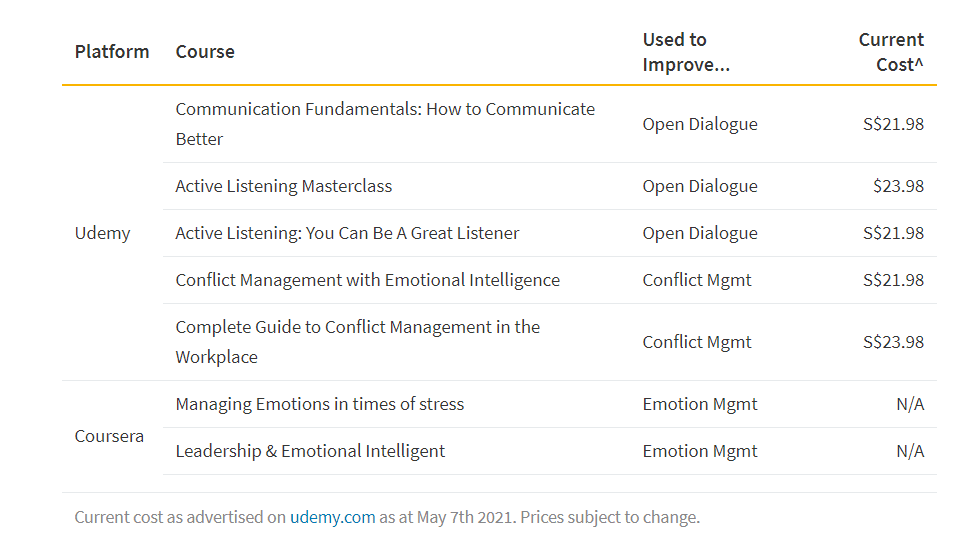
If you want to improve your interpersonal skills, sites like Udemy and Coursera provide a plethora of different courses for developing the soft skills mentioned above. Most courses at Udemy cost less than S$50 when they’re on sale and you are able to complete them in just a few hours’ time.

This table shows a variety of courses on Udemy and coursera that can be used to develop important interpersonal skills

If there are courses that are too expensive, you can look for alternatives that could be on sale or that are cheaper. Some courses may even be free or are eligible for the S$500 MySkillsFuture credit.

If you feel like you already excel in these skills and want to learn others, then you can consider moving towards making use of traineeship opportunities and enhancing your technical skills to make an even stronger case for why you deserve that promotion.

Editor’s note: e27 aims to foster thought leadership by publishing contributions from the community. This season we are seeking op-eds, analysis and articles on food tech and sustainability. Share your opinion and earn a byline by submitting a post.

Join our e27 Telegram group, FB community or like the e27 Facebook page

Image credit: Charl Folscher on Unsplash

The post Want a promotion? Time to develop your interpersonal skills appeared first on e27.

Posted on

Validating, testing, and pivoting with Adam Lane Robinson

Adam Lane Robinson is a Wall Streeter who turned to entrepreneurship after several unique experiences made him realise that it’s what he was made for.

He currently runs GetEmails, which is described as the world’s first-ever email-based retargeting software.

He’s also the Co-Founder and President of Robly, an email marketing firm.

In this fascinating talk, you’ll hear about:

  • What made Adam want to become an entrepreneur
  • How to validate your idea
  • How to determine when to pivot
  • How to come up with new ideas to test
  • Three great tools for measuring user behavior
  • And much more!

If you don’t see the player above, click on the link below to listen directly!

Acast

Apple

Spotify

Stitcher

This article was first published on We Live To Build.

Image Credit: Michal Czyz on Unsplash

The post Validating, testing, and pivoting with Adam Lane Robinson appeared first on e27.

Posted on

How to win term sheets and influence investors: Notes from founders of NewCampus, Snapask and Flickstree

fundraising tips from founders

Fundraising can be a daunting task for most first-time founders. Unlike running the startup, which is oftentimes based on the founders’ expertise on a subject matter or an unfair advantage they may possess, fundraising is not a skill and requires a lot of work.

Any founder who has gone through the process of fundraising can vouch for how arduous a task it is. A quick Google search can tell you all about the process of fundraising, but this article talks about actionable steps that startup founders — first-timers and seasoned — have taken to raise funds themselves.

Stop fixating on the “Idea”

“Ideas are like a**holes, everyone has one. Execution is what matters,” says William Bao Bean, General Partner at SOSV and Managing Director at Chinaccelerator and MOX.

One of the biggest myths in fundraising is the founders’ belief that they have a million-dollar idea. However, that is not always the case, as Saurabh Singh, Co-founder and CEO of Flickstree, explains. Flickstree is an AI-powered video publisher network that enables content websites and apps to maximise their revenues and has raised Series A of US$3 million in 2019.

Flickstree Co-Founders Rahul Jain, Nagender Sangra, and Saurabh Singh (L-R)

Ideas are useful only in the very early stages of the business to strike conversations with angel investors. Talking from his experience, Singh explains that the idea only helped Flickstree in the early stages of the business when they were starting out. Early investors invest in the pedigree of the founders and the idea, but over time, the pitch needs to evolve, and the idea cannot be the central theme anymore.

“If you are not embarrassed by looking at your first business plan and pitch deck after six months or one year of execution, there is something wrong,” he says.

Also Read: Term sheets: What you need to know

Take the road less traveled

NewCampus co-founder and CEO, Will Fan, shares a very interesting and unique approach to fundraising. NewCampus, a modern business school that offers live masterclasses needed to build future careers, has raised over US$1.2 million in seed money.

Having a VC that understands the business is more important than having just a popular VC. Big and prominent VCs get thousands of investment proposals and invest in hundreds of those businesses.

NewCampus Co-founders Fei Yao (left) and Will Fan; (The Business Times/ Yen Meng Jin)

NewCampus Co-founders Fei Yao (left) and Will Fan; (The Business Times/ Yen Meng Jin)

In the long run, it is important to find investors who bring not only financial resources but also other strategic resources.

Hence, instead of following a herd mentality, do your own due diligence and look for the diamonds in the rough: investors who understand your vision for the company and believe in you. This approach has allowed NewCampus to evolve, pivot, rebrand, and expand to several markets.

There is always smart money out there but as a founder, you must find the right people that are synergistic to you and smart for the business.

Look beyond the superficial numbers

Timothy Yu is the Founder and CEO, of Snapask, an on-demand tutoring startup. He raised US$35 million in a Series B round in early 2020 and an impressive US$56-plus million over the edutech startup’s lifetime.

Snapask Founder Timothy Yu; (GenT/ Moses Ng)

Having pitched to numerous investors, Yu explains that market size is often an overrated aspect of fundraising. Investors care about the long-term sustainability and the opportunities that exist in the industry that the business operates in. Founders tend to inflate market sizes and potential opportunities to legitimise the investment.

Also Read: What early stage startups should know when fundraising with VC’s

Eventually, investors are only looking into how much of the total addressable market the startup can tap into or successfully acquire. Simply claiming that a market is worth billions makes little sense if you are not servicing a significant chunk of it. What matters is your achievement and what you can practically achieve in the future.

Yu added that Snapask has always emphasised on being sustainable, looking beyond the market potential, and having a clear roadmap to profitability.

Singh echoes Yu’s thoughts and adds, “During fundraising, founders need to be clear on the scalability of their startups, the problems they’re solving, the market size, competitors, and exit plans for investors. Investors love founders who’ve done their homework.”

Be specific with investment needs

A common mistake that most founders make is being vague about the sum of money they need. Fundraising can be intimidating as the fear of rejection or the investment coming short of expectations looms over.

Hence, it is important to be able to justify to investors that the company needs the exactly what the founder is trying to raise. Timothy believes that founders should not fundraise just because they need a longer runway. Instead, they should go into the fundraising round knowing how the money they’re trying to raise will help the business grow.

This exercise not only shows the investors that you’re prepared, but also helps to build long-term trust with investors, which may be useful in subsequent fundraising rounds. And while this does not guarantee funding, it eases concerns and instills confidence that leads to a higher probability of fundraising success.

“Fundraising is not a milestone; it’s not an achievement. It’s just a necessary evil,” says Yu. Founders must understand that the long-term viability of the company depends on the sustainability of the business than on its valuation.

Founders’ pedigree matters

This point holds more truth to early-stage startups than it does to startups who have operated for a relatively longer period. Early-stage startups must make it a point to focus on their founders’ experience when pitching to investors.

Talking from his own experience building Flickstree, Singh talks about how they managed to establish authority with their background. He and his cofounder started a media company and were trying to build a content platform, where they could leverage their background of working in media and marketing.

Also Read: Early stage fundraising: What it takes to win over investors that best fit your team

This helped them build credibility with early investors as they could then answer any questions posed by the investors without being second-guessed, allowing them to raise the seed round, as well as subsequent rounds.

 Don’t bank on a single investor

Like investors looking to minimise risk by diversifying their portfolio, founders must also diversify their risk in fundraising by talking to multiple investors and not basing everything on a single investor.

One of the mistakes that Singh said he made early-on with fundraising was basing the round around one investor. While raising an angel round, the company received a deal from an investor who was meant to be the lead investor.

They made the mistake of announcing the lead investor and started collecting follow-on commitments from other investors. However, after negotiations with the lead investor fell through, the round went bust as all other investors pulled out of the deal.

“Once the lead investor pulls out, others start thinking that there must be something wrong with the company,” recalls Singh. This is when they realised that that banking on a single investor can be risky. “The round is never over until the money is actually in the bank account”, he adds.

Follow your own playbook

“There is no rulebook for startups operating in a blue ocean market,” says Fan. With billions of dollars being poured into the edtech industry today, edtech startups may be the hottest commodity in 2021 but it was not the case in 2015 when NewCampus was founded.

Attracting investors was challenging and so he says that founders must be willing to challenge the status quo and write their own playbook.

If it takes US$5,000 each from 50 investors to raise their angel round, they must be willing to do that. Founders must be willing to do what is right for the company. Especially in situations where the market is new.

Editor’s note: e27 aims to foster thought leadership by publishing contributions from the community. This season we are seeking op-eds, analysis and articles on food tech and sustainability. Share your opinion and earn a byline by submitting a post.

Join our e27 Telegram group, FB community or like the e27 Facebook page

Image credit: RODNAE Productions from Pexels

The post How to win term sheets and influence investors: Notes from founders of NewCampus, Snapask and Flickstree appeared first on e27.

Posted on

Malaysian fintech startup Finology wins Seedstars World Competition

Malaysian fintech startup Finology has been adjudged the global winner of Seedstars World Competition 2021.

Finology enables seamless access to financial products via the use of proprietary technology and digital distribution channels.

The company will receive US$500,000 in equity funding from Seedstars, Switzerland-based VC firm.

Other companies that reached the finals were Fulfillment Bridge (Tunisia), Pegasi (Venezuela), IMAN (Uzbekistan), and Ladda (Nigeria).

The jury comprised Salman T. Jaffrey, CIO of Wa’ed VenturesShannon Kalayanamitr, CEO of 5G Catalyst Technologiesand Charlie Graham-Brown

“Finology showed us a lot of promise in their mission to bridge together financial institutions and individuals by making financial products accessible for everyone. The Seedstars team believes that they will effectively help lead the way forward in the ever-increasing digitisation of the financial sector,” said Seedstars co-founder Alisée de Tonnac. 

Launched in 2012, Finology is a platform that enables users access to financial products and services like banking, property and insurance. Its technology has been deployed in four countries and its APIs are used by multiple large companies that include GHL, iProperty, and Tropicana.

“We’re all about using technology to deliver financial services to people in ways that are more meaningful to their lives. We look forward to rolling out more product offerings in Emerging Asia that have been designed around a seamless delivery experience,” said Finology CEO Jared Lim.

Also Read: Meet the 15 Asian startups that will advance to Seedstars World Competition 2020

Since 2013, Seedstars has organised world startup competition in emerging markets. This year, pandemic forced the event to be hosted online.

Seedstars received around 5,000 applications from 94 countries across Latin America, Africa, the Middle East, Eastern and Central Europe and Asia.

The full event can be accessed here.

Join our e27 Telegram groupFB community, or like the e27 Facebook page

Image Credit: Seedstars

The post Malaysian fintech startup Finology wins Seedstars World Competition appeared first on e27.

Posted on

Microsoft’s VC arm infuses US$6.25M into hyperlocal solutions startup NextBillion.ai

NextBillion.ai co-founders Gaurav Bubna and Ajay Bulusu (R)

NextBillion.ai, an Artificial Intelligence-powered hyperlocal solutions startup in Singapore, has extended its Series A financing round by adding US$6.25 million more to its war chest from Microsoft’s venture fund arm M12.

This follows a US$7 million round led by Lightspeed Venture Partners and Falcon Edge Capital last year.

The fresh funds will be used by the company for hiring, building vertical-specific AI-first capabilities, and expanding into new domains like neuro-linguistic programming and facial recognition.

NextBillion.ai was co-founded last year by Gaurav Bubna, Ajay Bulusu, and Shaolin Zheng — all former tech-leadership members of Grab who developed Grab Maps.

The AI startup is focused on building hyperlocal solutions, particularly in emerging markets where language and geospatial infrastructure challenges are significantly complex and unique.

Among its product is nextbillionmaps, which provides customisable features, such as routing and navigation, matrix calculation, and map data curation.

The second product currently under-the-making is nextbilliontasks, where AI is used for decoding of data to simplify multilingual texts, image classification, sentiment analysis and video annotations.

The idea hit the trio when they realised that there was no one map-fits-all solution and the future of location is decentralisation, Bulusu told Singapore Business Review in a recent interview.

Also Read: NextBillion.ai, a 6-month-old startup founded by the brains behind Grab Maps, raises US$7M Series A

They noticed that especially in a region like Southeast Asia where infrastructure and language barriers exist, challenges like losing a parcel or not being able to deliver things on time are common.

This motivated them to create nextbillionmaps, a service that provides customisable features such as routing and navigation, matrix calculation and map data curation, especially targeted at emerging markets.

The company said that it has scaled to support 15 customers across 20 countries and helped enterprises map over 2.5 million miles of roads and handled over 20 billion API calls.

As of today, the startup has 60-plus employees working from its offices in San Francisco, Bengaluru, Hyderabad, and Beijing.

NextBillion.ai is currently making deep-tech investments across AI, Machine Learning and computer vision as they expect to drive a lot of new technology innovation in the mapping industry.

Join our e27 Telegram groupFB community, or like the e27 Facebook page

Image Credit: NextBillion.ai

The post Microsoft’s VC arm infuses US$6.25M into hyperlocal solutions startup NextBillion.ai appeared first on e27.

Posted on

Connect with 3 investors active on e27 Connect today

In today’s edition of “Active Investors of the week”, we have Cathay Innovation, Endeavour, and Accion Venture Lab as our top three most active investors in our e27 Connect Program. The following are some details on who these investors are and what are their investment criterias:

Cathay Innovation
Based in: Singapore

Straight from Cathay Innovation: Cathay Innovation is a global venture capital partnership, created in affiliation with Cathay Capital, investing in startups at the center of digital revolution across N.America, SEA, China and Europe. They recently expanded their activities to Africa with their partner AfricInvest.
Investment range: Series A, Series B, Series C & above

Latest Investments:
Coherent (Hong Kong), Series A, $14M, Nov 2020
Axinan (Singapore), Series A, Undisclosed, Apr 2020
Kredivo (Indonesia), Series C, $90M, Dec 2019

Verticals: Agritech, Artificial Intelligence, Big Data, E-commerce, Education and more

e27 Admin/Investment Partner: Nicolas du Cray, an investment professional with 12-years experience in venture capital and overall 20-year experience in business development and innovation in the TMT sector.

Endeavour
Based in: Singapore

Straight from Endeavour: Endeavour Ventures is an emerging sector agnostic venture capital firm that invests in seed to series-A rounds in Southeast Asia, focusing on early-stage businesses in the FinTech, Big Data/AI and Digitalisation industries.

Investment range: USD 50K – USD 500K; Seed, Series A

Latest Investments:
Fabelio (Indonesia), Series C, $9M, Jun 2020

Verticals: Agritech, Artificial Intelligence, Big Data, E-commerce, Education and more

e27 Admin/Investment Partner: Sam Gibb is a managing partner at Endeavour Ventures. He has a deep understanding of the challenges that all businesses face throughout their private-to-public lifecycle, he helps early-stage businesses get off zero. Taking the role of a cheerleader or coach depending on what the situation requires, he is willing to sit shotgun with founders and help with recruitment, scale-up strategy, exit negotiations, and fundraising where required.

Accion Venture Lab
Based in: United States of America

Straight from Accion Venture Lab: Accion’s seed-stage investment initiative Accion Venture Lab provides capital and extensive support to innovative fintech startups that improve the reach, quality, and affordability of financial services for the underserved and have the potential to scale

Investment range: Not Specified; Seed, Pre-Series A / Bridge

Latest Investments:
Pintek (Indonesia), Venture Round, Undisclosed, May 2020
First Circle (Philippines), Venture Round, $1.3M, Apr 2017
Aye Finance (India), Series B, $10.3M, Nov 2016

Verticals: Agritech, Finance, Insurtech, Logistics/Supply Chain
e27 Admin/Investment Partner: Paolo Limcaoco is the Southeast Asia Investment Officer for Accion Venture Lab, Accion’s seed-stage impact investment initiative in fintech for the underserved.

We wish you all the best in your fundraising journey and hope our e27 Connect Program will assist you to secure quality conversations with the top investors in Southeast Asia in the quest to attain your fundraising goals. Find out more about how it works here. If you are a startup looking to fundraise, sign up here now for a free trial to get connected with the abovementioned investors. If you are an investor looking to get listed on our platform, here is how you can join our Connect Program!

— —

Photo by Anna Shvets from Pexels

The post Connect with 3 investors active on e27 Connect today appeared first on e27.

Posted on

TaniHub lands US$65.5M Series B to empower Indonesia’s 40M small farmers through tech, financing

TaniHub Group, which operates e-commerce and P2P lending platforms for farmers in Indonesia, has closed its US$65.5 million Series B round of financing, led by MDI Ventures.

New and existing investors, including Add Ventures, BRI Ventures, Flourish Ventures, Intudo Ventures, Openspace Ventures, Tenaya Capital, UOB Venture Management, and Vertex Ventures, also joined the round.

In January this year, the group announced in a virtual press conference that it was currently finalising a massive funding round.

Also Read: A comprehensive guide to Indonesia’s agritech ecosystem

The company will use the financing to expand the business by ramping up harvest collection and processing facilities while boosting exports for Indonesian agricultural goods.

In a press statement, the firm said these initiatives will enhance local farmers’ access to domestic and international markets.

The group is working closely with the government, including the Ministry of Trade, Ministry of Agriculture and the Ministry of Cooperatives and SMEs, to boost exports of local farmers’ produce and improve the competitiveness of Indonesian agricultural goods on the global market.

“TaniHub Group aspires to narrow the gap between the prices that Indonesia’s 40 million small farmers receive for their produce and the price that consumers pay for the same food,” said Pamitra Wineka, CEO of TaniHub Group.

“With the support of our investors and partners, we plan to strengthen our presence in every region of the country to ensure close proximity with farmers and communities. We will strive to help increase the competitiveness of Indonesia’s agricultural sector and make a difference in the lives of our farmer partners throughout the country,” he added.

Indonesia’s agricultural markets have traditionally been highly fragmented, with farmers restricted to selling in their local area and a long, inefficient supply chain of middlemen and traders. This reduces profits for farmers, increases prices for buyers, and leads to massive food waste.

TaniHub Group meets this challenge with an integrated business-to-business e-commerce, logistics and financing platform for the agricultural sector.

The startup offers a range of agriculture value chain services through TaniHub, TaniFund and TaniSupply.

TaniHub is an e-commerce platform, which aims to narrow the supply chain by giving farmers direct access to a broader range of buyers, mainly small businesses, restaurants, caterers, street food vendors, warungs, fruit and vegetable vendors, and households.

Also Read: Raising new funding round, TaniHub Group claims 600+ per cent gross revenue growth in 2020

TaniSupply is a logistics platform, which operates six warehousing and processing facilities around the country. Through a shorter supply chain and better handling of the produce, TaniSupply improves the durability of produce and reduces food wastage and carbon footprint.

TaniFund is its embedded fintech platform. This uses data-driven credit scoring to allow farmers in the TaniHub network to borrow money to fund cultivation—and pay off their loans once their produce is sold via the platform.

The group claims its gross revenue grew by more than 600 per cent year-on-year in 2020, as it strategically adjusted to shifting market dynamics to meet increased consumer demand for fresh, high-quality produce during the COVID-19 crisis.

In tandem, TaniHub Group has provided strong support for farmers to weather the pandemic by creating new markets for their produce and positively impacting rural communities as a trusted partner for farmers.

“Tanihub Group has an important role in transforming the agriculture sector and has proven that its presence can deliver positive impact to the quality of life of farmers. We hope our investment can help them continue their work and expand their coverage to more and more farming communities in Indonesia,” said Sandhy Widyasthana, Director of Portfolio Management at MDI Ventures.

Also Read: Indonesian agritech startup TaniGroup raises US$10M in Series A funding round

“TaniHub Group’s business model is a unique combination of sourcing network, demand aggregation, and embedded finance that is a win-win proposition for all stakeholders, including small farmers, street vendors, small business owners, and household consumers,” said Smita Aggarwal, Global Investments Advisor at Flourish Ventures.

In the past, the group has raised multiple rounds of investments in the past. In April last year, it closed a US$17 million Series A+ round of investment, co-led by Openspace Ventures and Intudo Ventures.

A year earlier, it secured US$10 million in Series A round led by Openspace.

Image Credit: TaniHub

The post TaniHub lands US$65.5M Series B to empower Indonesia’s 40M small farmers through tech, financing appeared first on e27.

Posted on

Thunes connects 260 businesses in 110 countries for cross-border payments, bags US$60M Series B

Thunes CEO Peter De Caluwe

Singapore-headquartered B2B cross-border payments company Thunes announced today it has received US$60 million Series B growth round, led by global private equity and VC firm Insight Partners.

Existing existing shareholders, including GGV Capital, Helios Investment Partners and Checkout.com, also participated.

“[This] will help us speed up investment in our operations, product and technology,” said Peter De Caluwe, CEO of Thunes.

Also Read: Payment network Thunes closes US$10M Series A led by GGV Capital

The latest round of investment comes exactly two years after Thunes bagged US$10 million in Series A in 2019.

Thunes is building a payment network that interconnects financial institutions and businesses in developed and developing markets and allows any payment player to transfer money across borders instantly without the need for countless integrations to multiple systems.

Its platform is used by global banks, money transfer operators, platforms and other businesses to make payments to bank accounts, mobile wallets and cash pick-up providers around the world.

Currently, it claims to connect more than 260 customers and network partners from across 110 countries to send and receive money globally.

Besides Singapore, Thunes has regional offices in London, Shanghai, New York, Dubai, and Nairobi.

Grab, PayPal, M-Pesa, Commercial Bank of Dubai, Western Union, Remitly, and NTUC Income are among its customers.

Thunes is regulated by the Monetary Authority of Singapore and the Financial Conduct Authority in the UK.

“Taking an innovative approach to solving the problems of an extremely fragmented and complex global payments ecosystem, Thunes has created a unique platform that provides accessible, fast, and reliable payment solutions. We see the company as poised for massive growth as it expands its infrastructure,” said Deven Parekh, Managing Director at Insight Partners.

Also Read: Indonesia’s Transfez raises seed funding to venture into B2B money remittance sector

Insight Partners will provide financial and operational resources to promote Thunes’s rapid and sustained growth.

Insight has invested in more than 400 companies worldwide and more than US$30 billion in capital commitments.

Image Credit: Thunes

The post Thunes connects 260 businesses in 110 countries for cross-border payments, bags US$60M Series B appeared first on e27.

Posted on

4 plant-based foods trends revealed at Big Idea Venture’s tasting event

Big Idea Ventures (BIV), along with Grand Hyatt Singapore, organised its first in-person and virtual tasting for plant-based foods called Tasting Big Ideas 2021.

The culinary tasting experience took place last week and was Big Idea Ventures’s third tasting event showcasing alternative protein innovations.

An image of the food at the event

BIV is a global VC firm-cum-accelerator in the plant-based food space. Its first fund, the New Protein Fund, recently raised over US$50 million.

“Working with these plant-based products is a great opportunity to share with like-minded guests who care deeply for food — things like where the ingredients come from and how it is being produced,” said chef Lucas of Grand Hyatt.

“It was like a black box competition, you receive the products, it all comes in boxes, you open and see — wow these are the products, then we think what we can create with that,” he added.

Here are the top trends that came out of the event:

Fermentation drives more options to alternative protein

Fermentation can develop everything from seafood to sustainable oils, and innovations in these areas will rise in 2021. The development of new alternative solutions entering the market will go some way to replacing their traditional products.

Also Read: Conscious consumption is driving the trend in foodtech: Study

Examples of companies developing such products are Aquacultured Foods, a whole muscle seafood alternative created through microbial fermentation, and Farmsow, a B2B ingredients company developing alternatives to tropical oils and animal fats.

Alternative protein dine-in and take-out options growing

Plant-based options have thrived despite the pandemic, and many products have launched throughout the world.

Angie’s tempeh is a Singaporean plant-based protein tempeh company launched during the pandemic and is now available in multiple grocery stores. Haofood’s from China also developed the first peanut protein-based chicken and is now served in over six restaurants in Shanghai.

In light of the pandemic, Tasting Big Ideas 2021 and 2020 also offered a virtual tasting option where guests can opt to have a tasting kit delivered to enjoy in the comfort of their homes or offices.

Improving taste and texture for alternative protein

As more consumers adopt the new diet, plant-based foods are required to have not just the right taste, smell and price but also the right texture.

Increasingly, technologies and companies like “Meat. The End” is needed that will allow plant-based foods to be indistinguishable from traditional meats.

Cell-based products futuristic concept overseas but a growing trend in Singapore

Singapore was the first country in the world to give approval to the commercialisation of cell-based meat. In late 2020, the Singapore Food Agency gave the approval to Eat Just to sell cultured chicken to customers.

Companies from BIV’s portfolio company, such as Animal Alternative Technologies and Innocent Meat, foresee this trend and provide end-to-end solutions to scale the production of cell-based meat in a cost-efficient manner.

Join our e27 Telegram groupFB community, or like the e27 Facebook page

Image Credit: Big Idea Ventures


The post 4 plant-based foods trends revealed at Big Idea Venture’s tasting event appeared first on e27.